

Heat Transfer and Its Types: Conduction, Convection and Radiation Explained with Real-Life Examples
Heat is constantly moving around us when you boil water, sit in sunlight, cook food, or even sip hot tea. This movement of heat from a warmer region to a cooler one is known as heat transfer, and it plays a central role in chemistry, physics, and everyday life. The reason why heat transfer is important to study as it helps students master concepts like calorimetry, phase changes, thermodynamics, and even real-life applications such as refrigerators, heaters, and cooking.
This article provides the details on heat transfer and its types which are conduction, convection and radiation, in a simple, relatable, and exam-ready manner.
Table of Contents
- What is Heat Transfer in Chemistry
- Types of Heat Transfer
- Factors That Affect Heat Transfer
- Uses of Heat Transfer in Real Life and Industries
- Frequently Asked Questions about Heat Transfer and Its Types

What is Heat Transfer in Chemistry
Heat transfer is the movement of thermal energy from a hotter object to a colder object because of a temperature difference. This happens naturally because particles in a hot object have higher kinetic energy they move faster. When these fast-moving particles come in contact with slower-moving particles in a cooler object, they pass on some of their energy. This transfer of particle motion is what we feel as heat moving.
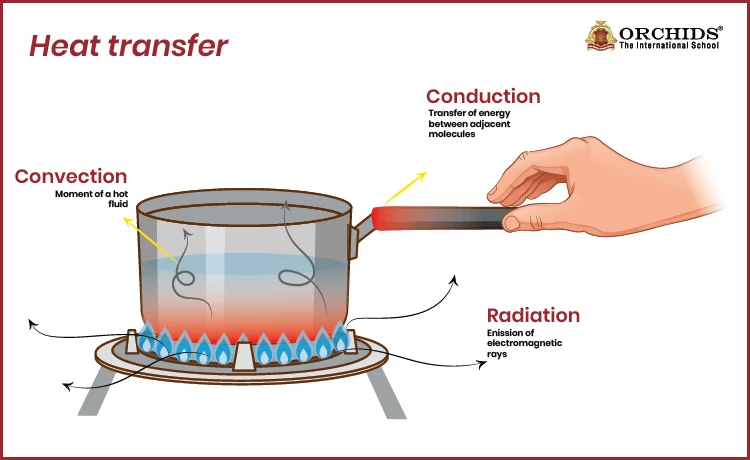
Heat transfer happens everywhere: when you cook food, touch a warm cup, sit under the sun, or when a refrigerator cools your water bottle. Industries also rely on heat transfer to run machines, power plants, chemical processes, and even cool electronic devices.
So, heat flows from hot to cold until both reach the same temperature, creating a balance. This idea forms the backbone of many chapters in chemistry.
Relation of heat transfer with Other Chemistry Concepts, that is, heat transfer connects directly with:
- Specific heat capacity
- Latent heat
- Enthalpy
- Endothermic & exothermic processes
- Thermodynamic laws
- Phase transitions
Without heat transfer, we wouldn't be able to explain why ice melts, why water boils, or why your laptop becomes warm while working.
Types of Heat Transfer
Chemistry deals with three main ways in which heat moves. Each happens differently and has its own examples you see daily.
1. Conduction: Heat Through Direct Touch
Conduction happens when heat travels through solids because of direct contact.
The solid doesn’t move; only the energy moves from one particle to the next.
The Conduction Equation is given by:
|
|
How it actually works:
Particles at the hot end vibrate more. They bump into neighbouring particles and pass the energy forward, like a chain reaction.
Examples you already know:
- A metal spoon becomes hot when kept in a hot cup of tea.
- An iron rod in a fire heats from one end to the other.
- Heat is moving from the bottom to the top of a hot cooking pan.
Why metals conduct heat fast:
Metals have free electrons that carry heat quickly. This is why cooking utensils are often metal and often have plastic/wood handles.
2. Convection: Heat Moving in Liquids and Gases
In simple terms, convection is heat transfer through the movement of fluids, that is, liquids and gases.
The Convection Equation is given by:
|
|
How it works:
- Hot liquid/gas becomes lighter and rises.
- Cooler liquid/gas sinks. This continuous motion forms convection currents.
Some Common real-life examples:
- Boiling water: hot water rises, cool water sinks.
- Sea breeze and land breeze.
- Warm air collects near the ceiling while fans push it down.
- Hot air balloons rise due to warm air inside them.
3. Radiation: Heat Transfer Without Any Medium
Radiation sends heat through invisible electromagnetic waves, no matter, no particles, no contact needed. This is the reason we feel heat from the Sun even though space is empty.
The Radiation Equation is given by:
|
|
How radiation works
Every hot object emits energy in the form of waves.These waves carry heat to anything they hit.
Radiation = heat transfer without contact, without a medium, through waves.
Everyday radiation examples:
- Feeling the warmth of the sunlight on your skin
- Feeling heat from a heater or a bonfire, even from far away
- Microwaves heating food
- Heat coming from electric bulbs and geysers
Do you know? Radiation works even in a vacuum, unlike conduction and convection.
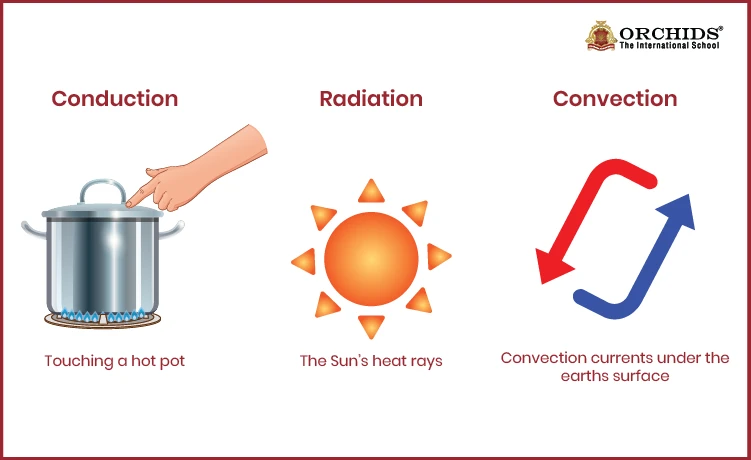
- Simply summarising all the types of heat transfer in one simple illustration below:
Do you know The fact that In the chemistry lab, heat transfer explains: Why do reaction mixtures heat up Why do some reactions cool down Why bomb calorimeters must be insulated
-
Why do reaction mixtures heat up
-
Why do some reactions cool down
-
Why bomb calorimeters must be insulated
Now, let's have a closure on the Units of Heat Transfer
| System | Unit |
| SI System | Joule (J) |
| MKS System | Calorie (cal) |
| Rate of heat transfer | Kilowatt (kW) |
Factors That Affect Heat Transfer
- The temperature difference is calculated by the bigger difference = faster heat transfer
- Surface area that is larger transfers heat faster
- Material type suggests that the metals conduct faster than wood/plastic
- Thickness tells that thicker materials slow heat transfer
- Nature of medium follows solids > liquids > gases (in conduction)
- Colour and texture tell that black & rough surfaces absorb more radiation
Also Read: Heat of Combustion
Uses of Heat Transfer in Real Life and Industries
heat transfer and its types plays a powerful role in everyday life, industries, and scientific research. It helps us cook food, cool machines, run factories, and even study new materials. Here are the major uses:
- Cooking:Heat transfer allows food to cook by moving heat from the stove or flame into the utensils and then into the food. Conduction heats the pan, convection circulates hot air or water, and radiation helps ovens and microwaves cook from a distance.
- Geysers / Water Heaters: Heat from the heating coil transfers to the water, and convection currents spread the heat throughout the tank so that the entire water becomes evenly hot.
- Refrigerators and Air Conditioners: These devices work by removing heat from inside and releasing it outside. Heat transfer through coils and refrigerants keeps food fresh and rooms cool.
- Room Heaters: Heaters warm the air around them, and this warm air spreads across the room through convection. Radiant heaters also send heat directly to people and objects without touching them.
- Power Plants: Power generation depends on heat transfer. Fuel combustion heats water to create steam, and the movement of this heat through boilers and heat exchangers makes turbines rotate and produce electricity.
- Chemical Reactors: Industrial chemical processes require strict temperature control. Heat transfer helps maintain safe and efficient reaction conditions by adding or removing heat when needed.
- Food Processing: Heat transfer is used in pasteurisation, sterilisation, baking, freezing, drying, and preserving foods. It ensures safety, taste, and long shelf life.
- Automobile Cooling Systems: Engines produce a lot of heat. Coolants absorb this heat and carry it to the radiator, where heat is released into the air, keeping the engine safe from overheating.
- Smartphone and Laptop Cooling: Electronic devices use heat sinks, cooling fans, and thermal pads to transfer heat away from processors so that the device runs smoothly without heating up.
- Calorimetry in Research Labs: Scientists use heat transfer to measure how much energy is absorbed or released during chemical and physical reactions. This helps in studying reaction behavior and energy requirements.
- Thermal Analysis of Materials: New materials are tested by heating and cooling them to check melting point, heat capacity, conductivity, and stability, all depending on heat transfer.
- Studying Reaction Energy Changes: Researchers monitor energy changes in reactions to create better fuels, efficient batteries, improved medicines, and safer industrial processes made possible through accurate heat transfer measurements.
Try These Yourself
|
As we learnt that the heat transfer and its types explains how energy moves in solids, liquids, gases, and even empty space.This knowledge builds a strong base for thermodynamics, calorimetry, energy changes in reactions, and numerical problem-solving, helping you score better and understand the world around you scientifically.
Frequently Asked Questions about Heat Transfer and Its Types
1. What is the most important type of heat transfer?
The most important Heat Transfer process depends on the situation, but radiant heat transfer is often vital because it works even without a medium.
2. What factors affect heat transfer?
Several factors affect Heat Transfer, such as temperature difference, surface area, and the nature of the material. These directly influence how heat and transfer work in each heat transfer type, including radiant heat transfer, which you see in many examples of heat transfer.
3. What is the main purpose of heat transfer?
The main purpose of Heat Transfer is to move energy from a hotter object to a colder one naturally. This explains how heat and transfer support every heat transfer and its type, including radiant heat transfer, and helps us understand everyday examples of heat transfer.
4. What are heat transfers called?
Heat Transfer processes are called conduction, convection, and radiant heat transfer.
Science isn't just a subject, it's the way of seeing the world. Curious how Orchids The International School teaches it that way? Talk to our admissions team.
Admissions Open for 2026-27
What type of concept pages would you prefer?
CBSE Schools In Popular Cities
- CBSE Schools in Bangalore
- CBSE Schools in Mumbai
- CBSE Schools in Pune
- CBSE Schools in Hyderabad
- CBSE Schools in Chennai
- CBSE Schools in Gurgaon
- CBSE Schools in Kolkata
- CBSE Schools in Indore
- CBSE Schools in Sonipat
- CBSE Schools in Delhi
- CBSE Schools in Rohtak
- CBSE Schools in Bhopal
- CBSE Schools in Aurangabad
- CBSE Schools in Jabalpur
- CBSE Schools in Jaipur
- CBSE Schools in Jodhpur
- CBSE Schools in Nagpur
- CBSE Schools in Ahmednagar
- CBSE School In Tumkur











Orchids The International School is one of India's leading chains of CBSE and ICSE schools, with 130+ schools across the country.