

Coal Products: Powering Everyday Life for Class 8
Coal is one of nature’s most valuable gifts to humankind. It has powered homes, industries, and transport systems for hundreds of years. Its existence is just a curious thing to know, which is formed from ancient plants that got buried and compressed under the Earth’s layers. Coal is rich in carbon and energy. It is called a fossil fuel because it formed millions of years ago from once-living matter.
It's a wonder how it not only provides fuel but also yields many useful coal products, such as coke, coal tar, and coal gas, which play a vital role in industries, medicine, and chemical production.
This article focuses on what coal is, how it forms, what its coal products are, and how these substances are used in everyday life and industry.
Table of Contents
- What is Coal?
- Major By-Products of Coal
- Environmental Impact and Clean Coal Technology
- Frequently Asked Questions on Coal Product

What is Coal?
It forms deep under the Earth’s surface from dead plant matter that decayed in swampy, oxygen-poor environments.
The fact that emerges is that over millions of years, pressure and heat turned this plant material into a solid energy source, coal. Because it takes so long to form, it is called a non-renewable resource.
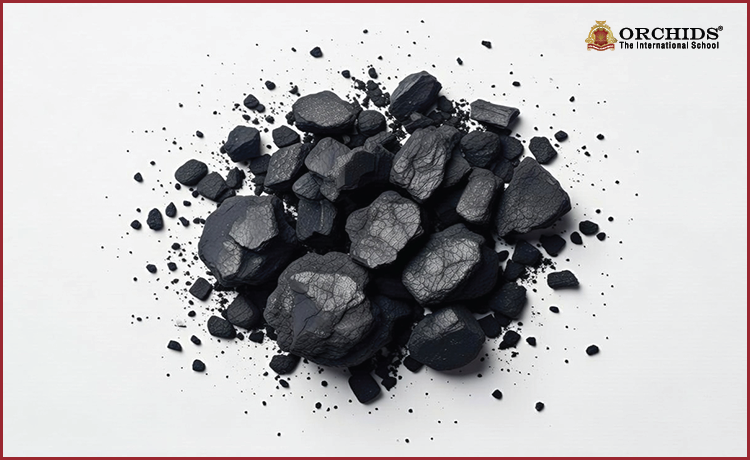
When it comes to its appearance, coal is a black or brownish-black combustible rock made mainly of carbon along with hydrogen, oxygen, nitrogen, and sulfur.
Coal is often found in thick layers called coal seams between sedimentary rocks. The more carbon it has, the more energy it gives when burned.
Major By-Products of Coal
Listed below are coal byproducts :
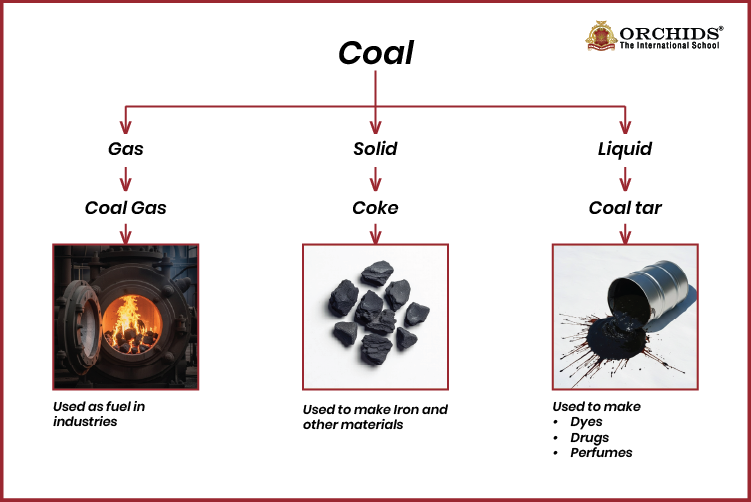
1. Coke and Its Uses
Coke is a strong, porous, grey-black solid obtained by heating coal without air (a process called destructive distillation). It is almost pure carbon and burns with very little smoke.
Uses of Coke:
- It is used in blast furnaces to convert iron ore into iron.
- It acts as a reducing agent in metal extraction.
- It is used in steel production and in industries needing intense heat.
- It serves as a fuel in foundries and domestic heating in some areas.
Fact: Coke produces more heat than the same amount of coal, making it a preferred industrial fuel.
2. Coal Tar and Its Uses
Coal tar is a thick, black liquid with a strong smell, produced along with coke during the distillation of coal. An interesting fact is that it contains hundreds of chemical compounds, many of which are useful raw materials.
Uses of Coal Tar:
- It is useful in making synthetic dyes, perfumes, and paints.
- It helps in producing naphthalene balls, explosives, and disinfectants.
- The products such as in shampoos, soaps, and ointments to treat dandruff and skin diseases.
- It is mainly used in waterproofing and road construction (tar coating).
- As a raw material for creosote and phenol in the chemical industries.
Note: Coal tar must be handled carefully because it contains some toxic compounds.
3. Coal Gas and Its Composition
Coal gas is a mixture of gases obtained when coal is heated in the absence of air. The fact that it is easily recognisable as it is a flammable gas and has a distinctive odour.
Typical Composition:
|
Gas |
Percentage |
Function |
|
Hydrogen (H₂) |
~50% |
Main combustible component |
|
Methane (CH₄) |
~35% |
Adds heating value |
|
Carbon Monoxide (CO) |
~10% |
Combustible, adds energy |
|
Ethylene (C₂H₄) |
~5% |
Aids burning |
Uses of Coal Gas:
- It is used as a fuel for lighting and heating.
- In industrial furnaces and chemical manufacturing, it is mainly used.
- Serves as a raw material for producing methanol and ammonia.
Do you know that in the 19th century, it was commonly used in street lamps before electricity became widespread?
Listed below are the Uses of Coal:
Coal remains an important part of our energy mix due to its wide applications:
- Electricity generation in thermal power plants.
- Steel production using coke in blast furnaces.
- Cement and brick industries as a heat source.
- The chemical industry for producing benzene, phenol, and synthetic fibres.
- Domestic fuel in some rural and cold regions.
- Coal liquefaction and gasification for producing cleaner fuels.
Environmental Impact and Clean Coal Technology
Coal mining and burning release pollutants such as carbon dioxide, sulfur dioxide, and nitrogen oxides, which contribute to air pollution and global warming.
To reduce harm, scientists are developing clean coal technologies like:
- Carbon Capture and Storage (CCS) traps CO₂ before it reaches the atmosphere.
- Fluidised Bed Combustion burns coal efficiently with less smoke.
- Gasification converts coal into cleaner gaseous fuels.
These technologies make coal use more eco-friendly and sustainable.
Below are the Safety and Handling of Coal:
Working with coal requires safety precautions:
- Avoid inhaling coal dust; wear masks in mining areas.
- Store coal in dry, ventilated spaces to prevent fire hazards.
- Handle coal tar carefully to avoid skin irritation.
- Maintain safe distances from open flames during coal gas use.
As the world shifts toward renewable energy like solar and wind, coal’s role is slowly changing. However, it remains vital for many developing countries where it is affordable and accessible. The focus is now on using coal responsibly and efficiently with cleaner technologies, recycling of by-products, and reduced emissions.
As we learned, coal is much more than just a fuel; it is a foundation for many industries and inventions that have shaped human progress. Its by-products, coke, coal tar, and coal gas, show how a single natural resource can lead to multiple useful materials.
Frequently Asked Questions on Coal Product
1. What is the byproduct of coal?
The main Coal byproducts include coal tar, ammonia, and coal gas, which are used in medicines, fertilisers, and dyes. These Coal byproducts make Coal even more valuable for industries.
2. What are the important products of coal?
Coal Products like coke, coal gas, and coal tar are used in power plants, steel industries, and chemical production. These Coal Products show what coal is and how it supports modern life.
3. What byproducts come from coal?
Coal byproducts such as coal tar, benzene, and naphthalene are obtained during coke production. These Coal byproducts highlight what coal is and why coal and petroleum are called fossil fuels.
4. What are the four byproducts of coal?
The four main Coal byproducts are coal gas, coal tar, ammonia liquor, and coke. These Coal byproducts are used in making dyes, plastics, and fuels, which explain what coal is and its importance.
5. Which type of coal produces byproducts?
Bituminous coal produces the most Coal byproducts, like coal tar and coke, during heating. This helps us understand what coal is and why coal and petroleum are called fossil fuels due to their ancient plant.
6. What is Coke, and what are its uses?
Coke is one of the major Coal Products made by heating coal without air. It is used in steel industries and shows what coal is and why coal and petroleum are called fossil fuels, as both are energy-rich carbon sources.
Science isn't just a subject, it's the way of seeing the world. Curious how Orchids The International School teaches it that way? Talk to our admissions team.
Admissions Open for 2026-27
What type of concept pages would you prefer?
CBSE Schools In Popular Cities
- CBSE Schools in Bangalore
- CBSE Schools in Mumbai
- CBSE Schools in Pune
- CBSE Schools in Hyderabad
- CBSE Schools in Chennai
- CBSE Schools in Gurgaon
- CBSE Schools in Kolkata
- CBSE Schools in Indore
- CBSE Schools in Sonipat
- CBSE Schools in Delhi
- CBSE Schools in Rohtak
- CBSE Schools in Bhopal
- CBSE Schools in Aurangabad
- CBSE Schools in Jabalpur
- CBSE Schools in Jaipur
- CBSE Schools in Jodhpur
- CBSE Schools in Nagpur
- CBSE Schools in Ahmednagar
- CBSE School In Tumkur











Orchids The International School is one of India's leading chains of CBSE and ICSE schools, with 110+ schools across the country.