

Understanding Sodium Chloride (NaCl): Composition, Properties, and Uses
Sodium chloride (NaCl), commonly known as table salt, is one of the simplest yet most useful compounds in chemistry. From seasoning food to being an essential raw material in industries, its importance goes far beyond the kitchen.
This article gives a detailed explanation of Sodium Chloride formula, its formation, its physical and chemical properties, and applications in both daily life and industries.
Table of Contents
- Sodium Chloride and Its Formation
- Physical Properties of Sodium Chloride
- Chemical Properties of Sodium Chloride
- Synthesis of Sodium Chloride
- Uses of Sodium Chloride
- Frequently Asked Questions on Sodium Chloride

Sodium Chloride and its Formation
Sodium chloride is an ionic compound produced when sodium (Na) and chlorine (Cl) combine. Interestingly!! It naturally occurs as the mineral halite and constitutes a large percentage of sea salt.
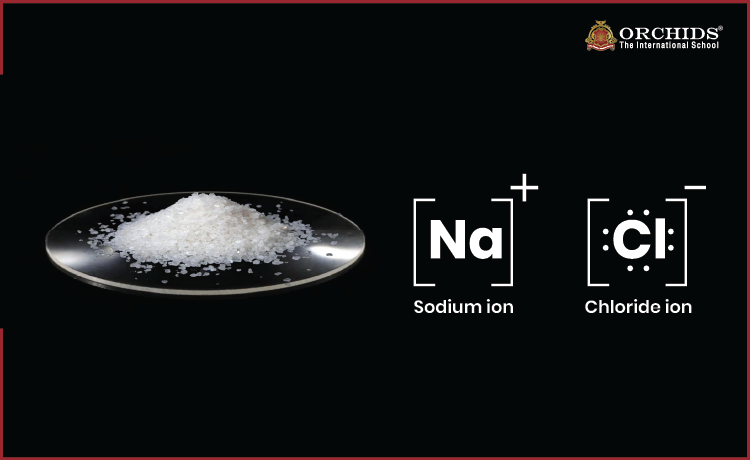
It dissociates into sodium (Na⁺) and chloride (Cl⁻) ions in water, both of which are necessary for bodily functions such as the transmission of nerve signals, maintaining fluid balance, and muscle contraction.
Physical Properties of Sodium Chloride
|
Property |
Description |
|
Appearance |
White crystalline solid, usually cube-shaped |
|
Taste |
Typical salty flavour |
|
Solubility |
Highly soluble in water |
|
Density |
~2.16 g/cm³ |
|
Melting Point |
~801°C |
|
Boiling Point |
~1413°C |
|
Structure |
A crystalline cubic lattice, which gives strength and hardness |
Chemical Properties of Sodium Chloride
- Sodium Chloride remains stable under normal conditions
- It conducts electricity only when molten or dissolved in water (due to free ions)
- NaCl is Neutral in nature (pH ~7)
- NaCl Reacts with concentrated H₂SO₄ to form hydrogen chloride gas
- It can be electrolysed to give sodium hydroxide, chlorine, and hydrogen gas.
Let's now see how its formation takes place!!
Synthesis of Sodium Chloride
Depending on the purpose, whether for laboratory experiments, large-scale industry, or everyday use, different methods are used to obtain pure sodium chloride.
1. In the lab, sodium chloride is usually prepared through reactions between acids and bases. These methods help students and chemists understand how salts are formed.
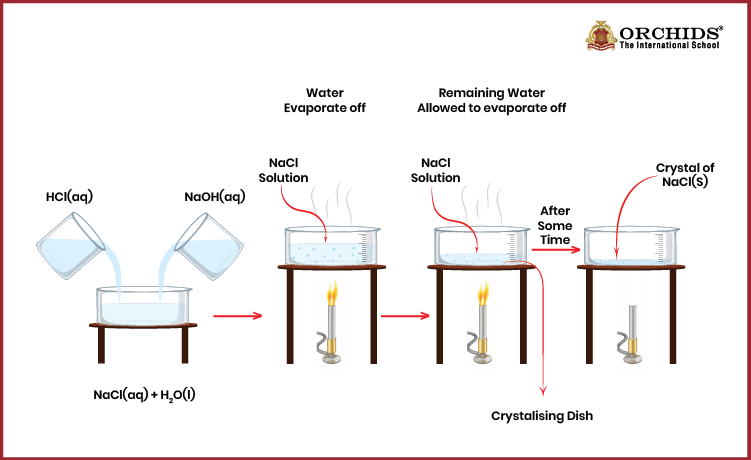
From Hydrochloric Acid and Sodium Hydroxide
Sodium hydroxide reacts with hydrochloric acid to form sodium chloride and water:
From Hydrochloric Acid and Sodium Bicarbonate
Sodium bicarbonate reacts with hydrochloric acid to produce sodium chloride, water, and carbon dioxide:
After either reaction, the mixture is evaporated to leave behind pure sodium chloride crystals.
2. Direct Synthesis, where Sodium metal is highly reactive, and chlorine gas is a poisonous gas. Under controlled conditions, they combine directly to form sodium chloride:
This shows how two dangerous elements form a stable, edible compound. However, due to safety risks, this method is not widely used outside controlled industrial setups.
3. In industries, sodium chloride is produced in bulk, mainly for commercial and food use. The two main methods are:
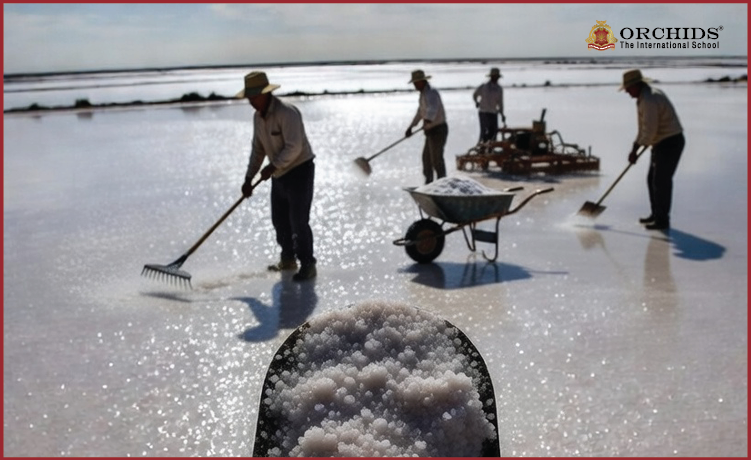
- Evaporation of Seawater (Brine)where seawater is left in shallow ponds where sunlight evaporates the water, leaving behind sodium chloride crystals.
- Mining Rock Salt (Halite) wherever rock salt deposits are mined, crushed, dissolved in water, purified, and then crystallised again to yield pure NaCl.
4. Purification of Sodium Chloride involves the crude salt from seawater or rock mines often contains impurities such as magnesium chloride, calcium sulfate, or clay.
To make it safe and pure, the following steps are followed:
- Dissolving the crude salt in water
- Filtering insoluble impurities
- Re-crystallising pure NaCl
Let's discuss its common uses:
Uses of Sodium Chloride
Sodium Chloride is a common and important compound because of its everyday uses:
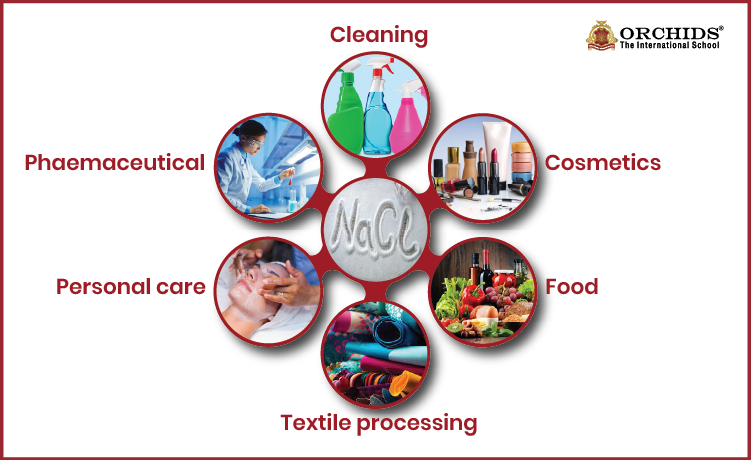
1. Domestic Uses
- Used as table salt to season food
- Sodium Chloride examples: Saves food products such as pickles, fish, and meat by inhibiting bacterial growth
2. Biological Significance
- Sustains electrolyte balance and hydration
- Essential for the transmission of nerve impulses
- Controls the contraction and relaxation of muscle
- Helps in blood pressure regulation
3. Industrial Applications
- Sodium Chloride examples are utilised to produce caustic soda (NaOH), hydrochloric acid, and chlorine gas
- Is involved in soap, detergent, glass, and textile production
- Used in the paper and leather industries
- It is used in water treatment and purification
Know More: Calcium and Ammonium Chloride
Common Misconceptions related to Sodium Chloride
- "Salt and Sodium are the same"
Sodium is a reactive metal, but sodium chloride is a stable compound. For nutrition, "sodium" is used to describe the sodium in salt, not pure sodium.
- "All salts are sodium chloride"
In chemistry, salt is a generic term for compounds produced from acids and bases. NaCl is merely the most common and well-known salt.
- "Sea salt and table salt are completely different"
Both are chemically NaCl. Sea salt might have trace minerals in it, and table salt is refined and then iodised, but still, the basic compound is the same.
- "Sodium chloride is toxic and must be avoided"
NaCl is critical to body processes such as fluid balance and nerve impulses. The danger exists only from overconsumption, not from regular use.
We learned that Sodium chloride, or salt, is a compound with extraordinary uses. Its exceptional properties make it necessary in homes, industries, and everywhere. Through studying its origin, properties, and use, we learned how this plain white crystal enhances humanity's survival and contemporary progress.
Frequently Asked Questions on Sodium Chloride
1. What is Sodium Chloride?
Sodium chloride is a chemical compound made of sodium and chlorine. It is commonly known as table salt and is essential for both food and industry.
2. What is the Sodium Chloride formula?
The sodium chloride formula is NaCl. It shows that one sodium atom bonds with one chlorine atom to form this stable compound.
3. Can you give some Sodium Chloride examples?
Yes, examples of sodium chloride include table salt used in cooking, sea salt from seawater, and rock salt mined from underground deposits.
4. Why is sodium chloride required?
Sodium chloride is required to maintain body fluid balance, support nerve signals, and add flavour to food. It also plays a key role in industrial processes.
5. What are 5 uses of sodium chloride?
Sodium chloride is used in cooking, food preservation, medicine (saline solutions), road de-icing, and as a raw material in chemical industries.
6. What is the common name for sodium chloride?
The common name for sodium chloride is table salt. It is the same salt that we use daily in food and cooking.
7. Is sodium chloride acidic or basic?
Sodium chloride is neither acidic nor basic. It is a neutral salt formed from the reaction of a strong acid and a strong base
Science isn't just a subject, it's the way of seeing the world. Curious how Orchids The International School teaches it that way? Talk to our admissions team.
Admissions Open for 2026-27
What type of concept pages would you prefer?
CBSE Schools In Popular Cities
- CBSE Schools in Bangalore
- CBSE Schools in Mumbai
- CBSE Schools in Pune
- CBSE Schools in Hyderabad
- CBSE Schools in Chennai
- CBSE Schools in Gurgaon
- CBSE Schools in Kolkata
- CBSE Schools in Indore
- CBSE Schools in Sonipat
- CBSE Schools in Delhi
- CBSE Schools in Rohtak
- CBSE Schools in Bhopal
- CBSE Schools in Aurangabad
- CBSE Schools in Jabalpur
- CBSE Schools in Jaipur
- CBSE Schools in Jodhpur
- CBSE Schools in Nagpur
- CBSE Schools in Ahmednagar
- CBSE School In Tumkur











Orchids The International School is one of India's leading chains of CBSE and ICSE schools, with 130+ schools across the country.