

Sulphur: Occurrence, Properties and Uses Explained
Ever noticed that shining yellow powder in matchsticks or firecrackers? That's sulphur, a plain-looking non-metal but with a very interesting property for serving in many roles. It comes in multiple physical states known as allotropes. Imagine sulphur wearing various forms, each with a unique style and characteristics.
This article provides detailed insights into Sulphur properties, allotropes and chemistry behind it , explained in structured and defined way.
Table of Contents
- Must-Know Facts About Sulphur!
- What is Sulphur
- Physical and Chemical Properties of Sulphur
- Applications of Sulphur
- Frequently Asked Questions on Sulphur

Must-Know Facts About Sulphur!
|
What is Sulphur
Sulphur is a yellow, non-metallic element found in nature, known for its distinct smell (like rotten eggs when it forms hydrogen sulphide gas). It is represented by the chemical symbol S and has an atomic number of 16.

Physical and Chemical properties of Sulphur
|
Property |
Details |
|
Symbol |
S |
|
Atomic Number |
16 |
|
Atomic Mass |
32.06 |
|
Group / Period |
16 / 3 |
|
Block |
p |
|
State at 20°C |
Solid |
|
Melting Point |
97.8 °C |
|
Boiling Point |
883 °C |
|
Density (g/cm³) |
0.97 |
|
Electron Configuration |
[Ne] 3s² 3p⁴ |
|
Key Isotopes |
³³S, ³⁴S |
It is Brittle, non-metallic, insoluble in water, but burns with a blue flame, producing sulphur dioxide.
The two most well-known types are:
- Rhombic sulphur (α-sulphur) is the peaceful, steady version you experiment with in labs.
- Monoclinic sulphur (β-sulphur), the dramatic one that materialises only under conditions of heat.
Rhombic Sulphur (α-Sulphur)
Rhombic sulphur, also known as octahedral sulphur, is the default sulphur form. It is the stable form at room temperature and is typically what is bottled up in school chemistry labs.
Key Highlights:
|
Property |
Rhombic Sulphur (α-Sulphur) |
|
Appearance |
Pale yellow crystals, small pyramidal shape |
|
Density |
Approximately 2.06 g/cm³, denser than monoclinic sulphur |
|
Stability |
Does not change shape until heated past 96°C |
|
Solubility |
Insoluble in water but dissolves easily in carbon disulfide (CS₂) |
Fun Fact:
If you sprinkle "flowers of sulphur" in your hand, you're essentially holding small rhombic sulphur crystals!
Monoclinic Sulphur (β-Sulphur)
Monoclinic sulphur, or prismatic sulphur, is the wild one. It develops long, needle-shaped crystals and only feels at ease at higher temperatures.
Key Highlights:
|
Property |
Monoclinic Sulphur (β-Sulphur) |
|
Appearance |
Shiny, pale yellow needles, nearly like mini icicles |
|
Density |
1.98 g/cm³, slightly lighter than rhombic sulphur |
|
Stability |
Stable only from 96°C to 119°C; cool it down, and it gradually reverts to rhombic sulphur |
|
Formation Trick |
Developed when molten sulphur cools slowly, usually in lab experiments |
Fun Fact: If ever you cool molten sulphur in a dish and patiently wait, gorgeous monoclinic crystals form but leave them overnight, and they somehow reconvert into rhombic sulphur!
Have you ever wondered how the Interconversion of Sulphur Allotropes takes place?
Interestingly, Sulphur prefers shape-shifting according to temperature:
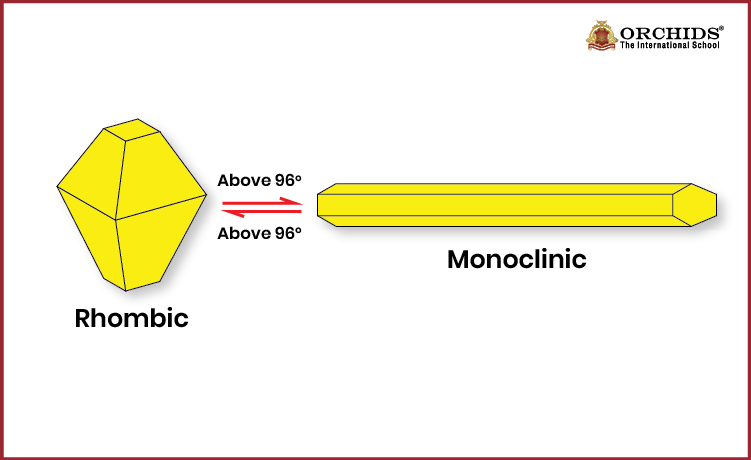
- Rhombic → Monoclinic: Heating above 96°C.
- Monoclinic → Rhombic: Cooling below 96°C.
That simple temperature trick is the reason sulphur is a classic allotropy textbook example, ideal for chemistry demonstrations!
Combustion of sulphur:
Sulphur burns in oxygen to give sulphur dioxide (acidic oxide).
Oxidation of sulphur dioxide (Contact Process step):
is oxidized to SOA3 (vanadium(V) oxide commonly used as catalyst).
Formation of sulphuric acid:
Sulphur trioxide reacts with water to produce sulphuric acid.
Reaction with hydrogen:
Hydrogen combines with sulphur to form hydrogen sulphide (toxic, rotten-egg odour).
Reaction with metals (formation of metal sulphides):
Sulphur reacts with metals to form metal sulphides (combination reaction).
Reaction with chlorine:
Sulphur reacts with chlorine to give sulphur dichloride (a halide of sulphur).
Applications of Sulphur
Sulphur looks like a meek yellow powder, but it's a closet multi-tasker industrial superstar.
- Production of Sulphuric Acid (H₂SO₄), the "king of chemicals", begins with sulphur!
- In Vulcanisation of Rubber, sulphur hardens and elongates rubber, which is used for tyres and conveyor belts.
- Have you noticedthat sudden flame and odour in matchsticks? All thanks to sulphur, it plays a great role in fireworks and matches.
- Medicines and Skin Care are employed in ointments, shampoos, and antibiotics to combat infection.
As we learned, Sulphur can seem like a normal yellow powder, but its chemistry is a story to tell. Being able to change allotrope and perform numerous industrial and agricultural functions, it shows how one non-metal can influence our daily lives.
Frequently Asked Questions on Sulphur
1. Mention 5 interesting facts about sulphur?
Sulphur is yellow, pure and odourless, and crystallises into beautiful crystals. It's vital to life, fireworks, fertilisers, and even skincare.
2. What is sulphur used for?
Sulphur is a behind-the-scenes hero in fertilisers, matches, fireworks, and rubber-making. It keeps industries, farming, and even the medical world ticking over.
3. Mention any three roles of sulphur?
Sulphur nourishes crops, hardens rubber through vulcanisation, and fights fungi in agriculture and skin infection in medicine.
4. What is the principle of sulphur?
The principle is that it is versatile, forms numerous compounds, alters allotropes with temperature, and ignites significant industrial and biological reactions.
5. Why does sulphur change shape?
Sulphur enjoys "shape-shifting" because its molecules change with temperature, providing us with rhombic at room temperature and monoclinic when heated.
6. Is sulphur safe to use daily?
Yes, in moderated quantities! It's employed in food preservatives, cosmetics, and farming, but raw handling must be cautious because of fumes and powders.
Science isn't just a subject, it's the way of seeing the world. Curious how Orchids The International School teaches it that way? Talk to our admissions team.
Admissions Open for 2026-27
What type of concept pages would you prefer?
CBSE Schools In Popular Cities
- CBSE Schools in Bangalore
- CBSE Schools in Mumbai
- CBSE Schools in Pune
- CBSE Schools in Hyderabad
- CBSE Schools in Chennai
- CBSE Schools in Gurgaon
- CBSE Schools in Kolkata
- CBSE Schools in Indore
- CBSE Schools in Sonipat
- CBSE Schools in Delhi
- CBSE Schools in Rohtak
- CBSE Schools in Bhopal
- CBSE Schools in Aurangabad
- CBSE Schools in Jabalpur
- CBSE Schools in Jaipur
- CBSE Schools in Jodhpur
- CBSE Schools in Nagpur
- CBSE Schools in Ahmednagar
- CBSE School In Tumkur











Orchids The International School is one of India's leading chains of CBSE and ICSE schools, with 130+ schools across the country.