

Non-Metals: Properties, Uses, and Importance Explained
Non-metals are one of the most interesting groups of elements because they behave very differently from metals. Unlike metals, they do not shine, do not conduct electricity well, and many of them exist as gases around us. Interestingly, Non-metals are essential to life. Oxygen helps us breathe, carbon forms the backbone of living organisms, and nitrogen enriches the air.
This article focuses on what non-metals are, their unique properties, types, chemical behaviour in chemistry, and their wide uses in daily life and industries.
Table of Contents
- What Are Non-Metals?
- Physical Properties of Non-Metals
- Chemical Properties of Non-Metals
- List of Non-Metals
- Uses of Non-Metals
- Frequently Asked Questions on Non-Metals

What Are Non-Metals?
Non-metals are elements that form negative ions by gaining or accepting electrons. They usually have 4, 5, 6, or 7 electrons in their outermost shell, which makes them eager to complete their octet by attracting electrons.
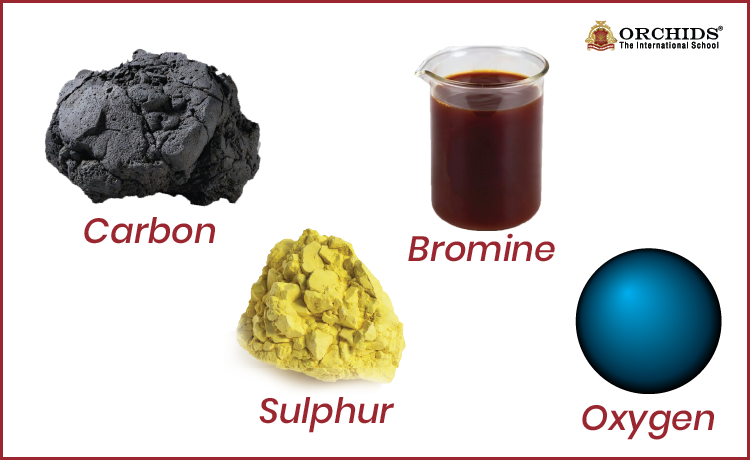
The fact that they do not show metallic properties such as lustre, malleability, or electrical conductivity. Many non-metals exist as gases, a few as solids, and only one, bromine a liquid. Their low density, low melting points, and weak physical structure set them apart from strong, shiny metals.
Let's have a closure on how the properties of non-metals differ from metals.
Physical Properties of Non-Metals
Nonmetals vary at each State at Room Temperature, according to the observation:
- Many non-metals are gases: Oxygen, nitrogen, chlorine, and fluorine.
- A few are solids: Carbon, sulphur, phosphorus, iodine.
- Only one is liquid: Bromine.
- They exhibit Low Melting and Boiling Points, which is typical of most non-metals, as their atoms are loosely bonded.
- Mostly Solid non-metals break easily; they are brittle, not malleable or ductile.
- Non-metals are Poor Conductors as they do not conduct heat or electricity, except graphite, which is a good conductor.
- They exhibit a lack of lustre as they are generally dull, except iodine, which has a slight shine.
- They do not produce ringing sounds when hit, so they are considered to be non-sonorous.
Apart from them, Non-metals show certain characteristics that make them unique:
1. Non-metals strongly attract electrons toward themselves, which is because of their High Electronegativity. This is why they easily gain electrons during reactions.
2. They require a lot of energy to remove an electron, which means they prefer gaining electrons instead of losing them because of High Ionisation Energy.
3. Most non-metals have smaller atoms, leading to a stronger electron-pulling ability, that is Smaller Atomic Size and decrease in atomic radius.
4. Nonmetals tend to Form Covalent Bonds, which is instead of giving or taking electrons like metals, nonmetals often share electrons, forming covalent compounds.
Chemical Properties of Non-Metals
1. Reaction with Water Non-metals do not react with water directly.
However, some reactive non-metals like phosphorus are stored in water to prevent them from catching fire in the air.
2. Reaction with Acids Non-metals generally do not react with acids.
3. Reaction with BasesSome non-metals react with strong bases.
Example: Chlorine + Sodium Hydroxide → Sodium Hypochlorite + Sodium Chloride + Water
4. Reaction with OxygenNon-metals produce acidic or neutral oxides when burned.
Example:
Sulphur + Oxygen → Sulphur Dioxide
5. Reaction with Metals Non-metals react with metals to form ionic compounds.
Example:
List of Non-Metals
|
Non-metal |
State at Room Temperature |
Symbol |
|
Hydrogen |
Gas |
H |
|
Nitrogen |
Gas |
N |
|
Oxygen |
Gas |
O |
|
Fluorine |
Gas |
F |
|
Chlorine |
Gas |
Cl |
|
Bromine |
Liquid |
Br |
|
Iodine |
Solid |
I |
|
Carbon |
Solid |
C |
|
Sulphur |
Solid |
S |
|
Phosphorus |
Solid |
P |
|
Silicon* |
Solid |
Si |
*Silicon is technically a metalloid but often studied with non-metals.
Uses of Non-Metals
Non-metals play a huge role in our lives:
1. Oxygen isused for breathing, medical support, industrial combustion, and welding.
2. Nitrogenisused in fertilisers, food packaging, and to create inert atmospheres.
3. Carbon forms the basis of life found in fuels, diamonds, pencils (graphite), and steel-making.
4. Sulphur is used in medicines, rubber vulcanisation, and making sulphuric acid.
5. Hydrogen is used as a clean fuel, in ammonia production, and in space rockets.
6. Chlorine & Iodine are used in water purification, antiseptics, and disinfectants.
We have learned that Non-metals may seem simple, but they play some of the most important roles in nature and industry. From helping us breathe to forming life-supporting compounds, non-metals are essential to our everyday existence.
Frequently Asked Questions on Non-Metals
1. What are non-metals used in everyday life?
Non-metals help us breathe (oxygen), cook and clean (chlorine), and stay healthy through medicines and antiseptics. When learning what is non metal, these daily uses show how important examples of non-metals are in our lives.
2. Which non-metal is known as the most essential for life?
Oxygen is the non-metal most essential for breathing and supporting life on Earth. In the study of metals and non-metals, oxygen becomes one of the most meaningful examples of non-metals.
3. How do non-metals react with water?
Most nonmetals do not react directly with water, but some, like phosphorus, are kept in water because they react with air. This behaviour helps students understand what non-metals are and how metals and non-metals behave differently.
4. What makes non-metals brittle?
Non-metals are brittle because their atoms are loosely bonded, so they break instead of bending. This property clearly separates metals and non-metals, and is why examples of non-metals like sulphur crumble easily.
5. Which non-metal is shiny?
Iodine is the only non-metal that looks shiny even though it is not a metal. It is one of the best examples of non-metals that helps students understand what is non metal through its unique appearance.
6. Why are non-metals weak?
Non-metals are weak because their particles are not packed tightly, making them soft or brittle. When comparing metals and non-metals, this weakness is a key feature that helps define what a non-metal is.
7. Which non-metal is strong?
Carbon in the form of diamond is the strongest non-metal known, even stronger than many metals. This makes diamond one of the most surprising examples of non-metals students learn while understanding what is non metal.
Science isn't just a subject, it's the way of seeing the world. Curious how Orchids The International School teaches it that way? Talk to our admissions team.
Admissions Open for 2026-27
What type of concept pages would you prefer?
CBSE Schools In Popular Cities
- CBSE Schools in Bangalore
- CBSE Schools in Mumbai
- CBSE Schools in Pune
- CBSE Schools in Hyderabad
- CBSE Schools in Chennai
- CBSE Schools in Gurgaon
- CBSE Schools in Kolkata
- CBSE Schools in Indore
- CBSE Schools in Sonipat
- CBSE Schools in Delhi
- CBSE Schools in Rohtak
- CBSE Schools in Bhopal
- CBSE Schools in Aurangabad
- CBSE Schools in Jabalpur
- CBSE Schools in Jaipur
- CBSE Schools in Jodhpur
- CBSE Schools in Nagpur
- CBSE Schools in Ahmednagar
- CBSE School In Tumkur











Orchids The International School is one of India's leading chains of CBSE and ICSE schools, with 130+ schools across the country.