

Argon
When we think about gases in the air, oxygen and nitrogen often come to mind. But did you know there’s another gas quietly present around us that makes up almost 1% of our atmosphere? That gas is Argon. It doesn’t react, it doesn’t burn, and it doesn’t even have a smellbut it plays a huge role in science, technology, and industry.
This article provides comprehensive information on Argon, including its properties, uses, and more, presented in a structured and easy-to-understand manner.
Table of Contents
- Must-Know Facts About Argon
- Argon in Chemistry
- Chemical Properties of Argon
- Uses of Argon
- Frequently Asked Questions on Argon

Must-Know Facts About Argon!
|
Argon in Chemistry
Argon is a noble gas with the symbol Ar and atomic number 18. It belongs to Group 18 of the periodic table, where all the unreactive gases like helium, neon, and krypton are found.
It makes up about 0.93% of the Earth’s atmosphere, which may not sound like much, but that actually makes it the third most common gas after nitrogen and oxygen.
Because it is chemically stable, argon doesn’t easily combine with other elements, making it perfect for creating environments where reactions must be prevented.
When we talk about the Electron Configuration of Argon, it has 18 electrons arranged in shells as 2, 8, 8:
- First shell: 2 electrons
- Second shell: 8 electrons
- Third shell: 8 electrons
That is the third shell is the outermost shell (valence shell), and it is full with 8 electrons.
The fact that atoms are most stable when their outer electron shell is full. Since argon already has a full valence shell, it doesn’t need to gain, lose, or share electrons, making it chemically inert.
This is why argon rarely forms compounds under normal conditions, it’s content with its electron arrangement.
In short: Argon’s full outer shell = stability = unreactive gas.
In its natural state, argon is:
- Colorless
- Odorless
- Tasteless
- Non-toxic
Argon possesses some Physical properties which easily help them to identify it!!
|
Property |
Value |
|
Symbol |
Ar |
|
Atomic Number |
18 |
|
Atomic Mass |
39.95 u |
|
State at Room Temperature |
Gas |
|
Density |
1.784 g/L (slightly heavier than air) |
|
Melting Point |
–189.3 °C |
|
Boiling Point |
–185.8 °C |
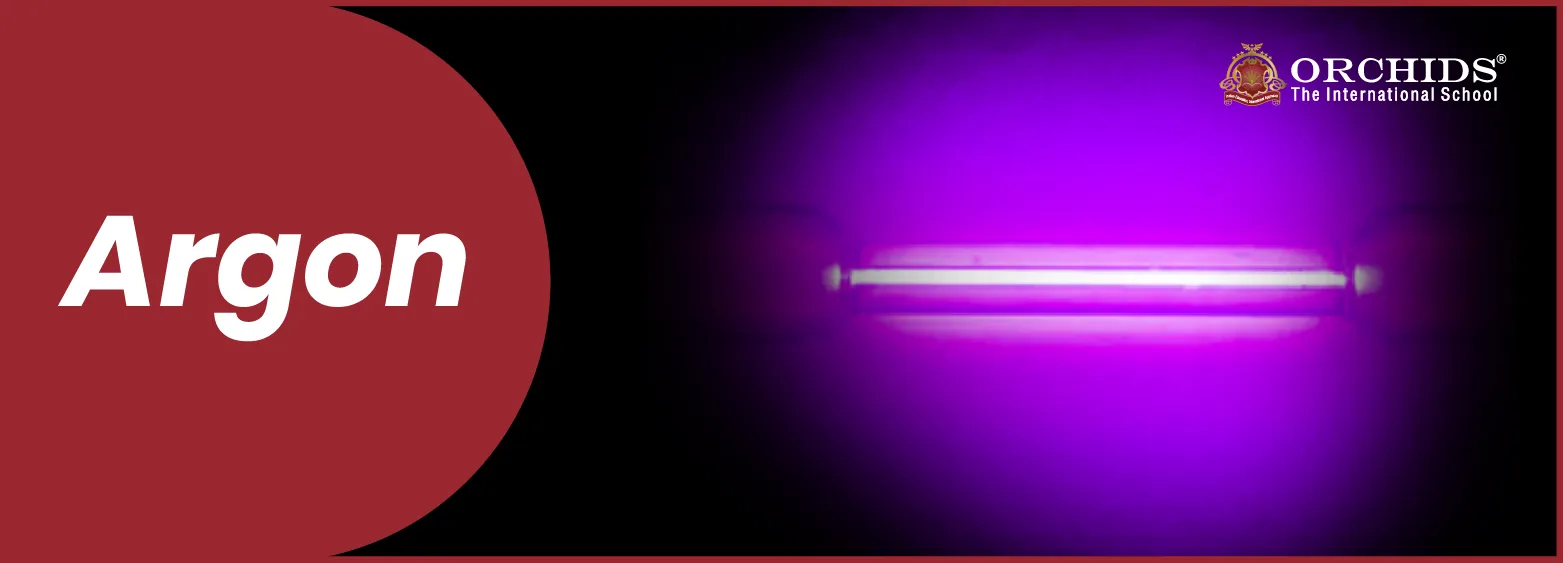
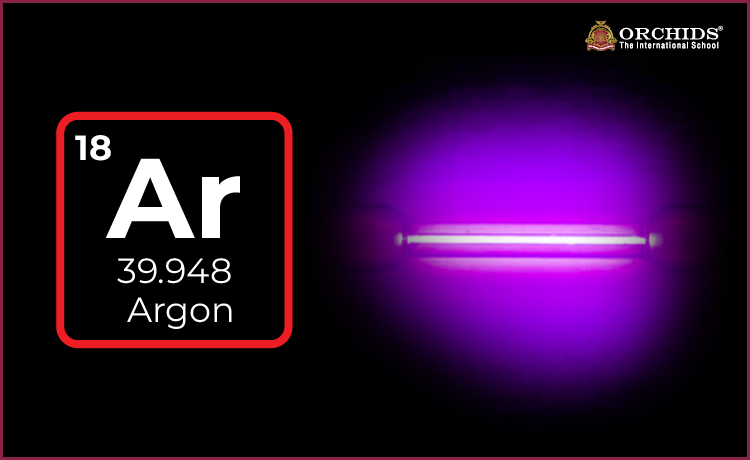
Do you know? Argon is heavier than air, so in closed spaces, it can replace oxygen. Although it is invisible to the eye, it glows a bluish-violet colour when electricity passes through it.
Let's Learn About Isotopes of Argon
Argon exists in nature in three stable isotopes: Ar-36, Ar-38, and Ar-40. Among them, Argon-40 is the most abundant and makes up about 99.6% of natural argon.
Fun fact: Ar-40 is formed from the radioactive decay of potassium-40, which is why argon accumulates inside rocks and minerals.
Chemical Properties of Argon
- Argon is chemically inert, meaning it does not easily react.
- It is non-reactive in nature because it already has a stable electron arrangement.
- Argon does not burn and does not support burning (no combustion).
- In extreme laboratory conditions, scientists have managed to create a few unstable argon compounds, but they break down quickly because they exist rarely.
This chemical inactivity is exactly why argon is so valuable in science and industry.
Uses of Argon
Even though argon seems like a “lazy” gas, it has a wide range of uses:
- Argon provides a protective atmosphere during welding, preventing metals from reacting with oxygen or moisture.
- Argon is filled inside light bulbs to stop the tungsten filament from degrading. It also produces a bluish glow in neon lights.
- Argon plays a major role in Preservation, which is used to preserve historical documents, fine wines, and artworks by keeping oxygen away.
- In Medical Treatments, Argon lasers are used in eye surgeries and cryosurgery to remove cancerous or damaged tissues.
- In the Electronics Industry, Argon is essential in semiconductor manufacturing and for creating controlled, oxygen-free environments.
We came to know that Argon might seem “invisible” and “inactive,” but its role in our world is far from small. From welding and preserving valuable artefacts to helping doctors perform advanced surgeries, argon quietly supports modern life. Its unreactive nature makes it reliable and safe for countless applications.
Frequently Asked Questions on Argon
1. What is the argon atomic number?
The argon atomic number is 18, which means it has 18 protons in its nucleus. This number defines its identity as the noble gas argon.
2. What is the atomic mass of argon?
The atomic mass of argon is about 39.95 u, showing the average weight of all its naturally occurring isotopes.
3. What is the atomic number of argon?
The atomic number of argon is 18, and this is what places it in Group 18 of the periodic table among the noble gases.
4. What is the importance of argon?
Argon is widely used in light bulbs, welding, and preserving historical documents because it doesn’t react easily with other elements.
5. What is the formula for argon?
The formula for argon is simply Ar, since it exists as a single atom and does not usually combine with others.
6. What are 5 interesting facts about argon?
Argon makes up about 1% of Earth’s atmosphere, is colourless and odourless, glows violet in electric discharge, is heavier than air, and was discovered in 1894.
7. Can argon react with anything?
Under normal conditions, argon does not react because of its full electron shell, but in extreme lab conditions, rare compounds can be made.
8. Why is argon considered stable?
Argon is considered stable because its outer electron shell (2,8,8) is filled, making it naturally unreactive.
Science isn't just a subject, it's the way of seeing the world. Curious how Orchids The International School teaches it that way? Talk to our admissions team.
Admissions Open for 2026-27
What type of concept pages would you prefer?
CBSE Schools In Popular Cities
- CBSE Schools in Bangalore
- CBSE Schools in Mumbai
- CBSE Schools in Pune
- CBSE Schools in Hyderabad
- CBSE Schools in Chennai
- CBSE Schools in Gurgaon
- CBSE Schools in Kolkata
- CBSE Schools in Indore
- CBSE Schools in Sonipat
- CBSE Schools in Delhi
- CBSE Schools in Rohtak
- CBSE Schools in Bhopal
- CBSE Schools in Aurangabad
- CBSE Schools in Jabalpur
- CBSE Schools in Jaipur
- CBSE Schools in Jodhpur
- CBSE Schools in Nagpur
- CBSE Schools in Ahmednagar
- CBSE School In Tumkur











Orchids The International School is one of India's leading chains of CBSE and ICSE schools, with 110+ schools across the country.