

Boron
Boron is an interesting element that bridges the gap between metals and non-metals in the periodic table. Represented by the symbol B and having an atomic number of 5, boron is small but incredibly useful. Interestingly, it occurs naturally in minerals like borax and kernite and is widely applied in making glass, ceramics, detergents, and fertilisers.
This article provides insight into what boron is, along with its structure, properties, and key reactions that explain its behaviour in chemistry and its wide-ranging applications in everyday life.
Table of Contents
- Must-Know Facts About Boron
- What is Boron?
- Properties of Boron
- Uses of Boron
- Frequently Asked Questions on Boron

Must Know Facts About Boron
- Boron exists in over 100 minerals, including borax and kernite.
- It’s the only non-metal in Group 13.
- Boromycin, a boron-based compound, is a natural antibiotic.
- Boron carbide is one of the hardest materials after diamond.
- Trace amounts of boron support bone and brain health in humans.
What is Boron?
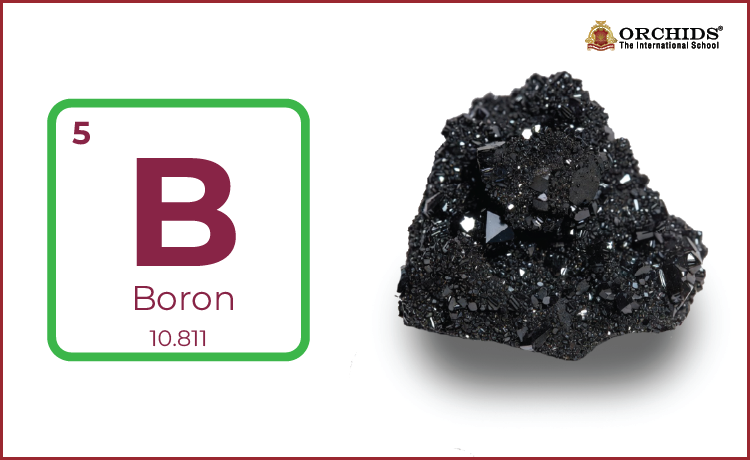
When it comes to its history, it was discovered in 1808 by Joseph Louis Gay-Lussac and Louis Jacques Thénard. Boron is known for its hardness, stability, and resistance to heat. In its pure crystalline form, it appears black and shiny, while amorphous boron is brown and powdery.
Many find confusion related to “Is boron a metalloid ?”
In chemical terms, Boron is a metalloid element that shows properties of both metals and non-metals. It is not found freely in nature but occurs in compounds such as borates.
Let's Discuss the Structure of Boron :
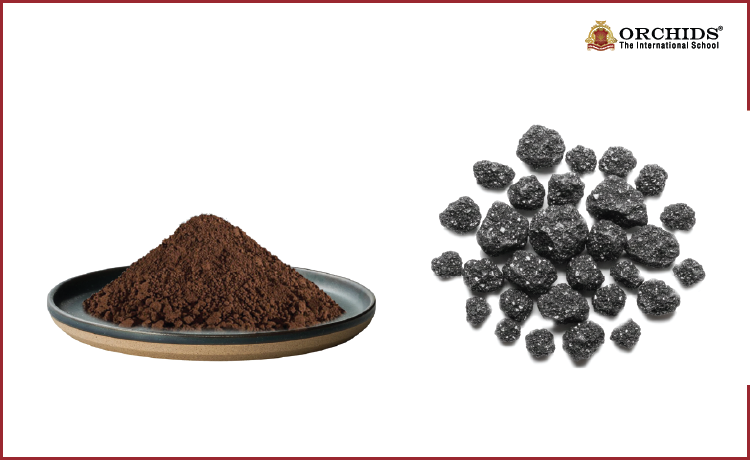
Boron exists in amorphous and crystalline forms:
-
Amorphous Boron is a Brown powder, non-reactive with oxygen, water, or acids.
-
Crystalline Boron is a Hard, shiny black solid with a three-dimensional covalent network.
This structure gives boron exceptional hardness and thermal stability, making it useful in boron carbide (B₄C) and boron nitride (BN) materials stronger than steel and resistant to heat.
Boron shows properties that identify it among other elements.
Next, the Boron family (Group 13), which includes B, Al, Ga, In, Tl, and Nh.
Also, students can refer to aluminium, the next member of the boron family.
Properties of Boron
The most interesting thing about Boron is because of its strong covalent bonding and rigid lattice structure, boron has an exceptionally high melting point and low electrical conductivity, distinguishing it from metals in the same group.
Apart from it :
-
It exhibits a +3 oxidation state and forms mainly covalent compounds.
-
It reacts with oxygen to form boron trioxide (B₂O₃).
-
When it combines with halogens to produce boron trihalides (BX₃).
-
Generally, boron is unreactive to acids and alkalis at room temperature.
-
It forms borides with metals and borates with oxygen-containing compounds.
-
It shows electron deficiency, making its compounds strong Lewis acids.
Uses of Boron
-
In the Glass and Ceramic industry, it is used in borosilicate glass (Pyrex) to resist heat and chemical corrosion.
-
Majorly in Detergents and Cleaners, Compounds like borax and sodium perborate serve as bleaching and cleaning agents.
-
In the Agriculture sector, it acts as a micronutrient for plants, helping in cell wall formation and nutrient absorption.
-
When it comes to Electronics, Doped boron is used in semiconductors and transistors for modern electronic devices.
Apart from it, Boron plays an important role in Biological aspects. Although required in trace amounts, boron plays a vital biological role, like:
-
In plants, it helps in cell wall strength and nutrient transport.
-
In humans, it supports bone metabolism and brain function.
-
Found naturally in fruits, nuts, and leafy vegetables.
So far, we have come across how Boron is truly a unique element, strong, stable, and versatile. From heat-resistant glass and fertilisers to semiconductors and superconductors, its applications bridge the gap between chemistry and technology.
Frequently Asked Questions on Boron
1. What is Boron?
Boron is a chemical element with the symbol B and atomic number 5. It’s a versatile element found in minerals like borax and used in glass, fertilisers, and semiconductors.
2. Is boron a metalloid?
Yes, boron is a metalloid because it shows properties of both metals and non-metals. It’s hard like a metal, but a poor conductor of electricity like a non-metal.
3. Is boron a metal?
No, boron is not a metal. It belongs to the metalloid category and stands between metals and non-metals in the periodic table.
4. What are 5 facts about boron?
Boron is the only non-metal in Group 13, has atomic number 5, forms strong covalent bonds, exists in crystalline and amorphous forms, and is vital for plant growth.
5. Which form of boron is best?
The crystalline form of boron is best because it’s extremely hard, heat-resistant, and widely used in tools, glass, and electronics.
6. Why is boron so important?
Boron is important because it strengthens glass, aids plant growth, and enhances electronic materials. It also helps in bone health and industrial innovations.
7. Which country has the most boron?
Turkey has the world’s largest boron reserves, contributing over half of global production through minerals like borax and kernite.
8. What is another name for boron?
Boron doesn’t have another official name, but it’s sometimes referred to in compounds like borax or boric acid, which are common boron sources.
9. Which plant is rich in boron?
Plants such as apples, almonds, avocados, and leafy vegetables are rich in boron, helping in cell wall formation and nutrient transport.
Science isn't just a subject, it's the way of seeing the world. Curious how Orchids The International School teaches it that way? Talk to our admissions team.
Admissions Open for 2026-27
What type of concept pages would you prefer?
CBSE Schools In Popular Cities
- CBSE Schools in Bangalore
- CBSE Schools in Mumbai
- CBSE Schools in Pune
- CBSE Schools in Hyderabad
- CBSE Schools in Chennai
- CBSE Schools in Gurgaon
- CBSE Schools in Kolkata
- CBSE Schools in Indore
- CBSE Schools in Sonipat
- CBSE Schools in Delhi
- CBSE Schools in Rohtak
- CBSE Schools in Bhopal
- CBSE Schools in Aurangabad
- CBSE Schools in Jabalpur
- CBSE Schools in Jaipur
- CBSE Schools in Jodhpur
- CBSE Schools in Nagpur
- CBSE Schools in Ahmednagar
- CBSE School In Tumkur










Orchids The International School is one of India's leading chains of CBSE and ICSE schools, with 110+ schools across the country.