

Element 33: Arsenic
Have you heard about the element Arsenic? The element that serves both harmful and beneficial effects on human life. It is a naturally occurring element that can be very toxic to humans if exposure limits are too high. It is found in soil, water, and even foods, which may cause serious health risks such as cancer and damage to organs.
This article provides you with an understanding of what arsenic is, its impacts on our health, and also the applications of Arsenic.
Table of Contents
- Must Know Facts About Arsenic
- What is Arsenic
- Properties of Arsenic
- Chemical Properties of Arsenic
- Safety Note to Handle Arsenic
- Frequently Asked Questions on Element 33: Arsenic

Must Know Facts About Arsenic!
|
What is Arsenic?
Arsenic is normally present in the form of minerals with other elements such as sulfur and oxygen, or in association with metals, such as iron and copper.
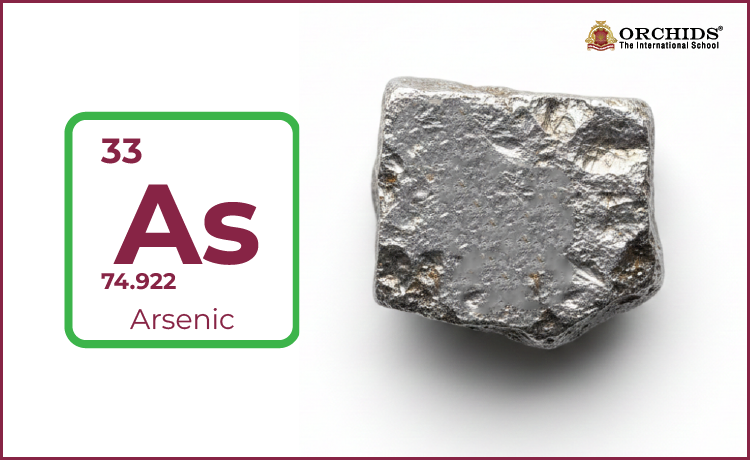
Interestingly!! Arsenic is usually present in all its forms in minute quantities in soil, water, and air. Arsenic exists both in elemental form and as chemical compounds. Most such compounds are toxic to living organisms.
Next, Arsenic shows a trend specifically which makes it easy to identify.
Properties of Arsenic
Arsenic displays remarkable chemical properties as a result of its placement in the periodic table. The following are some of its major chemical properties:
|
Property |
Value / Description |
|
Element Name |
Arsenic |
|
Symbol |
As |
|
Atomic Number |
33 |
|
Group |
15 (Pnictogens) |
|
Period |
4 |
|
Block |
p-block |
|
Element Category |
Metalloid |
|
Electron Configuration |
[Ar] 3d¹⁰ 4s² 4p³ |
|
Valence Electrons |
5 (from 4s² 4p³) |
|
Electronegativity |
2.18 (Pauling scale) |
|
Atomic Radius |
~119 pm (covalent radius) |
|
Ionic Radius |
~222 pm (As³⁻ ion) |
|
Ionisation Energy (1st) |
947 kJ/mol |
|
Melting Point |
817 °C (sublimes) |
|
Boiling Point |
~614 °C (under pressure; sublimes at atm. pressure) |
|
Density |
5.73 g/cm³ (grey arsenic) |
|
Oxidation States |
-3, +3, +5 |
|
Standard State |
Solid (grey arsenic) |
|
Occurrence |
Naturally in minerals (arsenopyrite, realgar, etc.) |
Chemical Properties of Arsenic
➔ Allotropic Nature:
- Exists in grey (stable), yellow (reactive), and black (unstable) forms.
- Grey is metallic and a poor conductor; yellow is produced by cooling vapours.
➔ Reactivity:
- Inert at room temperature in dry air.
- Burns with a blue flame, releasing garlic-like odour due to arsenic trioxide (As₂O₃).
➔ Oxidation States:
- Common states: -3, +3, +5.
- Forms highly toxic arsine gas (AsH₃) and acids like H₃AsO₃ and H₃AsO₄.
➔ Reactions with Other Elements:
- Combines with halogens (e.g., AsCl₃) and metals (forms arsenides).
➔ Solubility:
- Elemental arsenic is water-insoluble.
- Most compounds (especially oxides and acids) are soluble and toxic.
Also, you can check other elements: Argon, Actinum
Uses of Arsenic
-
It is used in CCA to protect wood; now banned/restricted due to toxicity.
-
It is formerly used in agriculture; now limited by regulations.
-
Have you noticed that Gallium arsenide (GaAs) is used in solar cells, LEDs, and high-speed electronics?
-
It is used to decolour glass and in certain enamels/ceramics.
-
It strengthens lead alloys; used in batteries and bullets.
-
When treating syphilis and psoriasis, still used in some cancer treatments (e.g., APL).
-
Used in Paris Green and Scheele’s Green; banned due to toxicity.
Safety Note to Handle Arsenic
-
Inorganic arsenic compounds are extremely toxic.
-
Long-term exposure can lead to skin issues, respiratory problems, and cancer.
-
Requires strict handling and environmental controls.
Learning about arsenic and how it can affect your health is necessary to protect your health and take steps to lower your exposure to it. Knowing where arsenic naturally occurs and how it can enter your body means you can now use this knowledge in the real world to make decisions to limit your exposure.
Frequently Asked Questions on Element 33: Arsenic
1. What are 5 interesting facts about arsenic?
Arsenic was once used in medicines and even makeup. It’s been found in rice, used in electronics, and earned the nickname “inheritance powder” in the past.
2. What is another name for arsenic?
While it’s scientifically called arsenic, people in history referred to it as “inheritance powder” because of its infamous use in secret poisonings.
3. What is arsenic important for?
Arsenic plays a small, still-debated role in the human body, but it's more widely known for its use in electronics, wood treatments, and cancer treatments
4. Is arsenic soluble in water?
The pure element doesn’t dissolve in water, but many arsenic compounds do, and those are often the most dangerous forms we encounter.
5. How does arsenic get into drinking water?
It naturally seeps into groundwater from surrounding rocks and soil, especially in areas with high natural levels or nearby industrial activity.
6. Can you reduce arsenic exposure from food?
Rinsing rice well, cooking it with extra water, and mixing up your grains can all help lower how much arsenic you consume from food.
Science isn't just a subject, it's the way of seeing the world. Curious how Orchids The International School teaches it that way? Talk to our admissions team.
Admissions Open for 2026-27
What type of concept pages would you prefer?
CBSE Schools In Popular Cities
- CBSE Schools in Bangalore
- CBSE Schools in Mumbai
- CBSE Schools in Pune
- CBSE Schools in Hyderabad
- CBSE Schools in Chennai
- CBSE Schools in Gurgaon
- CBSE Schools in Kolkata
- CBSE Schools in Indore
- CBSE Schools in Sonipat
- CBSE Schools in Delhi
- CBSE Schools in Rohtak
- CBSE Schools in Bhopal
- CBSE Schools in Aurangabad
- CBSE Schools in Jabalpur
- CBSE Schools in Jaipur
- CBSE Schools in Jodhpur
- CBSE Schools in Nagpur
- CBSE Schools in Ahmednagar
- CBSE School In Tumkur











Orchids The International School is one of India's leading chains of CBSE and ICSE schools, with 110+ schools across the country.