

2,4-Dinitrophenylhydrazine
Ever wondered how chemists quickly spot the presence of aldehydes or ketones in a mixture? That’s where 2,4-Dinitrophenylhydrazine (2,4-DNP) steps in! This bright yellow-orange reagent is like a detective in the chemistry lab; it reacts with carbonyl compounds to form colourful crystals, making them easy to identify.
This article explains about 2,4-DNP, its structure, properties, reactions, and uses in an easy and understandable way.
Table of Contents
- What is 2,4-dinitrophenylhydrazine?
- Structure of 2,4-Dinitrophenylhydrazine
- How is 2,4 DNP Made
- What is Brady’s Reagent
- Identifying a Carbonyl Compound with Brady’s Reagent
- How the 2,4 DNP Test Detects Carbonyl Compounds
- Reaction of 2,4-Dinitrophenylhydrazine with Ethanal
- Tips to Learn 2,4-DNP (Brady’s Reagent) Easily
- Conclusion
- Frequently Asked Questions on 2,4-Dinitrophenylhydrazine

What is 2,4-dinitrophenylhydrazine?
In the field of organic chemistry, 2,4-dinitrophenylhydrazine (or 2,4 DNP) is of vital importance when it comes to determining the presence of carbonyl compounds, including aldehydes and ketones. The fact that this chemical is sometimes referred to as Brady's reagent because to the scientist who first described the use of this chemical for carbonyl detection.
2,4 DNP is a red-orange solid, but because it can be explosive when dry, it is often supplied in a damp form to make it safer to handle in laboratories.
Structure of 2,4-Dinitrophenylhydrazine
2,4-Dinitrophenylhydrazine is based on a benzene ring with a hydrazine group.
This structure makes 2,4 DNP particularly good at reacting with carbonyl groups, which are found in aldehydes, ketones, and similar compounds. When these groups react with 2,4 DNP, they form new solid products that are easy to separate from the other compounds.
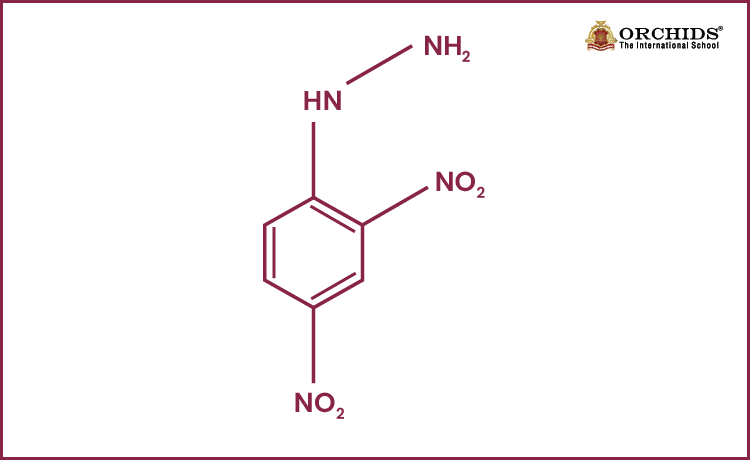
In chemistry laboratories, instead of separating aldehydes and ketones by traditional distillation, chemists often convert them into 2,4-DNP derivatives. These derivatives are more stable and can be separated by chromatography.
The best part is that once separated, these derivatives can be hydrolysed to get back the original carbonyl compounds.
How is 2,4 DNP Made
2,4-Dinitrophenylhydrazine is synthesised in two major steps. The chlorobenzene compound in question has a chlorine atom bound to the benzene.
Although 2,4-Dinitrophenylhydrazine isn't a commonly substituted hydrazine, it can be efficiently prepared using hydrazine (H₂N–NH₂) as a nucleophile.
The synthesis involves a two-step process:
- First, chlorobenzene is nitrated to introduce nitro groups at the 2 and 4 positions of the benzene ring, forming 2,4-dinitrochlorobenzene.
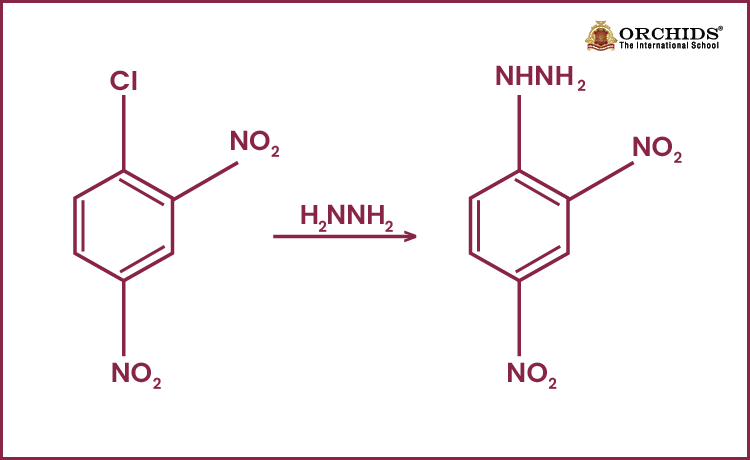
Then, this compound reacts with hydrazine, which replaces the chlorine atom. The presence of two electron-withdrawing nitro groups makes this substitution easier and more effective.
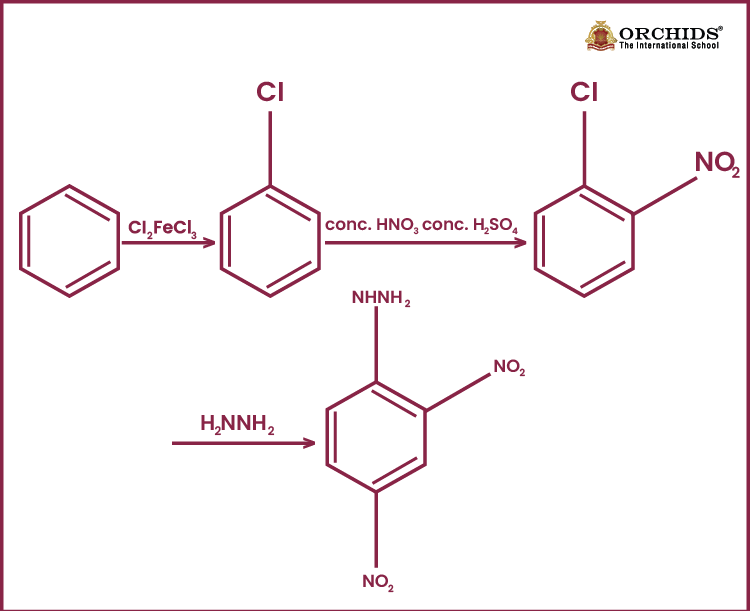
Since chlorine is ortho-para directing, and chlorobenzene can be easily derived from benzene, this method offers a straightforward route to synthesising 2,4-DNP in the lab.
What is Brady’s Reagent
When it comes to identifying aldehydes and ketones in a chemistry lab, one of the most trusted tools is Brady’s reagent. This is simply an acidified solution of 2,4-dinitrophenylhydrazine, often referred to as DNP.
- The way it works is beautifully straightforward is when a compound containing a carbonyl group (which is found in aldehydes and ketones) is mixed with Brady’s reagent, a brightly coloured solid forms, usually orange or yellow. These solids are called 2,4-dinitrophenylhydrazones.
- What makes them especially useful is that each one has a very specific melting point. So once you’ve made the crystals, you can measure how easily they melt and compare the result to known values.
- It's a quick and visual way to confirm a compound's identity, which is why it remains a favourite even in school and college laboratories.
Here are some additional nuggets related to lab chemistry:
- The fact that Benzoic acid, aside from its presence in food preservatives, is also used as a mild antiseptic. It's commonly found in medicines used to treat urinary tract infections.
When turned into vapour, it can also be inhaled to help clean and soothe the bronchial tubes.
- Acetic anhydride, another important lab compound, reacts with dinitrogen pentoxide (N₂O₅) to produce acetyl nitrate, which is used in various organic reactions.
The equation looks like this:
(CH₃CO)₂O + N₂O₅ → 2CH₃COONO₂
- There's also an interesting pattern when it comes to acid chlorides reacting with water. The longer the carbon chain in the molecule, the slower it tends to react. For instance:
CH₃COCl reacts faster than CH₃CH₂COCl, which in turn is faster than CH₃CH₂CH₂COCl, and so on.
Identifying a Carbonyl Compound with Brady’s Reagent
Brady’s reagent, a solution of 2,4-dinitrophenylhydrazine in acidified methanol, is used to detect aldehydes and ketones.
When you add Brady’s reagent to a substance that contains a carbonyl group, a bright orange or yellow solid appears.
This solid is known as a 2,4-dinitrophenylhydrazone. The formation of this colourful precipitate tells you right away that an aldehyde or ketone is present.
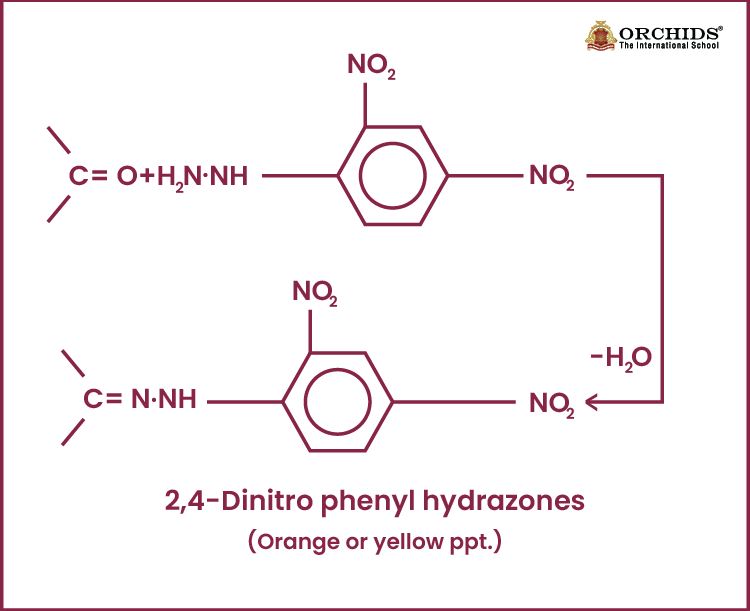
But it doesn’t stop there. These hydrazone crystals aren’t just for show-they also have a unique melting point. After filtering and purifying the crystals, you can measure their melting temperature.
Comparing that value with standard reference data helps you identify exactly which compound you started with.
The process is simple:
- Mix the sample with Brady’s reagent.
- Filter and purify the crystals.
- Measure the melting point.
- Compare it with reference data to confirm the compound.
This method is popular in labs and classrooms because it's quick, visible, and reliable.
How the 2,4 DNP Test Detects Carbonyl Compounds
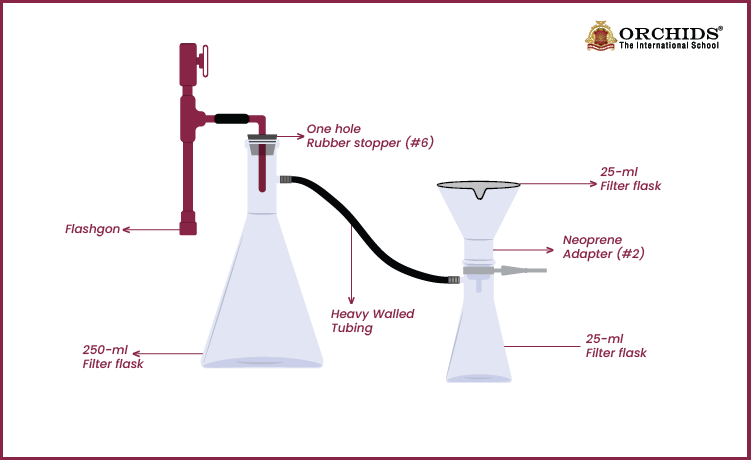
- Add five millilitres of 2,4-dinitrophenylhydrazine (Brady’s reagent) to a clean test tube.
- Add ten drops of the unknown compound to the test tube.
- Tap the test tube gently but firmly with your finger to mix the contents.
- If no crystals appear immediately, place the test tube in a water bath at sixty degrees Celsius and heat it for five minutes.
- After heating, transfer the test tube to an ice bath and allow it to cool until crystals begin to form.
- Use vacuum filtration with a Hirsch funnel to collect the crystals.
- Dry the crystals on the funnel by drawing air through them.
- Record the melting point of the crystals on your lab report sheet.
- If the melting point range is too broad, recrystallise the product using a minimum amount of ethanol, then repeat the melting point test.
Reaction of 2,4-Dinitrophenylhydrazine with Ethanal
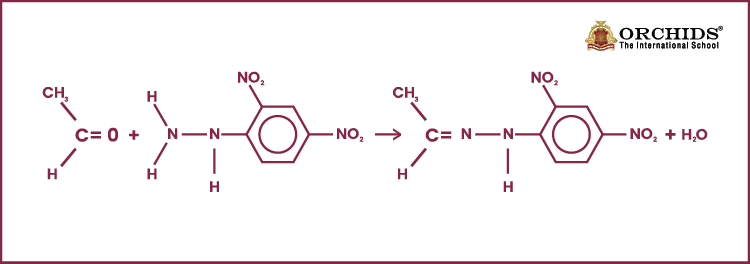
When 2,4-Dinitrophenylhydrazine (2,4-DNP), also known as Brady’s reagent, reacts with ethanal, a bright orange-yellow solid called ethanal 2,4-dinitrophenylhydrazone is formed.
This is a condensation reaction, where a water molecule is removed during the process. The product is a crystalline solid with a sharp melting point, which helps in identifying the original compound.
Because each aldehyde or ketone forms a unique hydrazone with a specific melting point, this test is commonly used to confirm the presence of carbonyl groups in organic compounds. The colour change and crystal formation make it easy to observe, even in school labs.
Tips to Learn 2,4-DNP (Brady’s Reagent) Easily
- Understand what it tests: It helps identify aldehydes and ketones by reacting with the carbonyl group.
- Think in colours: A yellow or orange solid means a carbonyl group is present. It’s a simple visual clue.
- Memorise the test steps: Add reagent → wait for crystals → filter → dry → check melting point.
- Safety first: Use the reagent in its damp form-the dry powder can be explosive.
- Link the synthesis: Made by reacting 2,4-dinitrochlorobenzene with hydrazine-two simple steps.
Conclusion
2,4-Dinitrophenylhydrazine is a simple yet powerful tool in organic chemistry. It helps detect and identify aldehydes and ketones through a clear colour change and a reliable melting point. Easy to use and widely trusted, it's a must-know test for every chemistry student.
Frequently Asked Questions on 2,4-Dinitrophenylhydrazine
1. What is Brady’s reagent used for in organic chemistry?
Brady’s reagent is used to detect aldehydes and ketones by forming a yellow or orange precipitate.
2. What is the DNPH reagent and how does it work?
DNPH reagent reacts with carbonyl groups to form coloured solids that help identify aldehydes and ketones.
3. What is 2,4-dinitrophenylhydrazine DNPH used for in laboratories?
2,4-dinitrophenylhydrazine DNPH is used to test for carbonyl compounds and form identifiable solid derivatives.
4. What is 2,4 DNP, and how is it related to aldehyde and ketone testing?
2,4DNP reacts with aldehydes and ketones to produce orange/yellow crystals for easy detection.
5. What is the purpose of 2,4-dinitrophenylhydrazine?
It is used to detect carbonyl groups in aldehydes and ketones. The reaction forms coloured crystals that help identify the compound.
6. What are the safety precautions for 2,4-dinitrophenylhydrazine?
Handle it in a damp form, as the dry compound is explosive. Use gloves, goggles, and work in a well-ventilated area.
7. What colour is Brady's reagent?
Brady’s reagent is typically orange-red in solution. It forms yellow to orange crystals upon reaction with carbonyl compounds.
8. What are the conditions for the 2,4-DNP test?
The test is done in an acidic methanol solution. Mild heating may be used if crystals do not form immediately.
Science isn't just a subject, it's the way of seeing the world. Curious how Orchids The International School teaches it that way? Talk to our admissions team.
Admissions Open for 2026-27
What type of concept pages would you prefer?
CBSE Schools In Popular Cities
- CBSE Schools in Bangalore
- CBSE Schools in Mumbai
- CBSE Schools in Pune
- CBSE Schools in Hyderabad
- CBSE Schools in Chennai
- CBSE Schools in Gurgaon
- CBSE Schools in Kolkata
- CBSE Schools in Indore
- CBSE Schools in Sonipat
- CBSE Schools in Delhi
- CBSE Schools in Rohtak
- CBSE Schools in Bhopal
- CBSE Schools in Aurangabad
- CBSE Schools in Jabalpur
- CBSE Schools in Jaipur
- CBSE Schools in Jodhpur
- CBSE Schools in Nagpur
- CBSE Schools in Ahmednagar
- CBSE School In Tumkur











Orchids The International School is one of India's leading chains of CBSE and ICSE schools, with 110+ schools across the country.