

Difference between Crystalline and Amorphous Solids Explained with Examples
Solids are literally everywhere around us, from the salt we sprinkle on our food to the glass in our windows. But here is something interesting, not all solids are actually the same. Once you understand how they differ at the particle level, it becomes a lot easier to make sense of chemistry as a whole.
In this article, we are going to break down the difference between crystalline and amorphous solids and compare them in a simple and clear way.
Table of Contents
- What is the Difference Between a Crystalline Solid and an Amorphous Solid
- How to Identify Crystalline vs Amorphous Solids
- Frequently Asked Questions on Difference Between Crystalline Solid and an Amorphous Solid

What is the Difference Between a Crystalline Solid and an Amorphous Solid?
Solids are one of the three major states of matter, the other two being liquids and gases. The behaviour of a solid depends entirely on how its atoms, ions, or molecules are arranged. 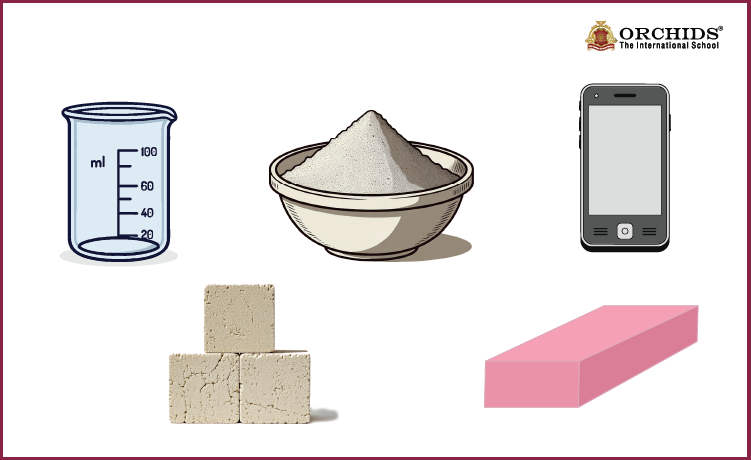
This arrangement gives a solid its strength, melting point, brittleness, and overall appearance. Unlike liquids and gases, solids have:
- A fixed shape and volume
- Strong intermolecular forces
- Very little free movement of particles
- Particles can only vibrate around fixed positions
- Rigid, incompressible nature
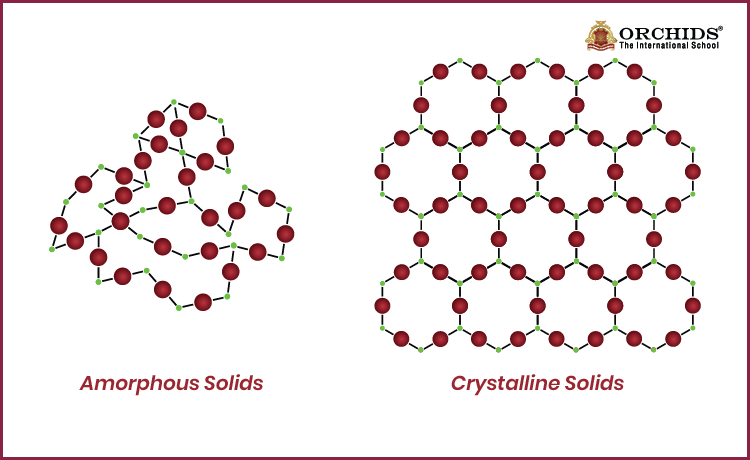
Because of how their particles are arranged, solids are divided into two major types:
- Crystalline Solids
- Amorphous Solids
Crystalline Solids
Crystalline solids are known for their highly ordered, repeating arrangement of particles. Their structure is organised in a three-dimensional lattice.
Apart from it, crystalline solids are used in cutting tools due to their hardness and are widely used in jewellery.
Some common examples are
- Salt (NaCl)
- Diamond
- Quartz
- Sugar crystals
- Copper sulphate
Amorphous Solids
The word "amorphous" means without a clear shape. These solids do not have a regular geometric arrangement of particles. These amorphous solids are used in construction (windows, doors, panels) and also used in packaging for food jars, cosmetic containers, etc.
Some common examples are:
- Glass
- Rubber
- Plastic
- Gels
- Pitch
Let's summarise the difference between a crystalline solid and an amorphous solid.
|
The structure of crystalline solids is like a well-organised library, where every book is placed neatly in order. Amorphous solids are like a box of randomly kept books, where some books touch each other, and some don’t; there is no fixed arrangement. |
Difference Between Crystalline and Amorphous Solids
|
Crystalline Solids |
Amorphous Solids |
|
Particles arranged in a regular 3D pattern |
No regular or repeating arrangement |
|
Sharp melting point |
Melt or soften over a range |
|
Anisotropic in nature |
Isotropic in nature |
|
True solids |
Pseudo-solids or supercooled liquids |
|
Symmetrical arrangement |
Irregular, unsymmetrical structure |
|
More rigid and harder |
Less rigid, more flexible |
|
Long-range order |
Only short-range order |
|
Example: Quartz, Diamond |
Example: Glass, Plastic |
Let's discuss some tips to differentiate between crystalline and amorphous solids:
How to Identify Crystalline Solid vs Amorphous Solid
- When it comes to Melting Behaviour, Crystals melt sharply; amorphous materials soften gradually.
- The fact that Crystals have sharp edges and flat faces, amorphous solids do not.
- Crystals split cleanly; amorphous solids break irregularly.
- Crystals show anisotropy; amorphous materials show isotropy.
- Crystals give a sharp diffraction pattern; amorphous materials give a diffused halo.
Example:
Salt breaks into neat cubes → crystalline
Glass shatters unevenly → amorphous
Also Read: Difference Between Compounds and Mixtures
Till now, we have heard that Crystalline and amorphous solids may look similar at first, but their internal structure makes a huge difference in their behaviour and applications. And knowing them well gives students a clearer understanding of the world around them.
Frequently Asked Questions on Difference Between Crystalline Solid and an Amorphous Solid
1. 1. What is the difference between amorphous and crystalline?
The main difference between crystalline and amorphous solids lies in how neatly their particles are arranged. Crystals have an ordered pattern, while amorphous solids are irregular and more flexible.
2. Is amorphous stronger than crystalline?
Crystalline solids are usually stronger because their tightly packed arrangement gives them rigidity. In the comparison of Crystalline solid vs amorphous solid, the ordered structure makes crystals much harder.
3. Do amorphous materials have dislocations?
Amorphous solids do not have dislocations because their particles are randomly arranged.
4. What are the advantages of amorphous solid forms?
Amorphous solids dissolve faster and can be moulded easily due to their loose structure. These advantages highlight an important difference between crystalline and amorphous materials in daily applications.
5. Why is amorphous important?
Amorphous solids matter because they offer flexibility, easy shaping, and better solubility for medicines.
6. Why is amorphous more soluble than crystalline?
Amorphous solids are more soluble because their particles are loosely packed and break apart easily. This is another clear difference between crystalline solids and amorphous solids, especially in pharmaceutical formulations.
Science isn't just a subject, it's the way of seeing the world. Curious how Orchids The International School teaches it that way? Talk to our admissions team.
Admissions Open for 2026-27
What type of concept pages would you prefer?
CBSE Schools In Popular Cities
- CBSE Schools in Bangalore
- CBSE Schools in Mumbai
- CBSE Schools in Pune
- CBSE Schools in Hyderabad
- CBSE Schools in Chennai
- CBSE Schools in Gurgaon
- CBSE Schools in Kolkata
- CBSE Schools in Indore
- CBSE Schools in Sonipat
- CBSE Schools in Delhi
- CBSE Schools in Rohtak
- CBSE Schools in Bhopal
- CBSE Schools in Aurangabad
- CBSE Schools in Jabalpur
- CBSE Schools in Jaipur
- CBSE Schools in Jodhpur
- CBSE Schools in Nagpur
- CBSE Schools in Ahmednagar
- CBSE School In Tumkur











Orchids The International School is one of India's leading chains of CBSE and ICSE schools, with 130+ schools across the country.