

Natural Resources: Types, Uses, and Importance in Daily Life
Natural resources are the gifts of nature that exist on Earth without any human creation or effort. Everything that supports life, air, water, soil, forests, sunlight, minerals, animals, and fuels comes directly from nature. These resources help us meet our basic needs like food, shelter, energy, and transportation.
This article focuses on natural resources types and uses to better score well and become more aware of environmental responsibility.
Table of Contents
- What Are Natural Resources
- Types of Natural Resources
- Difference Between Renewable and Non-Renewable Resources
- Uses of Natural Resources and Their Conservation
- Frequently Asked Questions on Natural Resources

What Are Natural Resources?
Natural resources are the naturally occurring materials and substances found in our environment that humans do not create but depend on for survival. They are incredibly valuable because they support life on Earth providing us with air to breathe, water to drink, soil to grow food, and minerals to build tools.
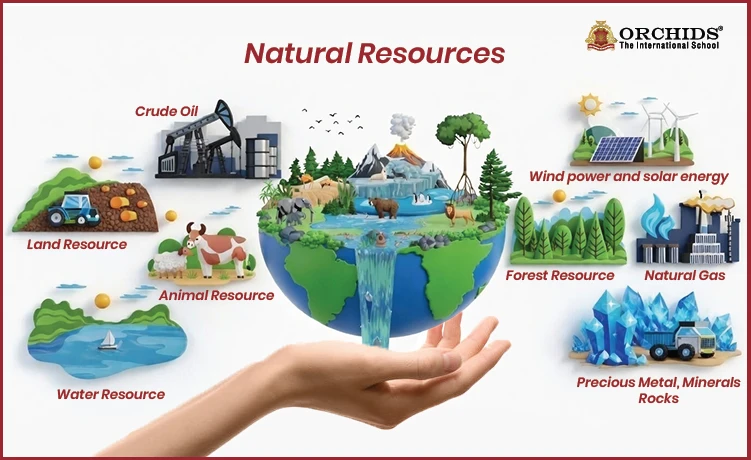
Beyond daily needs, natural resources fuel economic growth, power technology, and shape the overall progress of society, making them the true backbone of human development.
Some Common Examples include:
- Air
- Water
- Sunlight
- Soil
- Plants & animals
- Fossil fuels (coal, petroleum, natural gas)
- Minerals (iron, copper, gold, etc.)
These resources help provide food, clothing, shelter, medicines, energy, and raw materials for industries. Everything we use in daily life ultimately comes from natural resources.
But the major concern that arises is, why are natural resources depleting?
Natural resources are depleting mainly because we are using them faster than they can be renewed. Overpopulation, deforestation, overuse of fossil fuels, industrial waste, water pollution, soil erosion, and climate change are speeding up this loss.
Types of Natural Resources
Natural resources can be broadly grouped into two main categories: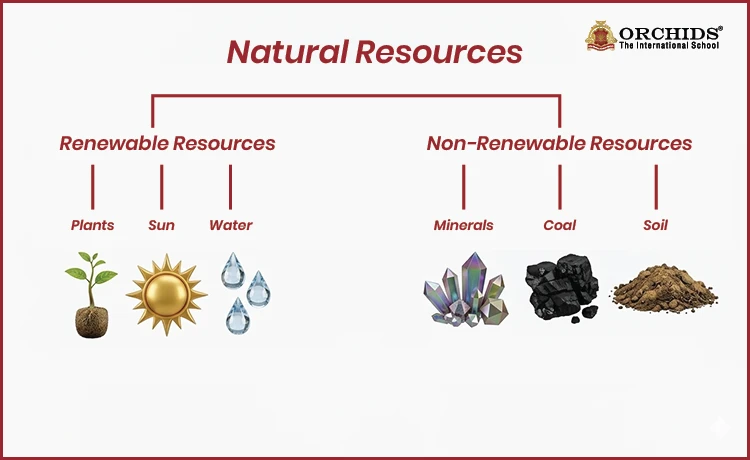
1. Renewable Resources
Renewable resources are natural materials that can replenish or restore themselves over time. When used responsibly, they do not run out and can support human needs for generations.
This is why conserving renewable resources is extremely important for a sustainable future.
But what Features make them so important?
- Renewable resources are valuable because they are sustainable, meaning they naturally replace themselves.
- They are also environmentally friendly, as they do not cause major pollution when used properly.
- The fact that even though many renewable resources are available in large amounts, they can still be damaged by overuse or misuse, such as cutting too many trees or polluting soil and water.
Some Examples that we observe or utilise daily are listed below:
- Water, which is renewed through the water cycle, supports life, farming, and household activities.
- Solar energy, which comes from the sun, can be used for electricity and heating.
- Wind energy, produced from moving air and used in windmills and wind turbines.
- Air is essential for breathing and supports all living organisms.
- Forests and plants, which grow back naturally when protected and help maintain ecological balance.
Let's discuss how non-renewable resources are different from renewable resources.
2. Non-Renewable Resources
Non-renewable resources are natural materials that exist in fixed, limited amounts on Earth. They take millions of years to form, so once we use them up, they cannot be replaced easily. This is why they are considered exhaustible and must be used carefully.
Let's Look into the Features of Non-Renewable Resources:
- They are limited and exhaustible, meaning once they are used up, they cannot be naturally replaced within a human lifetime.
- They have high economic value because they are essential for industries, transportation, and energy production.
- Their use often causes pollution, contributing to air pollution, global warming, and environmental damage.
- They must be conserved and used wisely through recycling, reduced consumption, and switching to cleaner alternatives.
Some Common Examples of Non-Renewable Resources are:
- Minerals such as iron, copper, and gold are extracted from the Earth for tools, machines, and industries.
- Intrestingly,Uses of Fossil fuels like coal, petroleum, and natural gas are widely used for electricity, transport, and manufacturing.
- Majorly, Nuclear fuels such as uranium are used to produce huge amounts of energy in nuclear power plants.
- Soil, which can regenerate slowly, supports agriculture and plant growth.
Next, let's summarise their differences to understand more clearly !!
Learn More: Fuel Types
Difference Between Renewable and Non-Renewable Resources
|
Renewable Resources |
Non-Renewable Resources |
|
Can be replenished naturally |
Cannot be replenished easily |
|
Sustainable, long-lasting |
Limited and can run out |
|
Low environmental impact |
Higher pollution & environmental impact |
|
Less expensive |
Cost increases as availability drops |
|
Replenish quickly (air, sun, water) |
Replenish very slowly or not at all |
Let's discuss the Most Important Natural Resources in our daily lives:
1. Air is essential for breathing, plant growth, and maintaining life on Earth. Clean air keeps humans healthy and supports all living organisms. Pollution control is important to protect this resource.
2. Water covers 70% of Earth, but only a small percentage is freshwater that humans can use. It supports drinking, farming, electricity generation, hygiene, and industries. Saving water is extremely important.
3. Soil provides minerals and nutrients needed for plant growth. It supports farming, forests, and natural habitats. Soil conservation prevents erosion and maintains fertility.
4. Minerals like iron, copper, gold, and bauxite are used to build tools, machines, transport systems, buildings, and technology. They are limited, so mining must be responsible.
5. Forests purify air, control climate, provide wood, support biodiversity, and offer natural medicines. Deforestation affects rainfall, increases pollution, and harms wildlife.
Do you know? Human Impact on Natural Resources as they haveboth positive and negative impacts.
- Positive: afforestation, renewable energy use, recycling
- Negative: mining, pollution, deforestation, overfishing
Read More: Effects of burning Fossil Fuels
Frequently Asked Questions on Natural Resources
1. What are some questions to ask about natural resources?
When learning about natural resources, students often ask about what natural resources are, their uses, and how they impact daily life. These questions help in clearly understanding the natural resources definition and the different types of natural resources.
2. What are the important points of natural resources?
The key points of natural resources include their importance, limited availability, and role in survival.
3. How can we protect the natural resources?
We can protect natural resources by saving water, reducing waste, and using renewable energy. Knowing the types of natural resources and the natural resources definition makes it easier to understand why conservation is important.
4. Why are natural resources important in our daily life?
Natural resources are important because they provide food, energy, clothes, and shelter that we use every day.
5. Where do natural resources come from?
All natural resources come directly from nature, such as air, water, soil, and minerals. Understanding what are natural resources and the natural resources definition helps explain how the Earth naturally provides different types of natural resources.
6. How do natural resources affect human life?
Natural resources affect human life by supporting health, industry, transportation, and home needs.
Science isn't just a subject, it's the way of seeing the world. Curious how Orchids The International School teaches it that way? Talk to our admissions team.
Admissions Open for 2026-27
What type of concept pages would you prefer?
CBSE Schools In Popular Cities
- CBSE Schools in Bangalore
- CBSE Schools in Mumbai
- CBSE Schools in Pune
- CBSE Schools in Hyderabad
- CBSE Schools in Chennai
- CBSE Schools in Gurgaon
- CBSE Schools in Kolkata
- CBSE Schools in Indore
- CBSE Schools in Sonipat
- CBSE Schools in Delhi
- CBSE Schools in Rohtak
- CBSE Schools in Bhopal
- CBSE Schools in Aurangabad
- CBSE Schools in Jabalpur
- CBSE Schools in Jaipur
- CBSE Schools in Jodhpur
- CBSE Schools in Nagpur
- CBSE Schools in Ahmednagar
- CBSE School In Tumkur











Orchids The International School is one of India's leading chains of CBSE and ICSE schools, with 130+ schools across the country.