

Reactivity Series Experiment: Chemical Reactions with Observations Explained
The reactivity series experiment shows metals arranged from most reactive to least reactive based on how easily they lose electrons and react with substances like water and acids. The aim of this article is to help students understand this concept through a simple experiment, allowing them to observe metal reactions in real time.
This makes chemistry concepts clear and builds practical lab skills,and connects theory with hands-on learning in an interactive way.
Table of Content

What is the reactivity series?
The reactivity series is a list of metals arranged from the most reactive to the least reactive. It helps predict how metals will react with water, acids, and other chemicals, making it an essential tool in chemistry for both practical experiments and real-life applications.
The reactivity of metals can be compared by observing how they displace one another from their salt solutions; that is a more reactive metal displaces a less reactive metal from salt solution. Such reactions are called displacement reactions.
Also,Students can also refer to learn more about the concept of reactivity series in detail.
Let's Understand how it works.
Aluminium
Aluminium can displace zinc, iron, and copper from their respective salt solutions, showing that it is highly reactive.
Zinc
Zinc can displace iron and copper, but not aluminium or itself. This means zinc is more reactive than iron and copper but less reactive than aluminium.
Iron
Iron can displace copper from its salt solution, but not aluminium, zinc, or itself, showing it is less reactive than those metals.
Copper
Copper does not displace any metal from its solution, indicating it is the least reactive of all.
Reactivity Order
From all the reactions, the decreasing order of reactivity is:
Lets look have the peek about the Colours of Metals and Their Salts
|
Compound Name |
Formula |
Colour |
|
Aluminium sulphate |
|
Colourless |
|
Copper sulphate |
|
Blue |
|
Zinc sulphate |
|
Colourless |
|
Ferrous sulphate |
|
Light green |
|
Copper (metal) |
|
Reddish brown |
|
Aluminium (metal) |
|
White |
|
Zinc (metal) |
|
Silver white |
|
Iron (metal) |
|
Blackish grey |
Now let's understand the Reactivity Series Experiment!!
Reactivity Series Experiment
Objective: To observe the reactivity of metals by performing displacement reactions.
Experimental Setup: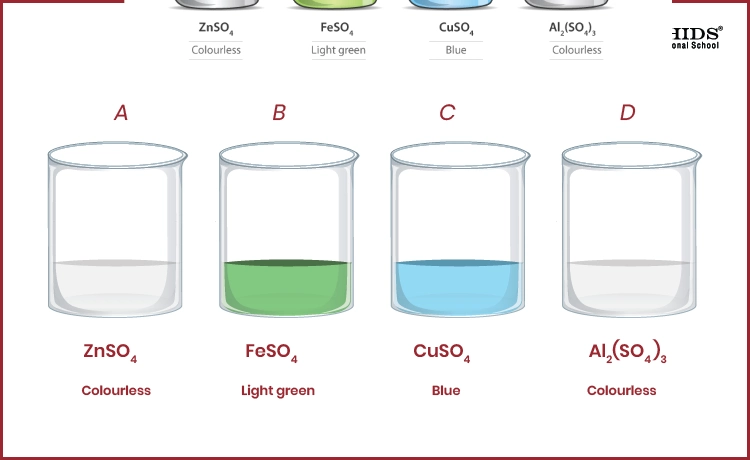
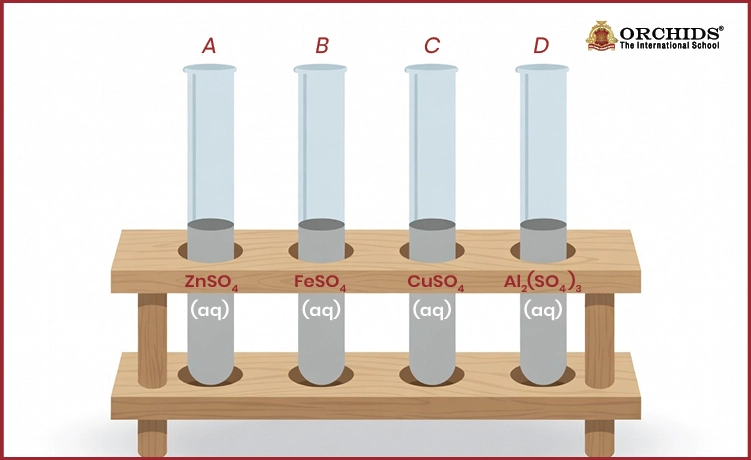
Materials Needed
- Metal strips: Aluminium (Al), Zinc (Zn), Iron (Fe), Copper (Cu)
- Solutions: ZnSO₄, FeSO₄, CuSO₄, Al₂(SO₄)₃ (5% concentration)
- Beakers and test tubes, distilled water, sandpaper, test tube stand
The Followed Procedure:
- Wash and dry four beakers and label them , ,
- Pour 50 mL of each metal sulfate solution into the respective beakers.
- Wash and dry four test tubes, label them A, B, C, D, and add 10 mL of the corresponding solutions.
- Clean the metal strips with sandpaper.
- Dip each metal strip into all four test tubes one by one and observe any color change or metal deposition.
Here Below is the Observations:
|
Metal |
Dipped in |
Observation |
|
Al |
ZnSO₄ |
The solution remains unchanged. Greyish zinc metal accumulates on the aluminium strip. |
|
Al |
CuSO₄ |
The blue solution turns colourless. Reddish brown copper metal accumulates on the aluminium strip. |
|
Al |
Al₂(SO₄)₃ |
No change is observed. |
|
Al |
FeSO₄ |
The green solution turns colourless. Greyish black iron metal accumulates on the aluminium strip. |
|
Fe |
ZnSO₄ |
No change is observed. |
|
Fe |
CuSO₄ |
The solution turns light green. Reddish brown copper metal accumulates on the iron strip. |
|
Fe |
Al₂(SO₄)₃ |
No change is observed. |
|
Fe |
FeSO₄ |
No change is observed. |
|
Zn |
ZnSO₄ |
No change is observed. |
|
Zn |
CuSO₄ |
The blue solution turns colourless. Reddish brown copper metal accumulates on the zinc strip. |
|
Zn |
Al₂(SO₄)₃ |
No change is observed. |
|
Zn |
FeSO₄ |
The light green solution turns colourless. Greyish black iron metal accumulates on the zinc strip. |
|
Cu |
ZnSO₄ |
No change is observed. |
|
Cu |
CuSO₄ |
No change is observed. |
|
Cu |
Al₂(SO₄)₃ |
No change is observed. |
|
Cu |
FeSO₄ |
No change is observed. |
The Final result that was observed was:
- Aluminium displaces Zn, Cu, Fe → most reactive.
- Zinc displaces Cu, Fe → more reactive than Cu and Fe.
- Iron displaces Cu → less reactive than Al and Zn.
- Copper does not displace any metal → least reactive.
Reactivity Order:
Frequently Asked Questions on Reactivity Series Experiment
1. What is the importance of the reactivity series?
The reactivity series helps us predict how metals will react with water, acids, and other substances. It’s a handy guide for chemists and engineers alike.
2. What is the cause of the reactivity series?
Based on reactivity series experiment Metals are arranged based on how easily they lose electrons to form positive ions. That tendency determines their position in the series.
3. On what basis is the reactivity series designed?
It’s designed according to how quickly metals react with water, acids, or other chemicals. The faster a metal reacts, the higher it ranks.Reactivity series experiment helps us to understand better.
4. Why is lithium not in the reactivity series?
Actually, lithium is in the reactivity series, usually near the top among alkali metals, because it reacts quickly with water and acids.
5. What is the most reactive metal on the reactivity series?
Generally, potassium is considered the most reactive common metal, reacting violently with water.
6. Why is beryllium less reactive than lithium?
Beryllium holds onto its electrons more tightly, so it doesn’t react as easily as lithium does.
7. What is the most reactive element?
Fluorine takes the crown; it's extremely eager to gain electrons and react with almost everything.
8. What is the order of the reactivity series?
Metals are usually listed from most reactive to least: potassium, sodium, lithium, calcium, magnesium… down to gold and platinum.
9. Why is sodium more reactive than lithium?
Sodium’s outer electron is further from the nucleus, so it’s lost more easily, making it slightly more reactive than lithium.
Science isn't just a subject, it's the way of seeing the world. Curious how Orchids The International School teaches it that way? Talk to our admissions team.
Admissions Open for 2026-27
What type of concept pages would you prefer?
CBSE Schools In Popular Cities
- CBSE Schools in Bangalore
- CBSE Schools in Mumbai
- CBSE Schools in Pune
- CBSE Schools in Hyderabad
- CBSE Schools in Chennai
- CBSE Schools in Gurgaon
- CBSE Schools in Kolkata
- CBSE Schools in Indore
- CBSE Schools in Sonipat
- CBSE Schools in Delhi
- CBSE Schools in Rohtak
- CBSE Schools in Bhopal
- CBSE Schools in Aurangabad
- CBSE Schools in Jabalpur
- CBSE Schools in Jaipur
- CBSE Schools in Jodhpur
- CBSE Schools in Nagpur
- CBSE Schools in Ahmednagar
- CBSE School In Tumkur











Orchids The International School is one of India's leading chains of CBSE and ICSE schools, with 110+ schools across the country.