

What is the Reactivity Series? Explained with Examples and Reactions
Have you ever wondered why sodium reacts explosively with water while gold stays shiny and untouched for centuries? The answer lies in the reactivity series of metals in chemistry. This series is akin to a chemical ranking chart that ranks metals in order of their reactivity with water, acids, and oxygen.
In this article reactivity series, its complete table, and the many ways it impacts both science and daily life are discussed.
Table of Contents
- Reactivity Series in Chemistry
- Reactivity Series Chart
- Significance of the Reactivity Series in Chemistry
- Frequently Asked Questions on Reactivity Series

Reactivity Series in Chemistry
The reactivity series is an ordered arrangement of metals based on their tendency to lose electrons and form positive ions. This tendency directly affects how metals interact with water, acids, and oxygen.
These reactivity series are broken into three parts as follows:
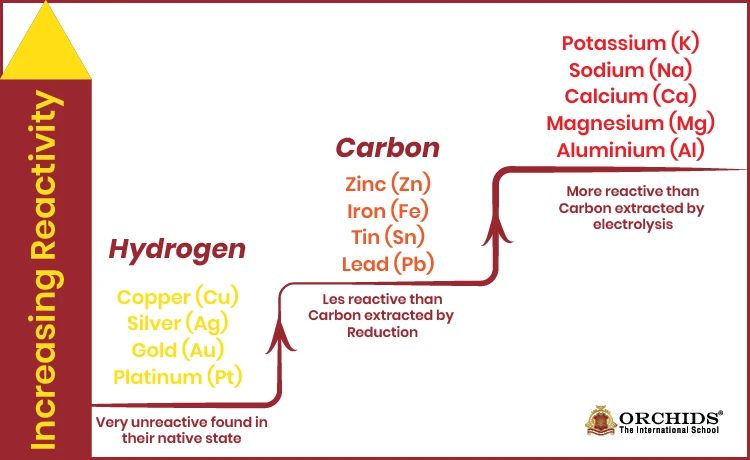
- Highly reactive metalslike potassium and sodium are always eager to lose electrons. This is why they react explosively with water, forming hydroxides and releasing hydrogen gas.
- Moderately reactive metals such as magnesium, aluminium, and zinc show controlled reactivity. They might need hot water, steam, or acids to react.
- The least reactive metals, like copper, silver, and gold, are often found in their pure metallic form in nature because they do not readily form compounds.
Reactivity Series Chart
Below is a detailed arrangement of metals in order of their reactivity, along with observations that make them unique:
|
Rank |
Metal |
Nature of Reactivity |
Key Notes & Observations |
|
1 |
Potassium (K) |
Extremely reactive |
Reacts explosively with cold water, producing hydrogen instantly |
|
2 |
Sodium (Na) |
Very reactive |
Vigorous reaction with cold water, stored under oil/kerosene |
|
3 |
Calcium (Ca) |
Reactive |
Reacts with cold water, forms calcium hydroxide and hydrogen |
|
4 |
Magnesium (Mg) |
Moderately reactive |
Burns with bright flame in air; reacts with hot water/steam |
|
5 |
Aluminium (Al) |
Reacts when the oxide layer is removed |
Protective oxide prevents corrosion; reacts strongly with acids |
|
6 |
Zinc (Zn) |
Moderate reactivity |
Reacts with acids and steam; commonly used for galvanisation |
|
7 |
Iron (Fe) |
Moderate to low |
Slowly reacts with acids; easily corrodes, forming rust |
|
8 |
Lead (Pb) |
Poor reactivity |
Only reacts with strong acids; protective coating in some reactions |
|
9 |
Copper (Cu) |
Very low |
Does not react with water or acids; reacts slowly with oxygen to form green patina |
|
10 |
Silver (Ag) |
Negligible |
Does not react with water/air quickly; tarnishes by reacting with sulfur |
|
11 |
Gold (Au) |
Least reactive |
Does not react with oxygen, water, or acids; highly corrosion-resistant |
Significance of the Reactivity Series in Chemistry
The reactivity series is not just a scientific chart; it has several practical uses that impact industries, laboratories, and daily life:
- The series helps in predicting whether a displacement reaction will occur.
Example: When zinc is added to a copper sulfate solution, zinc replaces copper (since zinc is more reactive), forming zinc sulfate and depositing copper metal.
2. Metal Extraction from Ores depends on its position in the reactivity series:
- Top of the series (highly reactive metals) is extracted using electrolysis of molten salts (e.g., sodium, potassium).
- The middle of the series (moderately reactive metals) is extracted using reduction with carbon or carbon monoxide (e.g., iron, zinc).
- The bottom of the series (least reactive metals) is found in the native state (e.g., gold, silver) and requires minimal extraction.
3.The position of a metal determines how easily it undergoes corrosion.
- Iron rusts quickly due to moderate reactivity.
- Gold and platinum remain untarnished even after centuries.
- Copper develops a protective green patina (copper carbonate) when exposed to moist air.
4.Safe Storage of Metals, like at the top of the series (sodium, potassium), are so reactive that they are stored in kerosene or oil to prevent contact with air and moisture.
5. Industrial and Everyday Applications
- Aluminium like used for aircraft bodies because of its strength and resistance to corrosion.
- Zinc is used in galvanisation to protect iron from rust.
- Copper is preferred for electrical wiring due to its low reactivity and excellent conductivity.
- Gold and Silver are used in jewellery because of their shine and resistance to tarnishing.
Some Other Important Uses of the Reactivity Series
The reactivity series helps predict how metals behave in different reactions, making it easier to understand and control chemical processes.
Metals and Water
Highly reactive metals like potassium, sodium, and calcium react with water to form a hydroxide and hydrogen gas:
Metals and Acids
Metals above lead, such as zinc or magnesium, react with acids to form salts and hydrogen:
Read More: Reactivity Series Experiment
As we have discussed, the reactivity series is a simple yet powerful tool in chemistry that helps us rank metals based on their behaviour. From predicting displacement reactions and explaining corrosion to guiding metal extraction methods, it connects classroom chemistry to real-world applications.
Frequently Asked Questions on Reactivity Series
1. What is the Reactivity Series?
The Reactivity Series is a scientific arrangement of metals based on how easily they react with water, acids, and oxygen. It helps predict reactions quickly.
2. What is the Reactivity Series of Metals?
The Reactivity Series of Metals shows which metals are more active and which are less. It guides us in understanding their uses and extraction methods.
3. What does the reactivity series of metals depend on?
The reactivity series of metals depends on how easily a metal loses electrons to form positive ions. Metals that lose electrons faster are more reactive.
4. Which is more reactive, tin or lead?
Tin is more reactive than lead. This means tin reacts a little faster with acids and oxygen compared to lead.
5. How to determine the reactivity series?
We determine the reactivity series by observing experiments such as reactions with water, acids, and displacement reactions between metals.
6. How are metals high in the reactivity series extracted?
Metals high in the reactivity series are usually extracted using electrolytic methods, since they cannot be reduced easily by common reducing agents.
Science isn't just a subject, it's the way of seeing the world. Curious how Orchids The International School teaches it that way? Talk to our admissions team.
Admissions Open for 2026-27
What type of concept pages would you prefer?
CBSE Schools In Popular Cities
- CBSE Schools in Bangalore
- CBSE Schools in Mumbai
- CBSE Schools in Pune
- CBSE Schools in Hyderabad
- CBSE Schools in Chennai
- CBSE Schools in Gurgaon
- CBSE Schools in Kolkata
- CBSE Schools in Indore
- CBSE Schools in Sonipat
- CBSE Schools in Delhi
- CBSE Schools in Rohtak
- CBSE Schools in Bhopal
- CBSE Schools in Aurangabad
- CBSE Schools in Jabalpur
- CBSE Schools in Jaipur
- CBSE Schools in Jodhpur
- CBSE Schools in Nagpur
- CBSE Schools in Ahmednagar
- CBSE School In Tumkur











Orchids The International School is one of India's leading chains of CBSE and ICSE schools, with 110+ schools across the country.