

Everything About Helium: Understanding the Lightest Noble Gas and its Uses
Helium is one of the most fascinating elements in the periodic table. As a noble gas, it behaves differently from many other elements due to its exceptional stability and also serves various applications in our daily lives.
This article provides an understanding of Helium's physical and chemical properties and its uses.
Table of Contents
- Must-Know Facts About Helium!
- What is Helium?
- Physical Properties of Helium
- Chemical Properties of Helium
- Uses of Helium
- Frequently Asked Questions on Helium

Must-Know Facts About Helium!
|
What is Helium?
Helium is the second lightest and most abundant element in the universe after Hydrogen. It is identified by a colourless, odourless, tasteless, and completely non-toxic gas. Found in Group 18 of the periodic table of elements in chemistry, it's part of the noble gas family.
The name "helium" comes from the Greek word helios, meaning sun, because it was first discovered not on Earth, but in the solar spectrum during a solar eclipse!
Interestingly, Helium is exciting and plays a fun part in daily lives, from inflating balloons to enabling space exploration.
Let's discuss its Isotopes, as Helium exists in nature mainly as two stable isotopes:
Isotopes of Helium
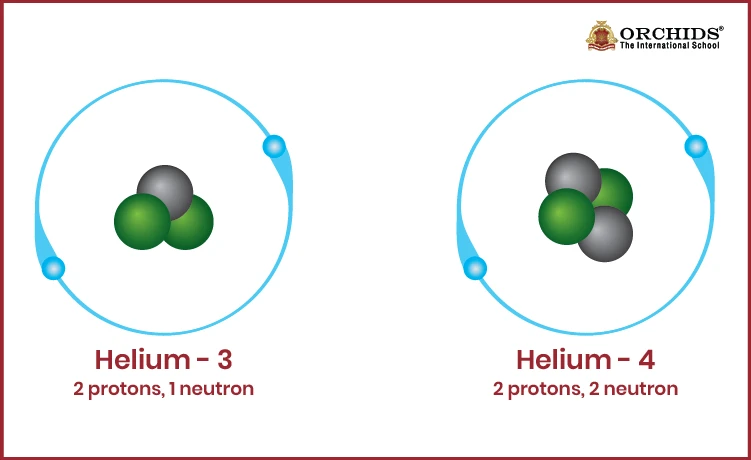
- Helium-3 (He-3);This is a rare isotope and has one neutron.
- Helium-4 (He-4); This is the most common isotope, making up over 99% of naturally occurring helium. It has two protons and two neutrons.
Though both are stable, Helium-4 is the isotope we encounter most often.
Also Read: 118 elements and their symbols and atomic number
Physical Properties of Helium
Helium is unlike most other elements in several interesting ways:
|
Property |
Description |
|
State at Room Temperature |
Gas |
|
Colour and Smell |
Colourless and odourless |
|
Density |
Much lighter than air |
|
Boiling Point |
Extremely low at –268.9°C (just a few degrees above absolute zero) |
|
Solubility |
Slightly soluble in water |
|
Inert Nature |
Chemically unreactive under normal conditions |
It’s also the only element that doesn’t solidify under standard pressure, even at extremely low temperatures, making it vital in cryogenics.
Chemical Properties of Helium
Helium is known for being chemically inert, which means when exposed to air, it will not react easily that is:
- It doesn’t easily form compounds with other elements.
- It does not support combustion (a helium-filled balloon won’t catch fire like a hydrogen-filled one).
- Its valence shell is full with two electrons, making it highly stable.
In laboratory conditions, some helium compounds have been artificially created, but they are extremely rare and unstable.
Uses of Helium in the Real World
Helium Uses have various applications that are surprisingly serious and scientific:
- Helium is used as a coolant in MRI scanners and scientific devices because of its very low boiling point. Furthermore, in Medical Imaging, helium serves as a cooled superconducting magnet that is critical in MRI scanners.
- In welding, helium is used as a shielding gas in arc welding to avoid oxidation.
- The most curious aspect of Helium is that it performs best in Space Exploration, such as in pressurised fuel tanks in rockets.
- Helium in Leak Detection is utilised to sense tiny leaks in pipelines and high-vacuum systems.
Even though helium is found in abundance in the universe, it's relatively rare on Earth, and once released into the atmosphere, it escapes into space, making its conservation important.
Frequently Asked Questions on Helium
1. What are 5 fun facts about helium?
Helium was first detected in the Sun before its discovery on Earth. It won't burn, makes your voice sound squeaky, inflates balloons, and cools down supermachines.
2. What are 5 uses of helium?
Helium is utilised in MRI equipment, weather balloons, deep-sea diving tanks, making semiconductors, and rocket fuel components.
3. What is helium?
Helium is the only element that never freezes at atmospheric pressure, it can be kept in liquid form even at temperatures near absolute zero.
4. Why is helium-3 so valuable?
Helium-3 is a scarce isotope that could be employed in future nuclear fusion power plants to produce clean, harmless energy with minimal risk of radiation.
5. Why do helium balloons float?
Helium is lighter than air, so it floats. This is what makes balloons and even airships fly off the ground.
6. Is helium safe to breathe in?
It might sound humorous, but breathing in helium is dangerous. It makes oxygen harder to breathe and, in sufficient quantities, makes a person dizzy or even gives them a sort of oxygen starvation.
Science isn't just a subject, it's the way of seeing the world. Curious how Orchids The International School teaches it that way? Talk to our admissions team.
Admissions Open for 2026-27
What type of concept pages would you prefer?
CBSE Schools In Popular Cities
- CBSE Schools in Bangalore
- CBSE Schools in Mumbai
- CBSE Schools in Pune
- CBSE Schools in Hyderabad
- CBSE Schools in Chennai
- CBSE Schools in Gurgaon
- CBSE Schools in Kolkata
- CBSE Schools in Indore
- CBSE Schools in Sonipat
- CBSE Schools in Delhi
- CBSE Schools in Rohtak
- CBSE Schools in Bhopal
- CBSE Schools in Aurangabad
- CBSE Schools in Jabalpur
- CBSE Schools in Jaipur
- CBSE Schools in Jodhpur
- CBSE Schools in Nagpur
- CBSE Schools in Ahmednagar
- CBSE School In Tumkur











Orchids The International School is one of India's leading chains of CBSE and ICSE schools, with 130+ schools across the country.