

Chloroform (CHCl₃):Properties, Structure and Uses Explained
Chloroform (CHCl₃) is a colourless liquid with a deceptively sweet smell. Discovered in 1831, it was once the go-to drug for knocking patients out before surgery. But how safe was it, really?Today it is no longer used as an anaesthetic, yet it remains everywhere in labs, dentistry, and industry. It won't catch fire, it sinks in water, and when handled carefully, it's surprisingly manageable.So what makes chloroform both fascinating and dangerous? This article breaks down its properties, uses, chemistry, preparation, and safety in plain, simple language.What if a single sniff could put you to sleep or worse, kill you? Lets Learn more...
Table of Contents
- What is Chloroform
- Physical Properties of Chloroform
- Chemical Properties of Chloroform
- Preparation of Chloroform
- Uses of Chloroform
- Frequently Asked Questions on Chloroform

What is Chloroform?
Chloroform (CHCl₃) is an organic chemical with a distinctive sweet, ether-like aroma. When it comes to its appearance, it is a clear, dense liquid that does not ignite easily, making it safer than many other volatile solvents.
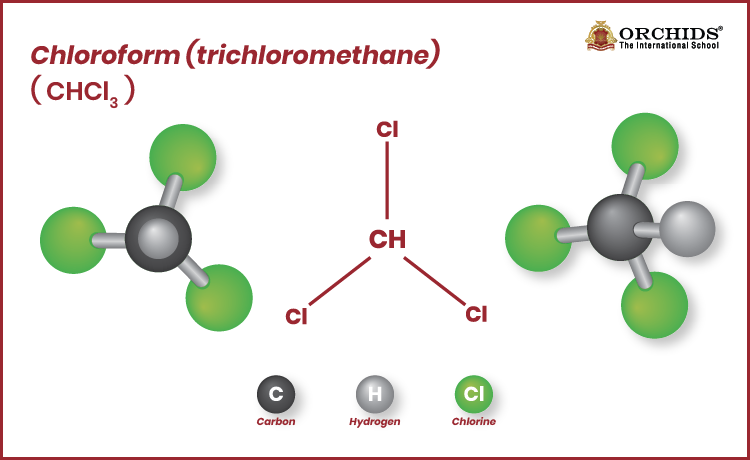
Its versatility allows it to be used in medicine, industry, and research, though it must always be handled with care due to its potential toxicity if misused.
Next is Chloroform, which has some notable physical and chemical traits that help us to identify it easily among all. Let's discuss it.
Physical Properties of Chloroform
|
Property |
Value |
|
Appearance |
Clear, colourless liquid |
|
Odour |
Sweet, ether-like |
|
Density |
1.49 g/cm³ |
|
Molecular Weight |
119.38 g/mol |
|
Boiling Point |
61.2 °C |
|
Melting Point |
-63.5 °C |
|
Solubility |
Practically insoluble in water |
These properties make it a useful solvent and easy to handle under controlled conditions.
Chemical Properties of Chloroform
Chloroform can react with other chemicals in ways that are important both industrially and in labs:
Reaction with Sodium Hydroxide:
Chloroform reacts with strong bases like NaOH to form sodium formate and sodium chloride:
Oxidation Reaction:
In the presence of oxygen, chloroform can form phosgene, a highly toxic compound, along with HCl:
These reactions highlight why safe handling and storage are essential when working with chloroform.
Preparation of Chloroform
Traditionally, chloroform was produced by the reaction of alcohol or acetone with bleaching powder.
Industrially, it is often made by chlorinating methane or other organic compounds under controlled conditions. This ensures a high-purity product for medical, laboratory, and industrial use.
Haloform Reaction (Laboratory Method):
Chloroform is prepared by reacting acetone or ethanol with bleaching powder or alkali.
$\,\text{C}_2\text{H}_5\text{OH} + 3\text{Cl}_2 + 4\text{NaOH} \rightarrow \text{CHCl}_3 + \text{HCOONa} + 3\text{NaCl} + 2\text{H}_2\text{O}\,$
This reaction produces chloroform along with a carboxylate salt and water, and is widely used in labs.
Industrial Method (Chlorination of Methane):
Methane is successively chlorinated under UV light to produce chloroform:
CH4→CH3Cl→CH2Cl2→CHCl3
Each step releases HCl, and this method allows large-scale production for industrial applications.
Uses of Chloroform
- Medical Applications:
Historically, chloroform was a widely used anaesthetic for surgeries and dental procedures like root canals. But the fact that today, safer anaesthetics are preferred, chloroform remains a reference chemical in medical studies. - Laboratory Uses:
Chloroform is an excellent solvent for extracting fats, oils, and greases. It also finds use in spectroscopy and chromatography for analysing chemical compounds. - Industrial Applications:
Chloroform is used in making adhesives, resins, and other chemicals and provides a variety of perks in the industrial sector.It's important to know that it sometimes appears as a component in indirect food additives and in the production of pharmaceuticals and pesticides. - Historical Uses: It was once common in dry cleaning and laundry as a grease and oil solvent, though this use has largely been discontinued due to toxicity concerns.
Safety Measures and Handling While Handling Chloroform
Although non-flammable, chloroform can be toxic if inhaled or ingested. Some key safety practices include:
- Always use in a well-ventilated area or fume hood
- Wear gloves, goggles, and protective clothing
- Store in airtight containers away from heat and sunlight
- Avoid prolonged skin contact or inhalation
Understanding these precautions is vital to prevent accidental exposure.
But when we talk about the Environmental Impact of Chloroform, Chloroform can persist in soil and water if disposed of improperly, potentially harming aquatic life. Interestingly! Industrial facilities follow strict regulations to minimise environmental contamination. Proper disposal and controlled usage help mitigate these risks.
Read More: Alcohol Structure
We learned that chloroform chemistry is a versatile and historically significant chemical with applications in medicine, laboratories, and industry, and one should appreciate its usefulness while minimising risks.
Frequently Asked Questions on Chloroform
1. What is Chloroform?
Chloroform is a clear, sweet-smelling organic chemical used in labs, industry, and medicine. It is also known as trichloromethane.
2. What is the Chloroform formula?
The chemical formula of chloroform is CHCl₃. It consists of one carbon, one hydrogen, and three chlorine atoms.
3. Mention the Uses of chloroform
Chloroform is used as a solvent in laboratories, in making adhesives and chemicals, and historically as an anaesthetic.
4. How to prepare chloroform?
Chloroform can be prepared by reacting acetone or ethanol with bleaching powder, or by chlorinating methane under controlled conditions.
5. What is chloroform mostly used for?
Today, chloroform is mostly used in laboratories as a solvent and in chemical industries to make other compounds.
Science isn't just a subject, it's the way of seeing the world. Curious how Orchids The International School teaches it that way? Talk to our admissions team.
Admissions Open for 2026-27
What type of concept pages would you prefer?
CBSE Schools In Popular Cities
- CBSE Schools in Bangalore
- CBSE Schools in Mumbai
- CBSE Schools in Pune
- CBSE Schools in Hyderabad
- CBSE Schools in Chennai
- CBSE Schools in Gurgaon
- CBSE Schools in Kolkata
- CBSE Schools in Indore
- CBSE Schools in Sonipat
- CBSE Schools in Delhi
- CBSE Schools in Rohtak
- CBSE Schools in Bhopal
- CBSE Schools in Aurangabad
- CBSE Schools in Jabalpur
- CBSE Schools in Jaipur
- CBSE Schools in Jodhpur
- CBSE Schools in Nagpur
- CBSE Schools in Ahmednagar
- CBSE School In Tumkur











Orchids The International School is one of India's leading chains of CBSE and ICSE schools, with 130+ schools across the country.