

Balanced Chemical Equations
Balanced Chemical Equations- Have you ever seen vinegar and baking soda fizz together? The bubbling is an indicator of a chemical change. Chemical reactions are taking place, and we can show the change with a chemical equation. Also, how to balance them. This is how nature keeps everything in balance!
This article breaks down and explains why balancing matters, how to do it correctly, and walks you through examples that make the process easy to follow and remember.
Table of Contents
- What are Chemical equations?
- Balancing Chemical Equations
- Ionic Chemical Equations
- Why balancing is important in chemistry
- Tips to understand the Balancing Chemical Equation
- Frequently Asked Questions on Balanced Chemical Equations

What are Chemical equations?
A chemical equation provides a symbol and formula that allows us to describe reactions in a simple, clear way. Think of a skeleton equation as a rough bone of a reaction. It lists what’s reacting and what’s being produced but doesn’t tell us how much of each is involved yet.
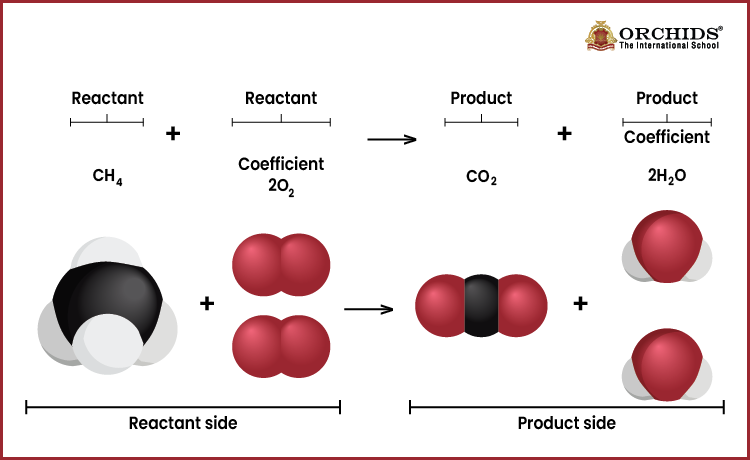
What’s on each side of an equation?
- Reactants: The starting substances (on the left)
- Products: The substances formed (on the right)
Skeleton equations give us a clear starting point to work from-and balancing makes them accurate. Once we know what is reacting, we can move ahead to balance the equation.
Instead of writing out lengthy names for the substances, we use short chemical symbols, such as H₂ (hydrogen) or O₂ (oxygen), in a chemical equation.
Let's look at a basic reaction:
This reaction shows us that hydrogen and oxygen make water, but that's not completely correct-the number of atoms must be the same on both sides.
- This is the correct representation of the reaction:
What this tells us is that two hydrogen molecules and one oxygen molecule will react together to form two molecules of water.
Balancing Chemical Equations
Balancing a chemical equation means making sure you have the same number of each type of atom on both sides.
This follows the Law of Conservation of Mass that matter can't be created or destroyed in a reaction.
- How to Balance a Chemical Equation:
- Write the unbalanced equation.
- State the correct formulas for the reactants and products.
- Count the number of atoms for each element.
- Confirm the number of atoms of each element on both sides.
- Change with coefficients.
- Put whole numbers in front of compounds to balance the atoms. Do not change the subscripts.
- Adjust as needed.
- Keep adjusting until all elements are balanced.
- Double-check your answer.
- Ensure that everything is the same on both sides.
Example: methane's combustion
Unbalanced:
Balancing steps:
Carbon: 1 on each side
- Hydrogen: 4 on the left, 2 on the right → put a 2 in front of H₂O:
- Oxygen: 2 in CO₂ and 2 in H₂O = 4 total → put a 2 in front of O₂:
Everything now adds up perfectly.
Ionic Chemical Equations
Sometimes reactions happen in water and involve ions. In these cases, we can write ionic equations that show how the individual ions behave.
In ionic equations, we break down the compounds into the ions they form when dissolved in water. This helps us see which particles are actually changing during the reaction.
Example: Sodium chloride reacts with silver nitrate
- Molecular Equation:
- Ionic Equation:
Here, Na⁺ and NO₃⁻ appear on both sides; they don’t actually change.
- Net Ionic Equation:
This is the heart of the reaction-silver and chloride ions form solid silver chloride.
Why is Balancing Important in Chemistry
- The backbone of chemistry consists of simple, balanced, or ionic chemical equations.
- Chemical balancing equations give us an understanding of what’s happening when we encounter everything from everyday chemical reactions to the most complex chemistry lab experiments.
- Once you understand how to read and balance chemical equations, it is like you have unlocked the language of chemistry.
Tips to understand the Balancing Chemical Equation
- Make sure you count the atoms on both sides before balancing.
- Do not change the actual formulas of the compounds-use coefficients in front of them only.
- Start with the most complex molecule, and then go with the simpler ones.
- If the reactions are in Solution, look for ions that do not change- they are just spectators!
- Recognising the differences between a molecular equation and a net ionic equation can help you get to the 'heart of the reaction'.
Knowing how to read and balance chemical equations helps you understand what is happening in a reaction, not just what you see, but also what is happening invisibly between atoms and molecules.
Frequently Asked Questions on Balanced Chemical Equations
1. What are balanced chemical equations?
Balanced chemical equations show that the number of atoms for each element is the same on both sides of a reaction. It’s a key step in understanding real chemistry.
2. What are chemical equations?
Chemical equations are like the language of chemistry; they show how substances change during a reaction, from reactants to products, using symbols and formulas.
3. Why is balancing chemical equations important?
Balancing chemical equations ensures mass is conserved, meaning nothing is lost or gained. It’s essential for accurate calculations and understanding chemical behaviour.
4. How do you balance equations in chemistry?
To balance equations, adjust the numbers (coefficients) in front of molecules so the number of atoms for each element is equal on both sides. Orchids International helps students master this skill step by step with guided practice, which helps students to crack exams.
5. What are the common mistakes when balancing chemical equations?
Many students change the chemical formulas instead of using coefficients, or forget to balance every element, especially oxygen and hydrogen.
6. What is guaranteed by balancing chemical equations?
Balancing ensures that no atoms are lost or gained-it follows the Law of Conservation of Mass, making the equation scientifically accurate.
7. Which method is easiest for balancing chemical equations?
The trial-and-error method is easiest for beginners-start with the most complex molecule and adjust coefficients step by step.
8. What are the big rules of balancing a chemical equation?
Never change subscripts in a formula; only adjust coefficients. And always make sure the number of atoms for each element matches on both sides.
Science isn't just a subject, it's the way of seeing the world. Curious how Orchids The International School teaches it that way? Talk to our admissions team.
Admissions Open for 2026-27
What type of concept pages would you prefer?
CBSE Schools In Popular Cities
- CBSE Schools in Bangalore
- CBSE Schools in Mumbai
- CBSE Schools in Pune
- CBSE Schools in Hyderabad
- CBSE Schools in Chennai
- CBSE Schools in Gurgaon
- CBSE Schools in Kolkata
- CBSE Schools in Indore
- CBSE Schools in Sonipat
- CBSE Schools in Delhi
- CBSE Schools in Rohtak
- CBSE Schools in Bhopal
- CBSE Schools in Aurangabad
- CBSE Schools in Jabalpur
- CBSE Schools in Jaipur
- CBSE Schools in Jodhpur
- CBSE Schools in Nagpur
- CBSE Schools in Ahmednagar
- CBSE School In Tumkur











Orchids The International School is one of India's leading chains of CBSE and ICSE schools, with 110+ schools across the country.