

Uses of Hydrochloric Acid in Everyday Life Explained
Uses of Hydrochloric acid (HCl) are one of the most important acids in chemistry and industry, as well as in our daily lives. You might know it as the acid in your stomach that helps digest food, but its role goes far beyond biology. From refining metals to purifying salt, HCl is a key player in manufacturing, cleaning, and chemical reactions, serving a major role in all sectors.This article provides insight into all the major uses of hydrochloric acid, explaining the chemical reactions to understand and learn the uses of hydrochloric acid in everyday life.
Table of Contents
- What is Hydrochloric acid
- Hydrochloric Acid in Daily Life
- Safety Guidelines for Using Hydrochloric Acid
- Frequently Asked Questions on Uses of Hydrochloric Acid

What is Hydrochloric Acid?
Hydrochloric acid (chemical formula HCl) is formed when hydrogen chloride gas dissolves in water, creating a clear, highly acidic solution.
When it comes to its preparation part, HCl is manufactured commercially by burning hydrogen and chlorine gases together or by recovering it as a by-product of chlorination processes.
Interestingly! In its pure form, hydrochloric acid is colourless, but commercial grades may appear slightly yellow due to dissolved iron or other impurities.
Its sharp, pungent smell makes it easily recognisable, and reagent-grade solutions are typically around 37% HCl.
Hydrochloric Acid in Daily Life
Below are some listed and explained major uses of hydrochloric acid:
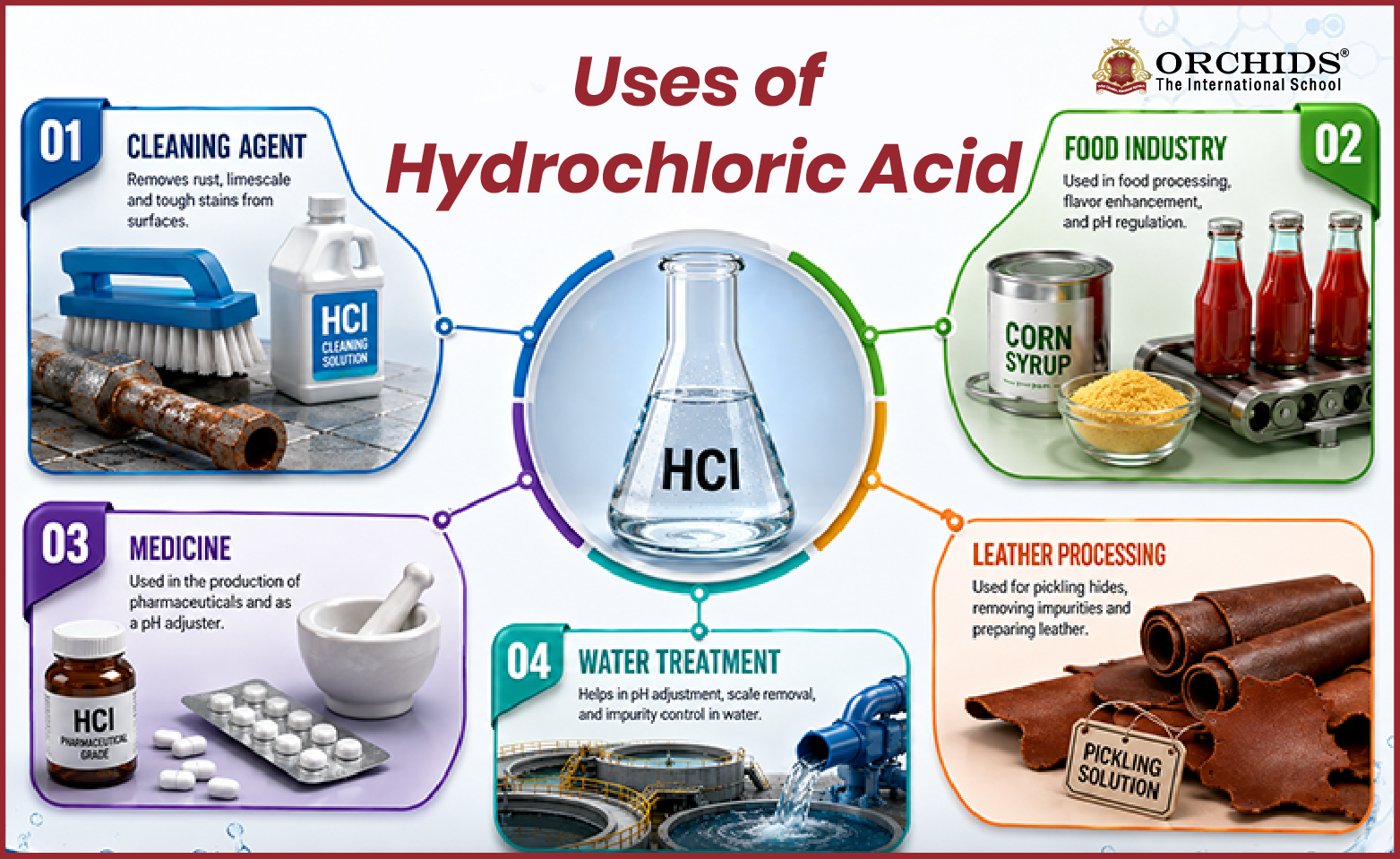
1. Uses of hydrochloric acid in the stomach. Did you know your body is a natural HCl factory? Your stomach produces hydrochloric acid every day.
Its job is to break down food, activate digestive enzymes, and kill harmful bacteria. Without HCl, proteins wouldn’t break down properly, and many germs could survive in your gut.
Without HCl, digestion would be less efficient, and harmful bacteria could survive in your gut.
2. In Industrial Cleaning and Metal Treatment, Hydrochloric acid is widely used to remove rust and scale from metals, a process called pickling. For example, in steel production:
This reaction removes the iron oxide layer from steel, leaving a clean surface for galvanising or welding. HCl is also used to clean tiles, stones, and ceramics in construction.
3. Production of Organic Compounds,HCl helps produce many everyday plastics and solvents.
For example, it’s essential for making vinyl chloride (C₂H₃Cl), which is polymerised into PVC (polyvinyl chloride) used in pipes, cables, and packaging.
It’s also used to produce dichloromethane (a solvent) and bisphenol A (for resins).
4. Production of Inorganic Compounds and Water Treatment, Hydrochloric acid is used to prepare important compounds like:
- Iron(III) chloride (FeCl₃) is used as a water treatment chemical.
- Polyaluminium chloride (PAC) is used for purifying drinking water.
Example reaction for iron chloride production:
HCl also regenerates ion-exchange resins in water softening systems, ensuring consistent water quality.
5. In Oil and Gas Industry Applications, it contributes a lot, as in petroleum wells, HCl is injected into rocks to dissolve carbonate deposits, enlarging pores for oil flow.
This process is known as acidising. It significantly increases crude oil extraction efficiency.
6. The fact that in food processing and salt purificationHydrochloric acid is surprisingly common in food-related industries.
It’s used to purify table salt, adjust acidity in foods, and convert starch into sugars like glucose or corn syrup.
7. It has noticeable household and construction uses as it is all related to our daily lives.
Diluted hydrochloric acid, commonly called muriatic acid, is found in many households for:
- Cleaning tough stains on bathroom tiles.
- Removing calcium deposits from faucets and sinks.
- Adjusting swimming pool pH to maintain clean, safe water.
8. Laboratory and Research Applications,In laboratories, HCl is a staple for:
- pH adjustment during experiments.
- Preparing buffer solutions.
- Dissolving metal oxides and salts for analysis.
9. For Manufacturing Glue, Gelatin, and Rubber,Hydrochloric acid is used in processing animal bones and hides to make glue and gelatin.
In the rubber industry, it helps in producing synthetic rubber products used in tyres, shoes, and industrial goods.
10. Have you ever heard about Aqua Regia for Noble Metals?When mixed with nitric acid (HNO₃) in a 3:1 ratio, hydrochloric acid forms aqua regia, a powerful mixture that dissolves gold and platinum:
This is why HCl is crucial in refining precious metals.
11. HCl is used in battery manufacturing to prepare metal chlorides and purify raw materials.
Its strong acidity makes it valuable in chemical reactions inside industrial battery production.
Safety Guidelines for Using Hydrochloric Acid
- Wear protective gear like gloves, goggles, and aprons.
- Work in ventilated areas, just avoid inhaling fumes.
- Dilute correctly, keep in mind that you always add acid to water, not water to acid.
- Proper storage is mandatory for the use of corrosion-resistant containers away from heat.
- An emergency tip that one should keep in mind while handling hydrochloric acid is that in case of skin contact, rinse immediately with plenty of water.
Also Read: Uses of Acetic Acid and Uses of Acetone
As we learned, hydrochloric acid is everywhere, from your stomach to major industries. Its powerful reactions make it essential for cleaning, manufacturing, food processing, and even extracting oil.
Frequently Asked Questions on Uses of Hydrochloric Acid
1. What are the commercial uses of hydrochloric acid?
Hydrochloric acid is widely used in industries to produce chemicals, refine metals, and treat water. It’s a key player behind many everyday products.
2. What are the uses of hydrochloric acid in industry?
Industries use HCl for cleaning metals, making fertilisers, and producing PVC and other chemicals. It helps processes run smoothly and efficiently.
3. What are the Uses of hydrochloric acid?
HCl is used in labs, factories, and even at home for cleaning, metal treatment, and chemical production. It’s a versatile chemical with many roles.
4. How to use HCl for cleaning?
Always dilute hydrochloric acid before use and wear gloves. It works well on tough mineral deposits, but safety comes first!
5. Where do you use hydrochloric acid?
You’ll find it in homes for cleaning, in factories for metal treatment, and in labs for experiments. Its uses are truly widespread.
6. What is hydrochloric acid used for in medicine?
HCl helps the stomach digest food and is also used to prepare certain medicines. It plays a hidden but important role in health.
7. What happens if hydrochloric acid touches skin?
It can burn or irritate the skin instantly, so rinse immediately with plenty of water and seek help if needed.
Science isn't just a subject, it's the way of seeing the world. Curious how Orchids The International School teaches it that way? Talk to our admissions team.
Admissions Open for 2026-27
What type of concept pages would you prefer?
CBSE Schools In Popular Cities
- CBSE Schools in Bangalore
- CBSE Schools in Mumbai
- CBSE Schools in Pune
- CBSE Schools in Hyderabad
- CBSE Schools in Chennai
- CBSE Schools in Gurgaon
- CBSE Schools in Kolkata
- CBSE Schools in Indore
- CBSE Schools in Sonipat
- CBSE Schools in Delhi
- CBSE Schools in Rohtak
- CBSE Schools in Bhopal
- CBSE Schools in Aurangabad
- CBSE Schools in Jabalpur
- CBSE Schools in Jaipur
- CBSE Schools in Jodhpur
- CBSE Schools in Nagpur
- CBSE Schools in Ahmednagar
- CBSE School In Tumkur











Orchids The International School is one of India's leading chains of CBSE and ICSE schools, with 110+ schools across the country.