

Carboxyl Group (-COOH): Structure, Properties, and Uses Explained
The carboxyl group may look like a tiny part of a molecule, but it plays a huge role in chemistry and daily life. Found in acids that give vinegar its sourness and in compounds that preserve food, this group defines the nature of carboxylic acids.
The article aims to make the concept of the carboxyl group simple, clear, and relatable by explaining its formula, structure, properties, and preparation with real-world connections.
Table of Contents
- Carboxyl Group in Chemistry
- Properties of Carboxyl Group
- Frequently Asked Questions on Carboxyl Group

Carboxyl Group in Chemistry
When you think of sour foods like vinegar, citric fruits, or even preservatives in packed foods, one thing they all have in common is the carboxyl group (–COOH). It is a functional group in organic chemistry that gives compounds their acidic nature and unique properties.
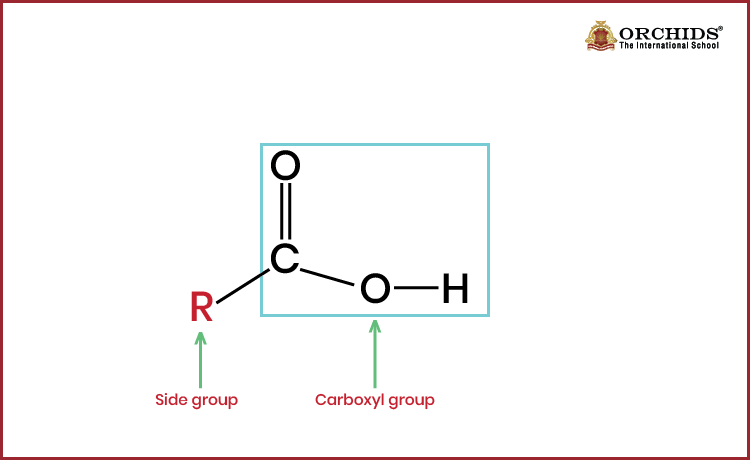
A carboxyl group is a combination of two smaller groups:
- A carbonyl group (C=O) → carbon double-bonded to oxygen.
- A hydroxyl group (–OH) → oxygen bonded to hydrogen.
Together, they form –COOH, also written as carboxyl group. Compounds containing carboxyl groups are known as carboxylic acids, which are an important class of organic compounds found in living organisms and industrial applications.
When it comes to biology, carboxyl groups are part of amino acids (the building blocks of proteins) and fatty acids (components of lipids). In everyday life, they show up in vinegar (acetic acid), preservatives (benzoic acid), and medicines.
Interestingly!! The structure of the carboxyl group is what gives it its acidic behaviour but how?
Lets Discuss Carboxyl Group Structure!
- The carbon atom of the carboxyl group is sp² hybridised, which makes the group planar (flat) with bond angles close to 120°.

- When it comes to polarity ,the C=O bond is highly polar, meaning electrons are not shared equally, making the carbon atom slightly positive.
- The O–H bond of the hydroxyl group is also polar, which makes it easy for the hydrogen atom to break off as a proton (H⁺).
This ability to release a proton is the reason carboxylic acids behave as weak acids in water.
Examples of Molecules Containing the Carboxyl Group in Daily Life:
- Acetic acid (CH₃COOH): Found in vinegar, the –COOH group gives it a sharp, sour taste.
- Benzoic acid (C₆H₅COOH): Commonly used as a preservative in foods and beverages; its carboxyl group is responsible for its chemical reactivity.
- Formic acid (HCOOH): Present in ant stings and bee venom; the carboxyl group contributes to its acidic nature.
Note: These examples are molecules containing the carboxyl group, which is the functional part responsible for their acidity, hydrogen bonding, and chemical behavior.
Properties of Carboxyl Group
Carboxyl groups give special properties to the compounds they are part of:
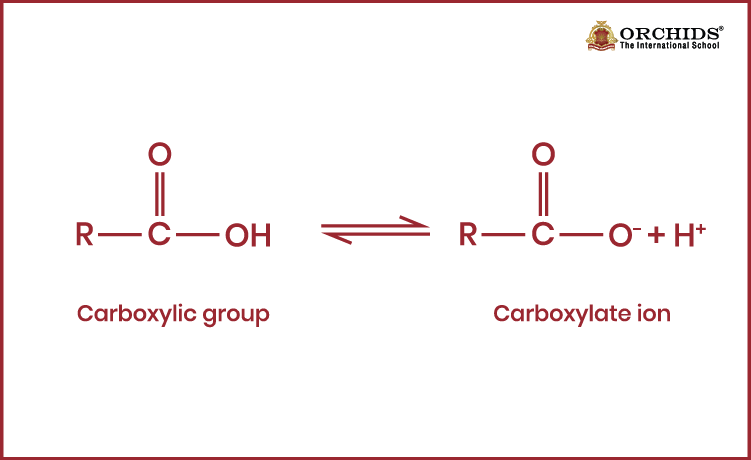
- Acidic Nature of Carboxylic acids makes it capable to donate a proton (H⁺) in aqueous solution.
- The contribution to hydrogen bonding that is the –OH group can form hydrogen bonds with water molecules.

This makes smaller carboxylic acids (up to 4 carbons) highly soluble in water.
- The fact about the carboxylic acid group is due to strong hydrogen bonding between molecules, carboxylic acids have higher boiling points compared to alcohols or ketones of similar molecular mass.
- When it comes to odour and taste lower carboxylic acids (like formic and acetic acid) have sharp, sour smells and tastes. Likewise higher carboxylic acids are waxy or greasy in nature.
- The most important of all is its reactivity, that is the carbon atom in the C=O group is electrophilic, making it a site for reactions like
- esterification
- reduction
- nucleophilic substitution
Carboxylic acids and their derivatives (esters, acyl chlorides, anhydrides) are central to organic synthesis.
- One of the most important features of the carboxyl group is resonance stabilisation, that is after losing a proton, the negative charge left behind is shared equally between the two oxygen atoms.

This delocalisation stabilises the carboxylate ion, making the release of H⁺ easier.This explains why carboxylic acids are stronger acids than alcohols or phenols.
Read More: Carbon monoxide
We learned that the carboxyl group (–COOH) formula may look simple, but it is one of the most influential functional groups in chemistry. From the sourness of vinegar and the sting of ants to life-saving medicines and preservatives, carboxylic acids are everywhere.
Frequently Asked Questions on Carboxyl Group
1. Which does not have a carboxyl group?
Compounds like alcohols, ketones, and alkanes do not have a carboxyl group. Only carboxylic acids and their derivatives carry the –COOH group.
2. What are the facts about carboxyl groups?
The carboxyl group is highly polar, makes acids weakly acidic, and allows hydrogen bonding. It is also common in biomolecules like amino acids and fatty acids.
3. Can carboxyl groups act as weak?
Yes, carboxyl groups act as weak acids. They donate protons (H⁺) in water but do not completely dissociate like strong mineral acids.
4. What is another name for a carboxyl group?
Another name for a carboxyl group is the carboxylic acid functional group, since it defines the chemistry of carboxylic acids.
5. What is the carboxylic acid functional group?
The carboxylic acid functional group is written as –COOH, made of a carbonyl (C=O) and a hydroxyl (–OH) linked to the same carbon. It gives acids their sour taste and reactivity.
6. What is the carboxylic group formula?
The carboxylic group formula is –COOH. This simple group is responsible for the acidic behaviour and many properties of carboxylic acids.
Science isn't just a subject, it's the way of seeing the world. Curious how Orchids The International School teaches it that way? Talk to our admissions team.
Admissions Open for 2026-27
What type of concept pages would you prefer?
CBSE Schools In Popular Cities
- CBSE Schools in Bangalore
- CBSE Schools in Mumbai
- CBSE Schools in Pune
- CBSE Schools in Hyderabad
- CBSE Schools in Chennai
- CBSE Schools in Gurgaon
- CBSE Schools in Kolkata
- CBSE Schools in Indore
- CBSE Schools in Sonipat
- CBSE Schools in Delhi
- CBSE Schools in Rohtak
- CBSE Schools in Bhopal
- CBSE Schools in Aurangabad
- CBSE Schools in Jabalpur
- CBSE Schools in Jaipur
- CBSE Schools in Jodhpur
- CBSE Schools in Nagpur
- CBSE Schools in Ahmednagar
- CBSE School In Tumkur











Orchids The International School is one of India's leading chains of CBSE and ICSE schools, with 130+ schools across the country.