

Polarity :Properties, Examples, and Applications
Polarity is a key concept in chemistry that explains why molecules behave differently in reactions and solutions. It's interesting to know that it occurs when there is an uneven distribution of electrical charge in a molecule, leading to positive and negative ends.
This article explains what polarity actually means, types, examples, and real-life importance in simple terms, also helping learners understand molecules and their interactions in a practical way.
Table of Contents
- What is Polarity?
- Types of Molecules Based on Polarity
- Factors Affecting Polarity
- Real-Life Examples of Polarity
- Frequently Asked Questions on Polarity?

What is Polarity?
In chemistry, polarity refers to the separation of electrical charge within a molecule. When atoms with different electronegativities form a bond, electrons are not shared equally.
The atom with higher electronegativity pulls electrons closer, creating a partial negative charge, while the other atom becomes partially positive.
Apart from chemistry Polarity is also observed in physics and electronics, where charges create positive and negative poles, similar to how charges distribute in molecules.
But the question is how polarity occurs in molecules?
Polarity arises due to differences in electronegativity:
Lets take an example what is observed in Hydrogen Fluoride (HF):
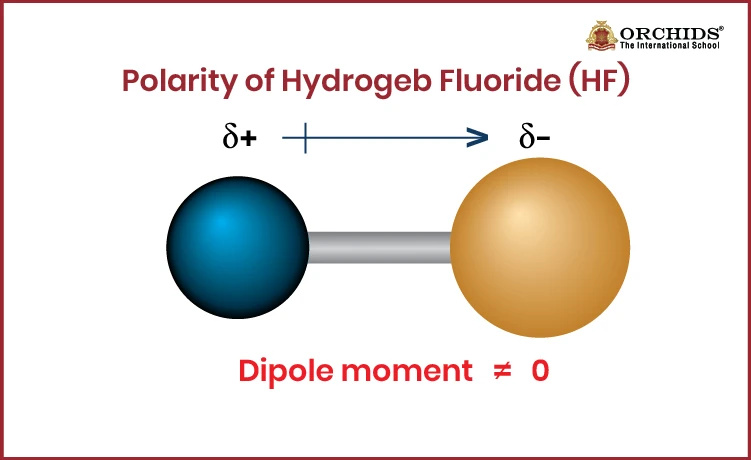
- Fluorine is more electronegative than hydrogen.
- Electrons spend more time around fluorine, making it slightly negative (δ⁻) and hydrogen slightly positive (δ⁺).
This unequal sharing of electrons gives the molecule a polar nature.
Next learn is molecules types based on the polarity:
Types of Molecules Based on Polarity
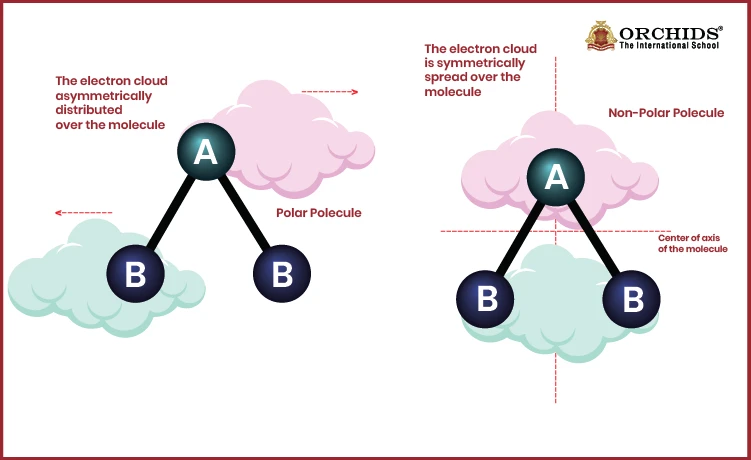
Below is the illustration of how polar molecules differ from non polar molecules:
1. Polar Molecules
Polar molecules have a positive end and a negative end due to uneven charge distribution.
- Shape matters that are molecules that are pyramid-shaped or V-shaped usually show polarity.
The Examples include:
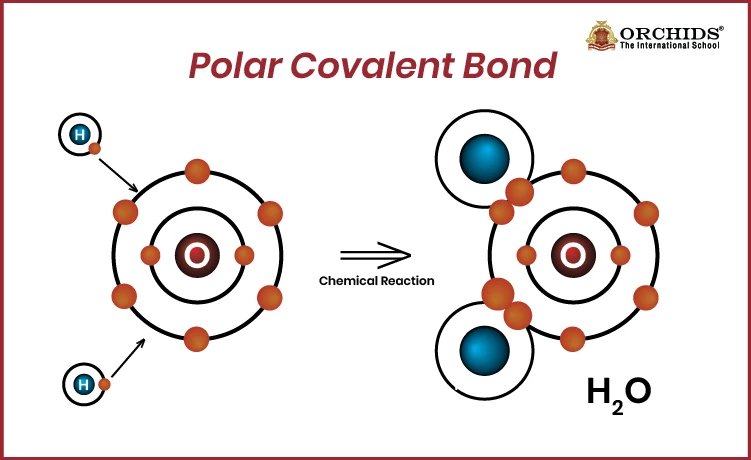
- Water (H₂O): Oxygen pulls electrons away from hydrogen, making water polar.
- Glucose (C₆H₁₂O₆): Uneven arrangement of oxygen and hydrogen creates polarity.
2. Non-Polar Molecules
The fact about Non-polar molecules is that they have evenly distributed electrons, so they do not have a positive or negative end.
- Shape matters, that is, Linear or symmetrical molecules are usually non-polar.
The Examples include:
- Carbon dioxide (CO₂): Linear structure cancels out dipoles, making it non-polar.
- Fats, oils, gasoline: Non-polar molecules do not mix with polar solvents like water.
Factors Affecting Polarity
- Electronegativity Differencethat is Larger differences in electronegativity between bonded atoms increase polarity.
- Another important factor is molecular shape like asymmetrical molecules tend to be polar; symmetrical molecules are often non-polar.
- Polarity also depends on bond type, that is, polar covalent bonds create dipoles, while non-polar covalent bonds do not.
Let's discuss the real life examples of polarity.
Real-Life Examples of Polarity
- Water’s polar nature allows it to pull ions apart and dissolve salt.
- Heard about?Oil and water separation, that is Non-polar oil does not mix with polar water molecules.
- The most common and noticeable one around us is non-stick cookware like Teflon’s strong carbon-fluorine bonds that are non-polar, preventing food from sticking.
- Polarity helps predict molecular interactions in the body, helping medicine and nutrition research as it plays an important role in drug design and nutrition.
While polarity has clear benefits in explaining solubility and bonding, there are some common misconceptions to understand and avoid confusion.
Common Misconceptions:
- Electronegativity vs. Electron Affinity: Electronegativity measures electron attraction in a bond, while electron affinity measures the ability to gain an electron.
- Noble gases: They usually do not have electronegativity values because they rarely form bonds.
- Metals vs. Nonmetals: Metals are not “bad” at bonding; they prefer to lose electrons rather than attract them like nonmetals.
As we learned that Polarity is a core concept in chemistry, explaining molecular behavior, solubility, and reactivity. Recognising polar and non-polar molecules helps us understand phenomena like water dissolving salt, oil separation, and chemical interactions in the body.
Frequently Asked Questions on Polarity?
1. What is Polarity?
Polarity is the uneven distribution of electrical charge in a molecule, giving it a positive and negative end. It explains why molecules behave differently in reactions and solutions.
2. What is polarisation?
Polarization is the process where the electrons in a molecule or bond are shifted toward one atom, creating a partial charge separation.
3. What is polar and nonpolar?
Polar molecules have a positive and negative end due to unequal electron sharing, while nonpolar molecules share electrons evenly and have no charge separation.
4. What is polarity?
Polarity refers to the separation of charges in a molecule, causing one side to be slightly positive and the other slightly negative.
5. Is water polar or nonpolar?
Water is polar because oxygen is more electronegative than hydrogen, pulling electrons toward itself and creating a dipole.
6. What is the purpose of polarity?
Polarity helps explain solubility, chemical reactivity, and molecular interactions in everyday life and laboratory chemistry.
7. What does polarity depend on?
Polarity depends on the difference in electronegativity between atoms and the shape of the molecule.
8. What are the two types of polarity?
The two types of polarity are bond polarity, which occurs within a single bond, and molecular polarity, which describes the overall dipole of a molecule.
9. Why does polarity change?
Polarity changes due to differences in electronegativity, molecular shape, or when atoms or substituents are added or removed.
10. How does polarity increase?
Polarity increases when the difference in electronegativity between bonded atoms grows or the molecular shape becomes more asymmetrical.
11. What is straight polarity?
Straight polarity occurs in linear molecules where the dipole is aligned along a single axis, creating a directional separation of charge.
Science isn't just a subject, it's the way of seeing the world. Curious how Orchids The International School teaches it that way? Talk to our admissions team.
Admissions Open for 2026-27
What type of concept pages would you prefer?
CBSE Schools In Popular Cities
- CBSE Schools in Bangalore
- CBSE Schools in Mumbai
- CBSE Schools in Pune
- CBSE Schools in Hyderabad
- CBSE Schools in Chennai
- CBSE Schools in Gurgaon
- CBSE Schools in Kolkata
- CBSE Schools in Indore
- CBSE Schools in Sonipat
- CBSE Schools in Delhi
- CBSE Schools in Rohtak
- CBSE Schools in Bhopal
- CBSE Schools in Aurangabad
- CBSE Schools in Jabalpur
- CBSE Schools in Jaipur
- CBSE Schools in Jodhpur
- CBSE Schools in Nagpur
- CBSE Schools in Ahmednagar
- CBSE School In Tumkur











Orchids The International School is one of India's leading chains of CBSE and ICSE schools, with 110+ schools across the country.