

Uses of Gypsum: Key Characteristics and Importance in Everyday Products
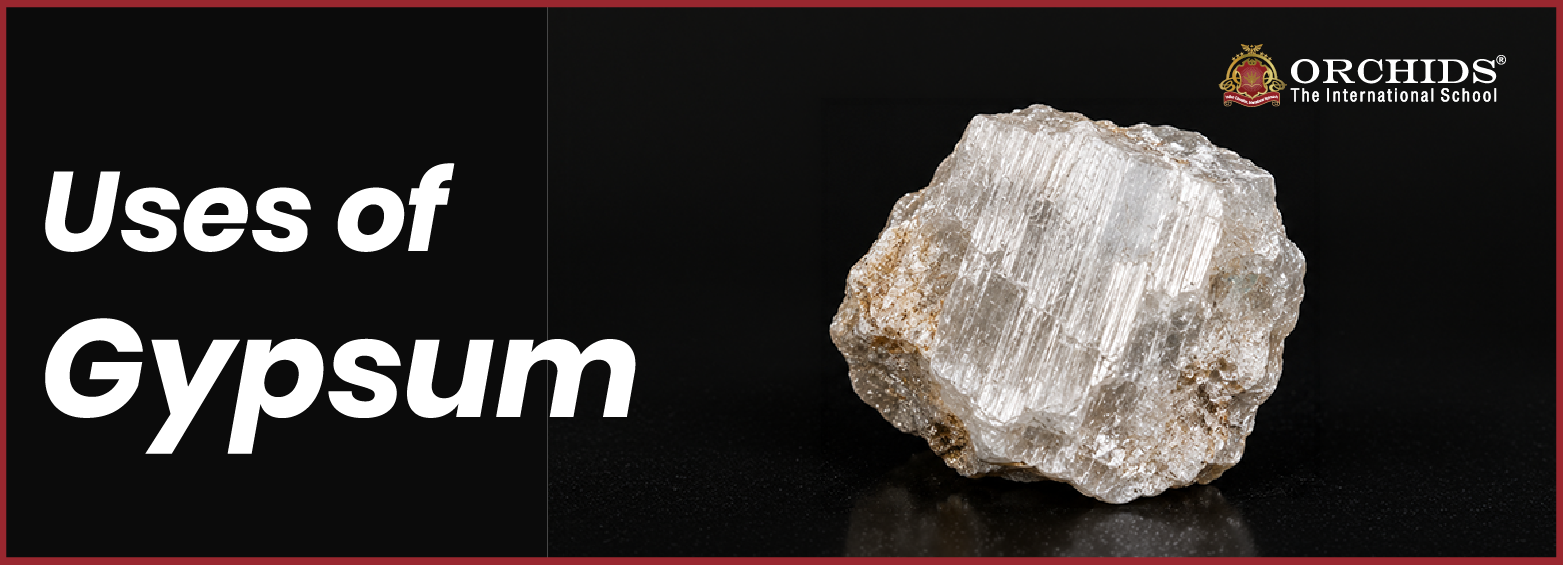
Gypsum may look like an ordinary white rock, but its uses touch nearly every part of life. Known scientifically as calcium sulfate dihydrate , gypsum has been used for thousands of years.
This article focuses on uses of gypsum showing how its special properties make homes safer, crops healthier, art more beautiful, and industries more efficient, as explained in a structured way.
Table of Contents
- What is Gypsum
- Why Gypsum Is So Widely Used
- Uses of Gypsum
- Frequently Asked Questions on Uses of Gypsum

What is Gypsum?
Gypsum is a naturally occurring mineral made of calcium, sulfur, oxygen, and water.
Interestingly !! It forms when seawater or lake water evaporates, leaving layers of crystals. Its softness makes it easy to shape, yet when heated and rehydrated, it hardens again, a property that underpins many of its uses.
The key reaction that makes gypsum versatile is:
This transformation produces plaster of Paris, which sets hard when mixed with water:
Why Gypsum Is So Widely Used
Gypsum’s popularity comes from its unique properties that make it useful in different sectors.
- It is fire-resistant and provides safety in construction.
- It does not alter soil pH, making it gentle on plants.
- It’s abundant, affordable, and non-toxic, so it can be used in food, art, and medicine.
- It can switch between hard and soft states through heating and rehydration, offering versatility unmatched by many other minerals.
Here are Some Additional Insights on Gypsum:
- Synthetic Gypsumin Power plants and industries produces synthetic gypsum as a by-product. When purified, it works just like natural gypsum, reducing the need for mining.
- Historical Use: Ancient Egyptians used gypsum plaster in the Pyramids, proving its long-standing value.
- Researchers are exploring gypsum composites for lighter, more durable building materials and eco-friendly concrete alternatives for Future Technologies.
Uses of Gypsum
Gypsum shows a variety of properties that make it perfectly suitable to use in different sectors, serving a useful purpose.
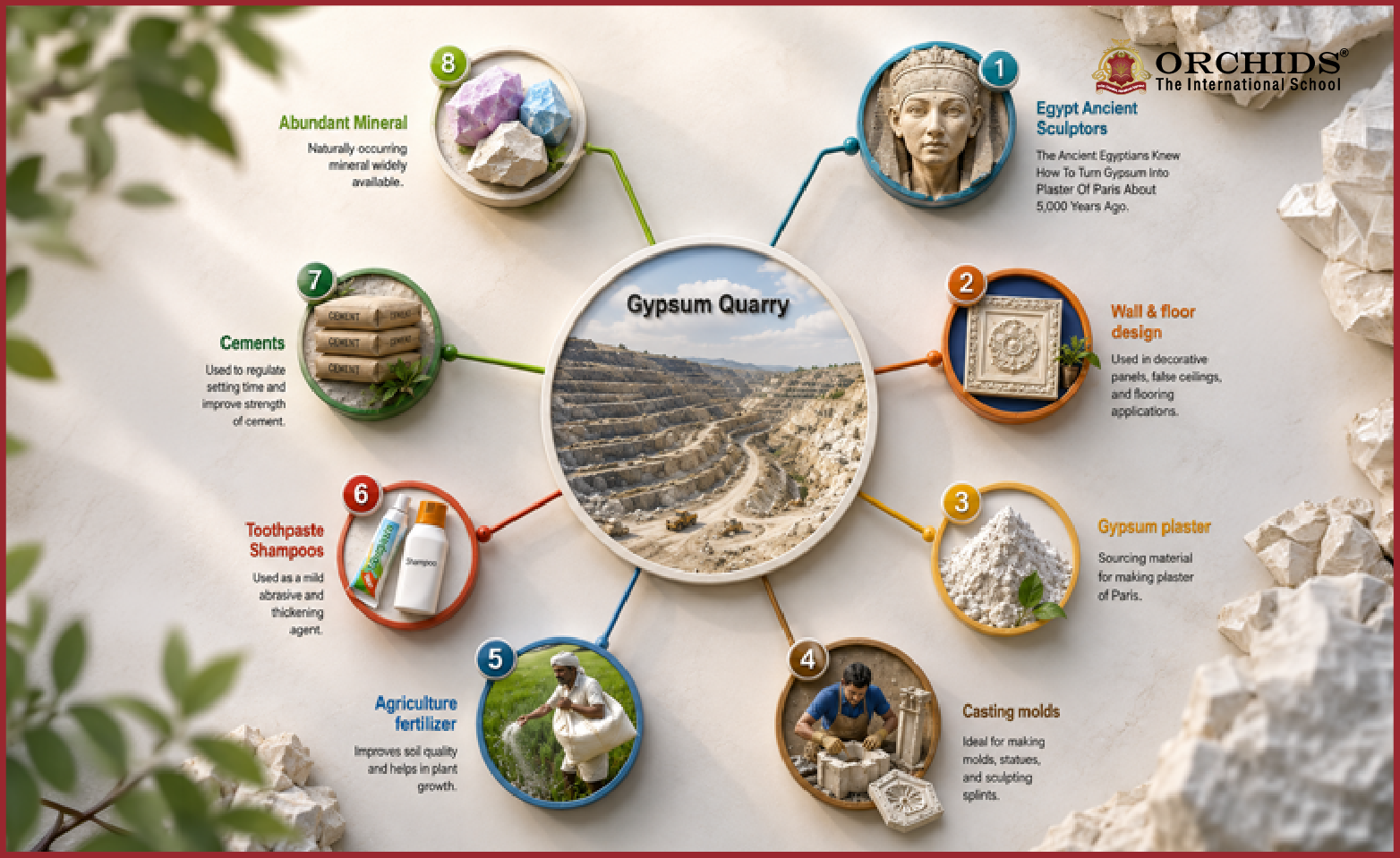
1. In Building and Construction, Gypsum is the backbone of modern interiors. It’s used in drywall (gypsum board) for walls and ceilings because it’s lightweight, fire-resistant, and easy to install.
Its ability to hold water molecules makes it excellent for slowing fire spread during a fire; the water in gypsum turns to steam, absorbing heat.
The fact that Builders also use gypsum plaster for smooth wall finishes and decorative mouldings.
2. It contributes to a major in Agriculture and Soil Health. Farmers rely on gypsum as a soil conditioner. It improves clay soils by breaking up compact particles, allowing better water flow and root penetration.
Gypsum adds calcium and sulfur, vital nutrients for plant growth, without altering soil pH.
It’s beneficial in reclaiming saline or sodic soils, where sodium buildup harms crops. Over time, gypsum helps create fertile fields and healthier harvests.
3. Gypsum controls how quickly cement sets. A small amount mixed into the cement slows down hardening, giving builders time to pour, shape, and finish the concrete.
The fact that Industries also use gypsum as a filler in paper, paints, and plastics, and as a mould material for ceramics and tiles, serves better and huge in Cement and Industrial Applications.
4. In hospitals and clinics, plaster of Paris (made from gypsum) is shaped into casts that protect broken bones while they heal.
Dentists use gypsum moulds to make crowns and dentures because they capture fine details. Its safety and ease of shaping make it invaluable in medical settings.
5. The curious thing to know about gypsum is that Artists and sculptors have used gypsum for centuries. Its smooth finish and quick setting time make it ideal for sculptures, ceiling roses, cornices, and ornamental pieces.
Even small home décor items, like picture frames or figurines, often contain gypsum plaster.
6. It is widely used in Food and Everyday products. Food-grade gypsum plays a quiet role in daily life.
It helps set tofu, strengthens bread dough, clarifies juices and beer, and provides a safe source of calcium in supplements.
Gypsum also appears in chalk, toothpaste, ceramics, and even some cosmetics.
7. Gypsum helps in water treatment by making tiny clay particles clump together, so they settle faster. It’s used in ponds, rivers, and industrial wastewater systems to improve clarity. Recycling gypsum from construction waste reduces landfill use and saves natural resources, making it an eco-friendly choice.
Also Read: Uses of Biogas and Uses of Acetone
As we studied, how Gypsum might not sparkle like precious gems, but its impact is everywhere in the walls around you, the fields that grow your food, the art you admire, and even the bread you eat. Its ability to harden, soften, and nourish makes it a quiet but powerful partner in progress.
Frequently Asked Questions on Uses of Gypsum
1. What are the uses of gypsum?
Gypsum Uses include making drywall, plaster of Paris, cement, and soil conditioners. It’s also used in medicine, art, food processing, and water treatment.
2. What is gypsum made of?
Gypsum is made of calcium sulfate and water , forming a soft white mineral found in sedimentary rocks.
3. How do we use gypsum in everyday life?
We use gypsum in our walls, ceilings, and cement, while farmers use it to enrich soil and dentists for moulds and casts.
4. What are the classifications of gypsum?
Gypsum is often classified into natural gypsum (mined from deposits) and synthetic gypsum (a by-product of industrial processes).
5. Why is gypsum important in construction?
Gypsum provides fire resistance, smooth finishes, and quick-setting plaster, making buildings safer and more attractive.
6. How does gypsum improve soil?
Gypsum adds calcium and sulfur to the soil, breaks up compact clay, and helps roots grow better without changing soil pH.
7. Can gypsum be recycled or reused?
Yes, construction waste gypsum can be recycled into new drywall or used in agriculture, reducing waste and saving resources.
8. When was gypsum first used by humans?
Gypsum has been used since ancient times; even the Egyptians used gypsum plaster in building the Pyramids.
Science isn't just a subject, it's the way of seeing the world. Curious how Orchids The International School teaches it that way? Talk to our admissions team.
Admissions Open for 2026-27
What type of concept pages would you prefer?
CBSE Schools In Popular Cities
- CBSE Schools in Bangalore
- CBSE Schools in Mumbai
- CBSE Schools in Pune
- CBSE Schools in Hyderabad
- CBSE Schools in Chennai
- CBSE Schools in Gurgaon
- CBSE Schools in Kolkata
- CBSE Schools in Indore
- CBSE Schools in Sonipat
- CBSE Schools in Delhi
- CBSE Schools in Rohtak
- CBSE Schools in Bhopal
- CBSE Schools in Aurangabad
- CBSE Schools in Jabalpur
- CBSE Schools in Jaipur
- CBSE Schools in Jodhpur
- CBSE Schools in Nagpur
- CBSE Schools in Ahmednagar
- CBSE School In Tumkur











Orchids The International School is one of India's leading chains of CBSE and ICSE schools, with 110+ schools across the country.