

Carbonic Acid (H₂CO₃): Structure, Reactions, and Industrial Uses Explained
Carbonic Acid: Every time you open a fizzy drink or take a breath, carbonic acid quietly appears and disappears in seconds. This weak acid, with the formula H₂CO₃, might seem ordinary, but it’s a hidden hero in regulating Earth’s chemistry and your own body’s balance. Formed when carbon dioxide (CO₂) dissolves in water, it keeps your blood pH stable, shapes caves, and even influences global oceans.
The article is all about carbonic acid covering its structure, reactions, and importance in nature and life, while building real-world connections that make chemistry more meaningful.
Table of Contents
- What is Carbonic Acid and Its Properties
- Preparation of Carbonic Acid
- Uses of Carbonic Acid
- Frequently Asked Questions on Carbonic Acid

What is Carbonic Acid and Its Properties?
Carbonic acid is a weak, diprotic acid formed by the reaction of carbon dioxide and water. It exists only briefly before breaking back into its components.
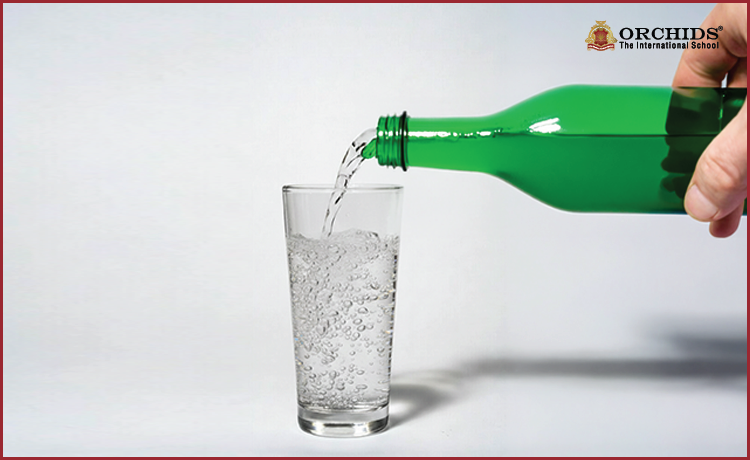
It plays a key role in maintaining pH balance in nature, especially in blood and oceans, and is found in fizzy drinks and natural carbonate rocks.
The chemical reaction can be shown as:
This reversible reaction explains why only a small amount of dissolved CO₂ in water becomes actual carbonic acid. It’s naturally found in rainwater, oceans, blood, and even carbonated beverages. Because of its fleeting nature, scientists call it transient, always forming and decomposing in balance.
Let's Study the Structure of Carbonic Acid
What are the Carbonic Acid atoms in two different ways:
- One carbon–oxygen double bond (C=O)
- Two carbon–oxygen single bonds, each connected to a hydrogen atom (–OH)
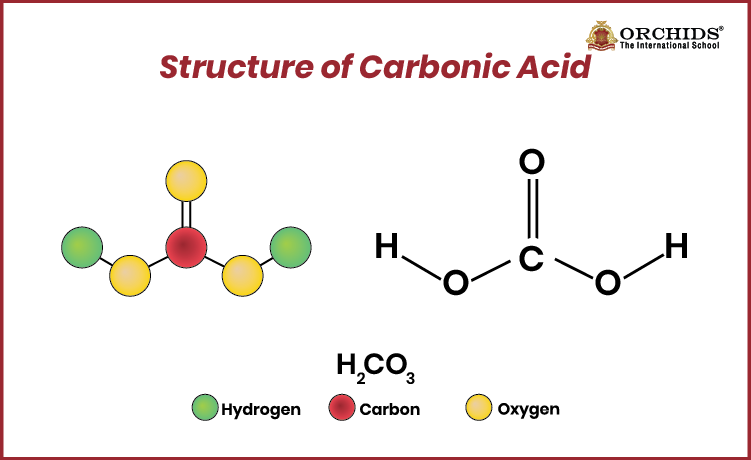
So its Carbonic Acid Formula can be represented as
This makes it a diprotic acid, meaning it can release two hydrogen ions (H⁺) when dissolved in water.
Let's look into the properties of Carbonic Acids :
1. Physical Properties
|
Property |
Description |
|
Molecular formula |
H₂CO₃ |
|
Molar mass |
62.024 g/mol |
|
Density |
1.668 g/cm³ (approx.) |
|
State |
Exists mainly in aqueous form |
|
Acidity (pKa) |
6.35 |
|
Nature |
Weak and unstable acid |
2. Chemical Properties
- Weak Acid Behaviour: Carbonic acid partially dissociates into hydrogen and bicarbonate ions:
- Salt Formation:
With mild base → Bicarbonate salts (like NaHCO₃ – baking soda)
With excess base → Carbonate salts (like Na₂CO₃ – washing soda)
- Decomposition: When heated or exposed to air, H₂CO₃ easily decomposes back to CO₂ and water:
Preparation of Carbonic Acid
Carbonic acid forms naturally whenever carbon dioxide dissolves in water, but this process also occurs artificially in beverages and labs.
1. By Natural Formation; When CO₂ gas from the air mixes with rainwater, this reaction occurs:
This is why rainwater is slightly acidic (pH ≈ 5.6). The same reaction helps dissolve limestone over time, shaping stalactites and stalagmites in caves.
2. By Laboratory Formation: In a controlled environment, CO₂ is bubbled into water under pressure.
What happens is the gas reacts with water molecules to form carbonic acid temporarily; this is how carbonated drinks like soda and sparkling water are made.
Uses of Carbonic Acid
- It gives carbonated drinks and sparkling wines their fizz in Beverages.
- It helps in Blood Regulation as it maintains acid-base balance by converting between CO₂, H₂CO₃, and bicarbonate.
- In Medicine, it helps in treating skin infections, and diluted solutions aid in lens cleaning.
- It is used in the synthesis of ammonium salts and as an intermediate in chemical processes in industry.
- In the environment, it plays a key role in the weathering of rocks and formation of natural cave structures.
Do you know that Carbonic Acid plays a major role in the Human Body, but how?
Inside our bloodstream, carbonic acid forms when CO₂ (produced by cells) dissolves in water.
This reaction is catalysed by an enzyme called carbonic anhydrase:
The acid quickly ionises into bicarbonate (HCO₃⁻) and hydrogen ions (H⁺), maintaining a delicate pH balance near 7.4.

What happens in the lungs?
In the lungs, the reaction reverses, releasing CO₂ for exhalation. This constant cycle is crucial for respiration and pH regulation, proving that chemistry literally keeps us alive.
Now, let's learn how Carbonic Acid and Ocean Chemistry relate.
Oceans act as giant carbon dioxide absorbers. When CO₂ dissolves in seawater:
However, with rising CO₂ emissions, more carbonic acid forms, making oceans slightly more acidic. This ocean acidification disrupts marine life, especially corals and shellfish that rely on carbonate ions to build their shells.
The fact that Scientists estimate that ocean pH has dropped by about 0.1 units since the Industrial Revolution, a small number with massive ecological impact.
Apart from that, it has Environmental and Geological Importance :
- It helps in Rock Weathering like Carbonic acid reacts with calcium carbonate in rocks, forming soluble calcium bicarbonate: This process creates limestone caves and karst landscapes.
- It’s part of Earth’s natural carbon cycle, balancing CO₂ levels in the atmosphere and oceans.
- It plays a vital role in Soil Chemistry as it helps dissolve minerals, making nutrients available for plant roots.
Read More: Carbon monoxide and Carbon Compounds
Till now, we learned that Carbonic acid might seem simple, but it connects your breath, the rain, the oceans, and even underground caves in one interesting chemical thread. It teaches us that weak acids can have powerful effects on both life and Earth’s systems.
Frequently Asked Questions on Carbonic Acid
1. What is Carbonic Acid also known as?
Carbonic Acid is also known as respiratory acid because it’s the only acid exhaled by humans through the lungs. It forms naturally when carbon dioxide mixes with water.
2. Why is Carbonic Acid called a weak acid?
Carbonic Acid is called a weak acid because it only partially ionises in water, releasing a small number of hydrogen ions. This makes it gentle yet important in biological systems.
3. What are the uses of Carbonic Acid?
Carbonic Acid is used in making carbonated drinks, regulating blood pH, cleaning lenses, and aiding in various industrial and medical applications. It’s also key in nature’s carbon cycle.
4. Why does Carbonic Acid break down?
Carbonic Acid breaks down easily into carbon dioxide and water because it’s unstable in its pure form. This reversible reaction happens quickly under normal conditions.
5. Why does Carbonic Acid burn?
Carbonic Acid doesn’t burn like typical acids; the term “burn” refers to its mild stinging sensation when it reacts with skin or tissues due to its weak acidic nature.
6. How is Carbonic Acid eliminated?
Carbonic Acid is eliminated naturally when it decomposes into carbon dioxide and water. The carbon dioxide is then released from the body through exhalation.
7. What is the Carbonic Acid Formula?
The Carbonic Acid Formula is H₂CO₃, showing it’s made up of two hydrogen, one carbon, and three oxygen atoms. This simple structure gives rise to complex natural roles.
8. What is Carbonic Acid and why is it important?
Carbonic Acid is a weak acid formed by the reaction of carbon dioxide and water. It’s essential for maintaining pH balance in blood and driving natural processes like rock weathering.
Science isn't just a subject, it's the way of seeing the world. Curious how Orchids The International School teaches it that way? Talk to our admissions team.
Admissions Open for 2026-27
What type of concept pages would you prefer?
CBSE Schools In Popular Cities
- CBSE Schools in Bangalore
- CBSE Schools in Mumbai
- CBSE Schools in Pune
- CBSE Schools in Hyderabad
- CBSE Schools in Chennai
- CBSE Schools in Gurgaon
- CBSE Schools in Kolkata
- CBSE Schools in Indore
- CBSE Schools in Sonipat
- CBSE Schools in Delhi
- CBSE Schools in Rohtak
- CBSE Schools in Bhopal
- CBSE Schools in Aurangabad
- CBSE Schools in Jabalpur
- CBSE Schools in Jaipur
- CBSE Schools in Jodhpur
- CBSE Schools in Nagpur
- CBSE Schools in Ahmednagar
- CBSE School In Tumkur











Orchids The International School is one of India's leading chains of CBSE and ICSE schools, with 130+ schools across the country.