

All About Carbon Dioxide: Formation, Properties, and Applications
Carbon dioxide (CO₂) is not visible, but its presence is omnipresent. From being present in the air we inhale to its applications in soft drinks, fire extinguishers, and refrigerators, CO₂ is a versatile compound.
This article provides insights about carbon dioxide, its properties, chemical behaviour, applications, and effects on the environment, so that you know why this unassuming gas is vital to life.
Table of Contents
- Structure of Carbon Dioxide
- Physical Properties of Carbon Dioxide
- Chemical Characteristics of Carbon Dioxide
- Laboratory Preparation of Carbon Dioxide
- Applications of Carbon Dioxide
- Frequently Asked Questions on Carbon dioxide
“Carbon Dioxide” Everyone must be familiar with Carbon dioxide gas Carbon which is a colourless and odourless gas composed of one carbon atom and two oxygen atoms. It has the chemical formula CO₂. Naturally occurring in the Earth's atmosphere.
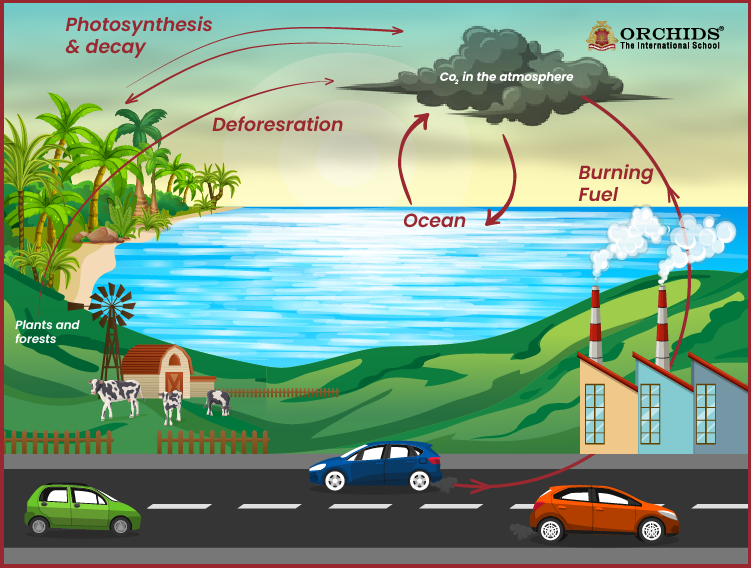
The occurrence of Carbon Dioxide is so common!
Carbon dioxide is present in the atmosphere in traces (approximately 0.04% by volume). It is always a wonder how carbon dioxide can be so vital in everyday lives as it can be
- Released during the respiration of plants and animals.
- Formed when fossil fuels such as coal, petrol, and diesel are combusted.
- Formed through the rotting of organic matter.
- Released during volcanic eruptions.
- Formed during fermentation and digestion within living organisms.

Structure of Carbon dioxide
Carbon dioxide (CO₂) has a simple yet elegant linear structure, where a single carbon atom sits between two oxygen atoms, connected by double bonds written as O=C=O.
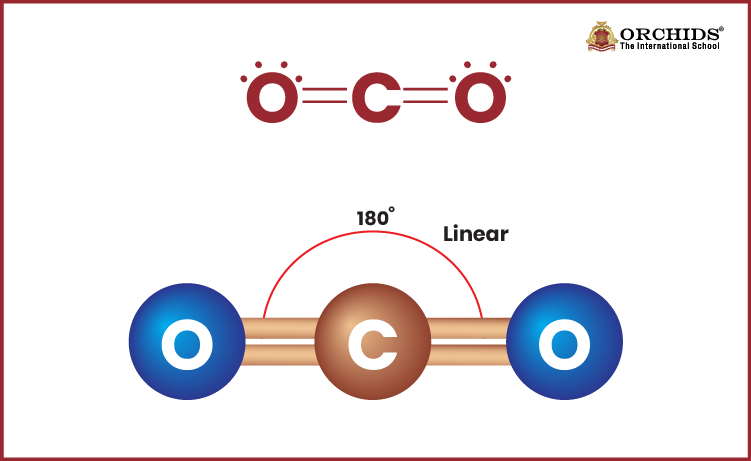
Due to this arrangement, the molecule forms a straight line with a bond angle of 180°, and the carbon atom undergoes sp hybridisation. The structure is so interesting to study that each oxygen has lone pairs, but the central carbon does not, which keeps the structure perfectly linear.
Interestingly !! Despite having polar bonds, CO₂ is overall non-polar because the opposing dipoles cancel each other out.
Physical Properties of Carbon Dioxide
|
Property |
Value |
|
Molecular Formula |
CO₂ |
|
Molar Mass |
44.0095(14) g/mol |
|
Density |
1,600 g/L – solid 771 g/L – liquid 1.98 g/L – gas |
|
Melting Point |
–56.6 °C |
|
Boiling Point |
–78.5 °C |
|
Specific Gravity |
1.53 at 21°C |
|
Synonyms |
Carbonic anhydride Dry ice Carbonic acid gas |
|
Henry Constant for Solubility |
298.15 mol/kg * bar |
|
Water Solubility |
0.9 vol/vol at 20°C |
Chemical Characteristics of Carbon Dioxide
-
Acidic Behaviour:
Carbon dioxide , though a simple molecule, exhibits fascinating chemical behaviour, especially in water. When dissolved in water, CO2 reacts mildly to form carbonic acid (H2CO3), a weak and unstable acid. The resultant reaction is as follows:
What happens is this carbonic acid doesn't remain unchanged; it partially breaks down in water, producing bicarbonate ions and hydronium ions (H3O+) in a reversible reaction:
This reaction plays a crucial role in maintaining the pH balance in natural water bodies and even within the human body through buffering systems.
-
Reaction with Lime Water
Passing CO₂ into lime water (calcium hydroxide solution) produces a white precipitate (calcium carbonate), milking the solution:
-
Action of Excess CO₂
When the milky lime water is treated with excess carbon dioxide, the calcium carbonate gets dissolved as calcium hydrogen carbonate is formed, and the milky appearance vanishes:
Laboratory Preparation of Carbon Dioxide
Unlike other gases, Carbon dioxide is very easily prepared in the lab by simply reacting dilute hydrochloric acid (HCl) with calcium carbonate (CaCO₃), which is readily available in the form of marble chips.
The resultant chemical reaction is:
Let's discuss the Outcome of the reaction:
- Calcium chloride (CaCl₂) is produced as a salt.
- Water and carbon dioxide gas are given off.
- The gas is collected by downward delivery since it is heavier than air.
Applications of Carbon Dioxide
- Carbon dioxide is utilised to produce fizzy drinks (e.g., soda and sparkling water).
- Carbon dioxide contributes most significantly to fire extinguishers for electrical fires and burning liquids.
- Photosynthesis by plants is impossible without Carbon dioxide.
- Carbon dioxide oxide applied in refrigeration systems in the form of solid CO₂ or dry ice to keep temperatures very low.
Let's discuss the impact of Carbon dioxide on the environment. We all know the fact that “ Everything in Limit keeps the balance, but if it goes in excess” Same with Carbon dioxide, excess carbon dioxide in the atmosphere acts like a heat-trapping blanket, leading to global warming and climate change.
It also dissolves in oceans, causing ocean acidification that threatens marine life like corals and shellfish. While CO₂ is vital for life, too much of it upsets nature’s balance, increasing extreme weather events and harming ecosystems worldwide.
What we learnt is that carbon dioxide, although found in minute amounts in the environment, is very important in keeping organisms alive as well as maintaining environmental processes in balance. Its characteristics and behaviour make it vital in laboratories, industries, and nature.
Frequently Asked Questions on Carbon dioxide
1. Why is carbon dioxide necessary for life?
CO₂ is necessary for photosynthesis, allowing plants to produce food and emit oxygen for humans and animals to breathe.
2. Where does the majority of carbon dioxide originate naturally?
It originates primarily from respiration, volcanoes, the breakdown of organic matter, and ocean release.
3. Why does carbon dioxide make lime water milky?
CO₂ reacts with lime water to produce insoluble calcium carbonate, resulting in a milky appearance.
4. Can carbon dioxide be harmful?
Yes, excessive CO₂ in enclosed areas may lead to dizziness, breathing difficulties, and even suffocation.
5. How is carbon dioxide utilised in everyday life?
From carbonated beverages and fire extinguishers to dry ice for cooling, CO₂ finds its usage in industries and households.
6. Does carbon dioxide impact the environment?
Yes, excessive CO₂ holds heat in the air, leading to global warming and climate change.
Science isn't just a subject, it's the way of seeing the world. Curious how Orchids The International School teaches it that way? Talk to our admissions team.
Admissions Open for 2026-27
What type of concept pages would you prefer?
CBSE Schools In Popular Cities
- CBSE Schools in Bangalore
- CBSE Schools in Mumbai
- CBSE Schools in Pune
- CBSE Schools in Hyderabad
- CBSE Schools in Chennai
- CBSE Schools in Gurgaon
- CBSE Schools in Kolkata
- CBSE Schools in Indore
- CBSE Schools in Sonipat
- CBSE Schools in Delhi
- CBSE Schools in Rohtak
- CBSE Schools in Bhopal
- CBSE Schools in Aurangabad
- CBSE Schools in Jabalpur
- CBSE Schools in Jaipur
- CBSE Schools in Jodhpur
- CBSE Schools in Nagpur
- CBSE Schools in Ahmednagar
- CBSE School In Tumkur











Orchids The International School is one of India's leading chains of CBSE and ICSE schools, with 130+ schools across the country.