

Actinum
Actinium is a silvery-white, glowing metal that is part of the actinide series on the periodic table. While it is rare in nature, it is of great importance in modern science and research.
This article aims to make actinium simple in concept from its chemical behavior, to its unique application in cancer treatment and scientific research.
Table of Contents
- What is Actinium?
- Position in the Periodic Table
- Physical Properties of Actinium
- Chemical Behaviour: Actinium
- Uses of Actinium
- Health Hazards and Safety
- Conclusion
- Frequently Asked Questions on Actinum

What is Actinium?
Actinium is the very first element in the actinide series of the periodic table, carrying the atomic number 89 and is represented by the symbol Ac. It was discovered in 1899 by Friedrich Oskar Giesel, who named it after the Greek word “aktinos,” meaning ray, referring to its strong radioactivity.
This rare, silvery metal is highly radioactive, making it both interesting and dangerous at the same time.
When we talk about its occurrence in nature, Actinium isn’t found in large amounts on its own. Instead, it exists in trace quantities within uranium ores. Because it is so scarce and decays quickly, actinium doesn’t build up in large deposits.
But have you heard of Actinum radioactivity?
When freshly prepared, actinium shines with a metallic silver color, and because of its intense radioactivity, it can even give off a faint blue glow in the dark. What happens is a striking visual effect is caused by ionising radiation exciting surrounding air molecules.
Did you know! Scientists have discovered 36 isotopes of actinium, and all of them are radioactive.
Two isotopes actinium-227 and actinium-228 occur naturally:
- Actinium-227 has a half-life of about 21.77 years, meaning it takes that long for half of its radioactive atoms to decay.
- Actinium-228 decays much faster, with a half-life of only about 6.13 hours.
One more fact about Actinium is that it is around 150 times more radioactive than radium, which makes it exceptionally hazardous if not handled properly.
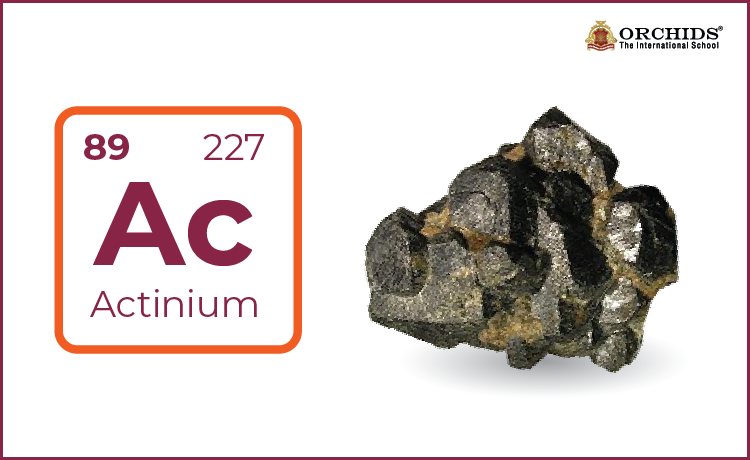
Must Know Facts About Actinium !
|
Let's look at some features of the Actinide !!
Position in the Periodic Table
|
Property |
Value |
|
Symbol |
Ac |
|
Atomic Number |
89 |
|
Atomic Mass |
~227 u |
|
Group |
Actinides |
|
Period |
7 |
|
Block |
f-block |
|
Electron Configuration |
[Rn] 6d¹ 7s² |
|
Oxidation State |
+3 |
|
Category |
Radioactive metal |
Physical Properties of Actinium
- Appearance: Silvery-white, shiny metal
- Radioactivity: Extremely radioactive, glows in the dark due to ionising radiation
- Density: ~10.07 g/cm³
- Melting Point: About 1,050°C
- Boiling Point: Roughly 3,200°C
Its radioactive glow is quite striking, emitting a soft blue light, making it fascinating but dangerous to observe without protection.
Chemical Behaviour : Actinum
- Actinium behaves chemically like lanthanum (La).
- It usually forms compounds where it exists in the +3 oxidation state, such as AcCl₃ (actinium chloride) or Ac₂O₃ (actinium oxide).
- It reacts slowly with oxygen and moisture but does not catch fire easily.
- Its chemical reactivity is moderate ,it can react with acids to release hydrogen gas.
Uses of Actinium
Though rare and hazardous, actinium has a few specialised applications:
- Medical Research: Actinium-225 is being used for targeted alpha therapy (TAT) with cancer patients.
- Neutron Source: In conjunction with beryllium, actinium can serve as a neutron source for scientific experiments.
- Nuclear Science: It has been studied for insight into nuclear decay chains and heavy element behavior.
Health Hazards and Safety
Actinium is highly radioactive, and direct exposure can cause severe harm. Therefore:
- Protective gear and shielded labs are mandatory during handling.
- It's never used in consumer products or general public settings.
- Its use is strictly regulated by nuclear safety authorities.
Conclusion
Actinium may not have made the name lists of household elements everywhere, but is a giant in the world of nuclear chemistry. As scientists learn more about heavy radioactive elements, actinium will continue to glow literally when it comes to the advanced research behind it.
Frequently Asked Questions on Actinum
1. What are 5 interesting facts about actinium?
Actinium glows with a soft blue light and is highly radioactive. It’s incredibly rare, discovered in 1899, and only a few grams are found on Earth at any time.
2. What is the importance of actinium?
Actinium plays a key role in cancer treatment through targeted alpha therapy. It also helps scientists understand radioactive decay and nuclear processes better.
3. How long does actinium last?
Actinium-227 has a half-life of about 22 years, which means it takes that long for half of it to naturally decay.
4. Where is actinium commonly found?
Actinium is found in very small amounts in uranium ores. Most of the actinium used today is produced in laboratories for research and medical use.
Science isn't just a subject, it's the way of seeing the world. Curious how Orchids The International School teaches it that way? Talk to our admissions team.
Admissions Open for 2026-27
What type of concept pages would you prefer?
CBSE Schools In Popular Cities
- CBSE Schools in Bangalore
- CBSE Schools in Mumbai
- CBSE Schools in Pune
- CBSE Schools in Hyderabad
- CBSE Schools in Chennai
- CBSE Schools in Gurgaon
- CBSE Schools in Kolkata
- CBSE Schools in Indore
- CBSE Schools in Sonipat
- CBSE Schools in Delhi
- CBSE Schools in Rohtak
- CBSE Schools in Bhopal
- CBSE Schools in Aurangabad
- CBSE Schools in Jabalpur
- CBSE Schools in Jaipur
- CBSE Schools in Jodhpur
- CBSE Schools in Nagpur
- CBSE Schools in Ahmednagar
- CBSE School In Tumkur











Orchids The International School is one of India's leading chains of CBSE and ICSE schools, with 110+ schools across the country.