

How Are Solids Separated from Liquids? Methods, Examples For Grade 6
Have you ever wondered how the salt in your kitchen comes from the sea, or how clean drinking water is separated from mud and sand? The answer lies in a fascinating branch of science, the separation of solid-liquid mixtures. Not all solids behave the same way in liquids. Some dissolve completely (like salt in water), while others simply don't mix (like sand in water). Because of this difference, scientists and engineers use different techniques to separate them.
In this article, we explore five key methods: evaporation, condensation, sedimentation, decantation, and filtration, with real-life examples that make these concepts easy to understand.
Table of Contents
- What is the Separation of a Solid-Liquid Mixture
- Separation of Soluble Solids from Liquids
- Separation of Insoluble Solids from Liquids
- Frequently Asked Questions on Separation of Mixtures for a Solid-Liquid Mixture

What is the Separation of a Solid-Liquid Mixture?
To separate solids from a liquid, various methods are used based on whether the solid is soluble or insoluble in the liquid. For example, salt is soluble in water. However, sand is insoluble. So, the methods used to separate salt from water and sand from water are quite different.
Separation of Soluble Solids from Liquids
The following methods are used to separate soluble solids from a liquid.
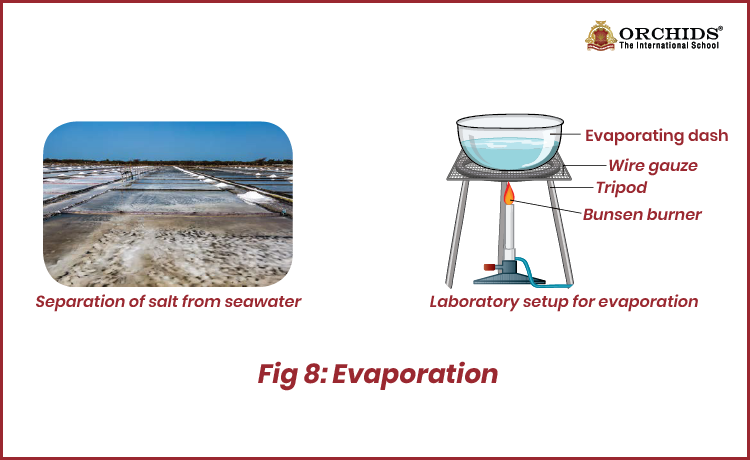
Evaporation
The process of conversion of a liquid into a gas is known as evaporation. In this method of separation, a mixture of soluble solid and liquid is heated, and the liquid component evaporates and solid behind.
For example, Seawater contains large amounts of salts. Evaporation is used to obtain common salt from seawater. In this process, seawater is allowed to flow into shallow ponds called salt pans.
The water collected in these salt pans is allowed to evaporate in the sun. After a few days, the sun's heat evaporates all the water, leaving behind solid crystals of salt.
The salt is collected and sent for purification. After purification, the purified salt is used for various purposes.
Condensation
The process of conversion of a gas into a liquid on cooling is known as condensation. It is the opposite of evaporation. Condensation is used when the liquid component of the mixture also needs to be recovered.
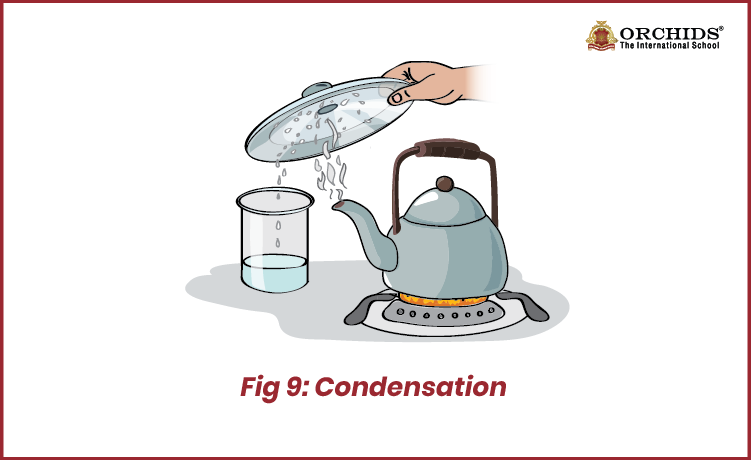
During evaporation, the liquid is lost. However, in condensation, the evaporated liquid can be condensed and collected in a separate container.
During summer, when we feel very thirsty and pick a bottle of cold water from the refrigerator, we notice small droplets of water outside the bottle within a few minutes. Where did these water droplets come on the bottle?
This happens due to the process of condensation. The water vapour present in the air comes in contact with a relatively cold surface of the bottle and cools down to form tiny droplets of water.
Both evaporation and condensation play an important role in the water cycle.
Separation of Insoluble Solids from Liquids
The following methods are used to separate insoluble solids from a liquid.
Sedimentation and Decantation
Insoluble solids which are heavier than the liquid can be separated by sedimentation and decantation.
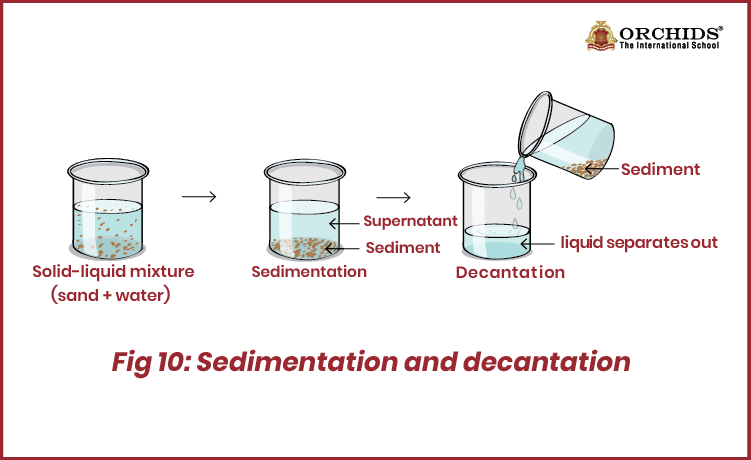
Sedimentation: The process of allowing heavier insoluble solids suspended in liquid to settle down at the bottom of the container is known as sedimentation.
The insoluble solid that is heavier and settles down is known as sediment, and the upper layer of liquid is known as supernatant.
Decantation: It is the next step after sedimentation. Decantation is a process in which the supernatant is removed without disturbing the sediments.
For example: Sand and water can be separated by using sedimentation and decantation. Sand settles easily because it is insoluble and heavier than water. The clear water is decanted without disturbing the sand settled at the bottom.
Sedimentation and decantation are used:
- To remove insoluble impurities from river water.
- To wash rice and pulses before cooking.
Filtration
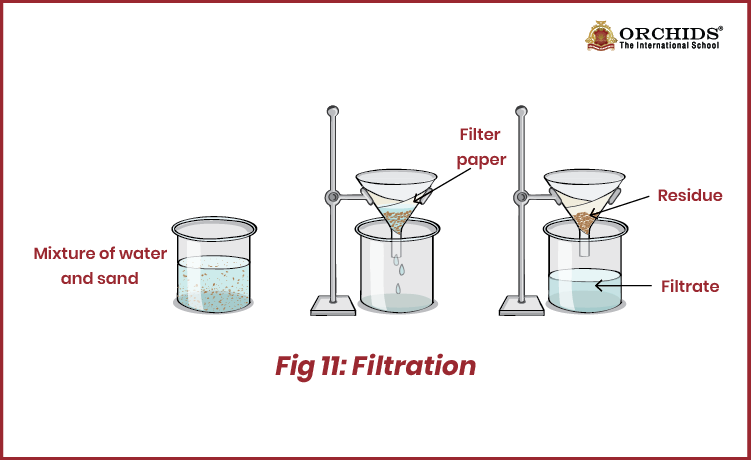
The process of separating suspended solid particles from a liquid by passing the mixture through a filter paper or a strainer is known as filtration.
Filtrate: The liquid which has passed through the filter is called the filtrate.
Residue: The insoluble solids that remain on the filter paper are known as the residue.
This method is used when the solid particles are insoluble in liquid but they are not too heavy to settle at the bottom.
Filtration is used in:
- Water filters to separate impurities.
- Separation of seeds and pulp from juices.
- Separation of tea leaves from tea.
Separation of solids from liquids is an essential concept in chemistry that helps us understand how different substances can be isolated based on their properties. Methods like sedimentation, decantation, filtration, evaporation, and condensation are commonly used in everyday life. These techniques not only help in practical tasks like purifying water and obtaining salt but also build a strong foundation for advanced scientific learning.
Frequently Asked Questions on Separation of Mixtures for a Solid-Liquid Mixture
1. What is the difference between evaporation and condensation?
Evaporation is the process of converting a liquid into a gas by heating, while condensation is the opposite, it converts a gas back into a liquid by cooling. In separation, evaporation is used when only the solid needs to be recovered, whereas condensation is used when the liquid also needs to be collected.
2. When should sedimentation and decantation be used instead of filtration?
Sedimentation and decantation work best when the insoluble solid particles are heavy enough to settle at the bottom on their own. Filtration is preferred when the particles are lighter and remain suspended in the liquid without settling.
3. What is the difference between filtrate and residue?
The filtrate is the clear liquid that passes through the filter paper during filtration. The residue is the insoluble solid that remains behind on the filter paper and does not pass through.
4. Can evaporation be used to separate sand from water?
No. Evaporation is used to separate soluble solids (like salt) from liquids. Since sand is insoluble in water, methods like sedimentation, decantation, or filtration are more appropriate for separating sand from water.
5. What is supernatant?
The supernatant is the clear upper layer of liquid that remains above the sediment after sedimentation has occurred. It is carefully removed during the decantation process without disturbing the settled solid at the bottom.
Science isn't just a subject, it's the way of seeing the world. Curious how Orchids The International School teaches it that way? Talk to our admissions team.
Admissions Open for 2026-27
What type of concept pages would you prefer?
CBSE Schools In Popular Cities
- CBSE Schools in Bangalore
- CBSE Schools in Mumbai
- CBSE Schools in Pune
- CBSE Schools in Hyderabad
- CBSE Schools in Chennai
- CBSE Schools in Gurgaon
- CBSE Schools in Kolkata
- CBSE Schools in Indore
- CBSE Schools in Sonipat
- CBSE Schools in Delhi
- CBSE Schools in Rohtak
- CBSE Schools in Bhopal
- CBSE Schools in Aurangabad
- CBSE Schools in Jabalpur
- CBSE Schools in Jaipur
- CBSE Schools in Jodhpur
- CBSE Schools in Nagpur
- CBSE Schools in Ahmednagar
- CBSE School In Tumkur











Orchids The International School is one of India's leading chains of CBSE and ICSE schools, with 110+ schools across the country.