

Biuret Test: The Science Behind Protein Detection
Biuret test; We all know that Proteins are essential molecules that perform a variety of functions in living organisms, from building tissues and enzymes to transporting nutrients. Do you know the fact that detecting proteins in a sample is a fundamental task in biology and biochemistry, and the Biuret Test provides a simple and reliable method to do so? Isn't it interesting to know how?
This article is designed to help students understand the Biuret Test clearly and practically. It explains the principle, reagents, procedure, and variations, so learners can confidently perform the test and recognise proteins.
Table of Contents
- What is the Biuret Test
- Procedure of the Biuret Test
- Applications of the Biuret Test
- Frequently Asked Questions on Biuret Test

What is the Biuret Test?
The Biuret Test is a chemical test used to detect peptide bonds, the chemical links between amino acids in proteins. This test identifies peptide bonds in proteins by producing a characteristic purple colour when the sample reacts with the Biuret reagent under alkaline conditions.
Interestingly! The intensity of this colour can also give an idea about the protein concentration in the sample.
Principle of the Biuret Test for Protein
The biuret test principle is based on coordinate bonding between copper(II) ions and nitrogen atoms in peptide bonds.
The steps are:
- In an alkaline solution, Cu²⁺ ions react with peptide nitrogen atoms.
- Four nitrogen atoms from two peptide bonds coordinate with one Cu²⁺ ion to form a chelate complex.
- The complex absorbs light at 540 nm, producing a purple colour.
Chemical representation:
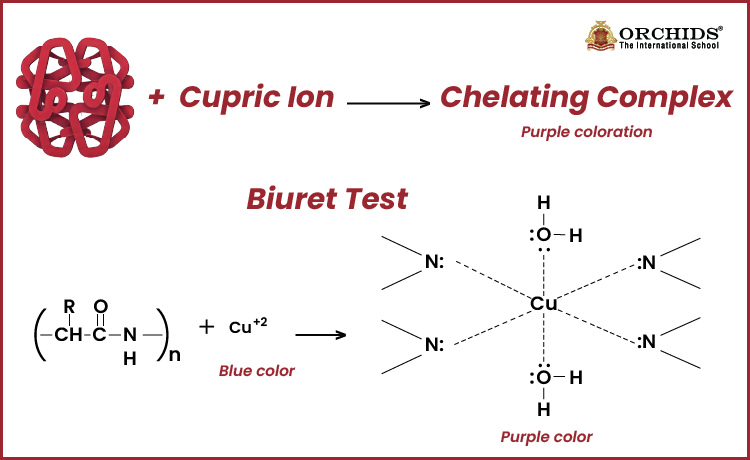
Protein with peptide bonds + Cu2+alkalinePurple chelate complex
- Short peptides may give blue or pink hues instead of deep purple.
- The colour intensity is proportional to the protein concentration (Beer-Lambert law).
Even small peptides can give a positive reaction, although the colour intensity may vary depending on protein length.
Let's learn about Biuret Reagent
The Biuret reagent is a solution made from:
- Copper sulfate pentahydrate : Provides Cu²⁺ ions for binding with peptide bonds.
- Sodium hydroxide (NaOH): Creates an alkaline environment needed for the reaction.
- Rochelle salt Sodium-potassium tartrate, Stabilises the copper ions, preventing precipitation and ensuring a clear reaction.
This reagent is essential to produce the purple-colored complex when proteins are present.
Procedure of the Biuret Test
Materials Needed:
- Sample solution (protein/analyte)
- 1% Sodium hydroxide (NaOH) or Potassium hydroxide (KOH)
- Copper(II) sulfate (CuSO₄) solution
- Test tubes
Steps:
- Dissolve a small amount of the sample in water to make a clear solution.
- Add 1% NaOH or KOH to the solution to make it alkaline.
- Add 2-3 drops of CuSO₄ solution to the mixture.
- Observe the colour:
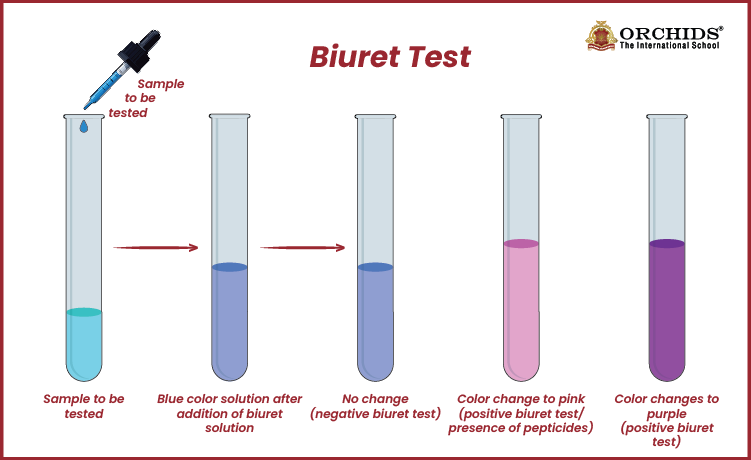
- Purple colour: Protein is present.
- No colour change: Protein is absent or below detection limit.
Tip: Ensure the solution is sufficiently alkaline for the reaction to occur.
Here's the Result Interpretation :
The outcome of the Biuret Test can be understood by observing the colour change that appears after adding the reagent. The results are interpreted as follows:
Observation |
Interpretation |
| 1. The solution turns purple. | Indicates the presence of proteins and a positive Biuret test. |
| 2. The solution turns pink. | Suggests the presence of short peptides is still a positive Biuret test, but with smaller peptide chains. |
| 3. No colour change is observed. | Means no proteins or peptides present a negative Biuret test. |
| The control sample (second tube) changes to purple. | Confirms a positive control, showing the test is working properly. |
| The control sample (third tube) shows no colour change. | Acts as a negative control, confirming the accuracy of the results. |
Let's Know about the Variations of the Biuret Test:
- Modified Lowry Test, as it combines the Biuret reaction with the Folin-Ciocalteu reagent for higher sensitivity.
- BCA Test (Bicinchoninic Acid) as it produces a stable and intense purple colour, suitable for detecting low concentrations of proteins.
These modifications are widely used in research and clinical laboratories for quantitative protein estimation.
Applications of the Biuret Test
The Biuret Test is widely used to detect and quantify proteins through its characteristic purple colour. Its simplicity makes it valuable in labs, classrooms, and research.
- In Food Testing, it is used to check the protein content in foods like milk, eggs, and meat, helping assess their nutritional value.
- In Clinical Diagnosis, it is applied in medical labs to measure protein levels in blood serum or plasma, helping in detecting liver, kidney, or nutritional disorders.
- Researchers use it to quantify protein concentration in biological samples before advanced tests like the Lowry or Bradford assays in Biochemical Research.
- In the Education sector, it is commonly demonstrated in schools to teach how peptide bonds react with the Biuret reagent, forming a purple complex.
- In Pharmaceutical use, it helps in quality control of protein-based drugs and formulations to ensure stability and accuracy.
So till now read how the Biuret Test is a straightforward and reliable method for detecting proteins in a sample. Its simplicity, combined with variations like the Lowry and BCA tests, makes it a valuable tool in both education and scientific research.
Frequently Asked Questions on Biuret Test
1. What is a biuret test?
The Biuret test is a chemical experiment used to detect the presence of proteins in a sample. It works by forming a purple-coloured complex with peptide bonds under alkaline conditions.
2. What is a biuret test for protein?
The Biuret test for protein helps identify whether proteins are present in a solution. A purple colour indicates protein presence, making it a simple visual test.
3. What is the biuret test principle?
The Biuret test principle is based on copper(II) ions binding to nitrogen atoms in peptide bonds. This interaction forms a purple chelate complex that confirms protein presence.
4. What is the principle of the Biuret test?
In the Biuret test, copper(II) ions react with peptide bonds under alkaline conditions. The resulting purple complex shows the presence of proteins in the sample.
5. Why does protein turn purple in biuret tests?
Proteins turn purple in Biuret tests because copper(II) ions form a coloured complex with peptide bonds. The intensity of purple depends on the protein concentration.
6. What makes a Biuret test positive?
A Biuret test is positive when the sample contains proteins or compounds with peptide bonds. The appearance of a purple colour confirms this reaction.
7. What are the two chemicals used in the Biuret test?
The main chemicals in the Biuret test are copper(II) sulfate and sodium hydroxide. Copper binds to peptide bonds, while sodium hydroxide provides the alkaline environment.
Science isn't just a subject, it's the way of seeing the world. Curious how Orchids The International School teaches it that way? Talk to our admissions team.
Admissions Open for 2026-27
What type of concept pages would you prefer?
CBSE Schools In Popular Cities
- CBSE Schools in Bangalore
- CBSE Schools in Mumbai
- CBSE Schools in Pune
- CBSE Schools in Hyderabad
- CBSE Schools in Chennai
- CBSE Schools in Gurgaon
- CBSE Schools in Kolkata
- CBSE Schools in Indore
- CBSE Schools in Sonipat
- CBSE Schools in Delhi
- CBSE Schools in Rohtak
- CBSE Schools in Bhopal
- CBSE Schools in Aurangabad
- CBSE Schools in Jabalpur
- CBSE Schools in Jaipur
- CBSE Schools in Jodhpur
- CBSE Schools in Nagpur
- CBSE Schools in Ahmednagar
- CBSE School In Tumkur











Orchids The International School is one of India's leading chains of CBSE and ICSE schools, with 130+ schools across the country.