

List of Strong Acids: Properties and Uses Explained with Examples
The list of Strong acids is the powerhouse of the chemistry world. Have you ever questioned why they earn the title “strong”? That is because when dissolved in water, they fully break apart into ions, releasing hydrogen ions (H⁺) that drive numerous chemical reactions. From cleaning metals to powering batteries and enhancing digestion, strong acids are everywhere.
This perfect guide will explain what makes an acid “strong,” and get the complete list of strong acids, with their unique properties and real-life uses.
Table of Contents
- What Are Strong Acids
- List of Strong Acids and Bases
- Some of the Common Strong Acids Explained
- Real-World Applications of Strong Acids
- Safety Tips When Handling Strong Acids
- Frequently Asked Questions on List of Strong Acids

What Are Strong Acids?
In simple terms, a strong acid is an acid that completely dissociates in water. Every molecule splits into hydrogen ions (H⁺) and its corresponding anion.
Chemically, can write this as:
For strong acids, this reaction goes to completion, unlike weak acids, which only partially ionise. Strong acids have very low pKa values (≤ -2), meaning they are highly acidic.
The properties that acids show make it easy to identify them as strong acids:
- As they show complete dissociation, that means they fully ionise in water, which results in high electrical conductivity
- Strong acids have a Corrosive Nature, which can damage skin, metals, and other surfaces
- It shows low pKa Values, which indicate extremely high acidity
- Its Powerful Reactivity initiatesredox reactions, salt formation, and catalysis processes in chemistry.
- It acts as a strong electrolyte that conducts electricity efficiently.
So the fact that strong acids are incredibly reactive, which is why they are essential in:
- Laboratories for processing chemical reactions
- Industrial processes for manufacturing and refining
- Natural processes like digestion (e.g., hydrochloric acid in the stomach)
Understanding strong acids is crucial for safe handling, scientific research, and practical applications.
But how do these strong acids differ from weak acids? Here are the clear illustrations and differentiation below :
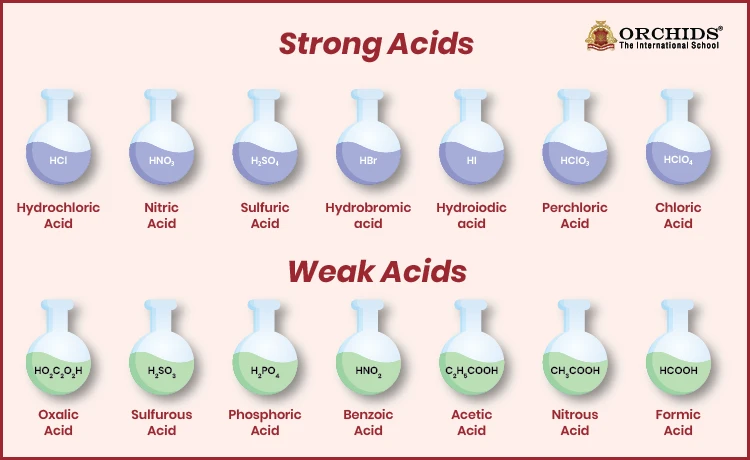
Difference Between Strong and Weak Acids
|
Feature |
Strong Acids |
Weak Acids |
|
Ionisation in water |
Complete |
Partial |
|
pKa value |
≤ -2 |
Higher (e.g., 4.76 for acetic acid) |
|
Conductivity |
High |
Low |
|
Example |
HCl, H₂SO₄ |
CH₃COOH, HF |
List of Strong Acids and Bases
Below is the list of Strong acids and bases to understand better:
| List of Strong Acids | Chemical Formula | List of Strong Bases | Chemical Formula |
| Hydrochloric Acid | HCl | Lithium Hydroxide | LiOH |
| Nitric Acid | HNO₃ | Sodium Hydroxide | NaOH |
| Sulfuric Acid | H₂SO₄ | Potassium Hydroxide | KOH |
| Hydrobromic Acid | HBr | Calcium Hydroxide | Ca(OH)₂ |
| Hydroiodic Acid | HI | Barium Hydroxide | Ba(OH)₂ |
| Chloric Acid | HClO₃ | Rubidium Hydroxide | RbOH |
| Perchloric Acid | HClO₄ | Cesium Hydroxide | CsOH |
Learn More: Acid Test
Some of the Common Strong Acids Explained
Did you know that chemists universally recognise only seven acids as truly strong acids? These acids completely dissociate in water, releasing all their hydrogen ions, which makes them highly reactive.
Here’s a closer look at each one:
1. Hydrochloric Acid (HCl)
Where it’s found: Hydrochloric acid is naturally present in our stomach as gastric juice, helping to digest food.
Uses: It’s used in metal cleaning, food processing, and laboratory experiments. Its ability to react with many substances makes it a versatile industrial and lab chemical.
2. Hydrobromic Acid (HBr)
Type: A strong hydrogen halide acid.
Uses: Essential in producing bromine-based compounds and in various organic synthesis reactions. Its strong acidic nature makes it a reliable reagent in chemical labs.
3. Hydroiodic Acid (HI)
Power:One of the most potent acids among the hydrogen halides.
Uses: Frequently used in chemical synthesis reactions, particularly when introducing iodine atoms into organic molecules. Its high reactivity is valuable for complex chemical manufacturing.
4. Sulfuric Acid (H₂SO₄)
Industrial importance: Known as the “king of acids,” sulfuric acid is used in fertilisers, car batteries, and a wide range of industrial processes.
Unique property: It is a strong dehydrating agent. For example, it can remove water from sugar, leaving behind carbon:
This demonstrates how reactive and versatile sulfuric acid is in chemical processes.
5. Nitric Acid (HNO₃)
Type: Strong oxidising acid.
Uses:Key for making explosives, fertilisers, and pharmaceuticals. Its ability to donate oxygen makes it crucial in chemical reactions that require strong oxidation.
6. Chloric Acid (HClO₃)
Type: Strong oxidising agent.
Uses: Primarily found in specialised laboratory and industrial applications. Its strong oxidative properties are helpful for certain chemical transformations that other acids cannot achieve.
7. Perchloric Acid (HClO₄)
Power:Extremely strong and highly reactive.
Uses: Often used in rocket propellants, explosives, and advanced research laboratories. Due to its high reactivity, it must be handled with extreme care.
Real-World Applications of Strong Acids
- Medicine and Biology:
- HCl helps in digestion in the stomach
- HNO₃ and derivatives are used in pharmaceuticals
- Industry:
- H₂SO₄ in lead-acid batteries and metal refining
- HCl for cleaning and metal etching
- Agriculture:
- H₂SO₄ and HNO₃ for producing fertilisers
- Research and Manufacturing:
- Cleaning lab glassware
- Synthesising chemicals and polymers
Safety Tips When Handling Strong Acids
- Always wear gloves, goggles, and protective clothing
- Work in a well-ventilated area or fume hood
- Add acid to water, never the other way around (prevents splashes)
- Store in corrosion-resistant containers
Read More: Acid and Base Difference and Acid,Base and Salts
As we have learned, strong acids are more than just lab chemicals; they are essential to industry, agriculture, and life itself. Their ability to fully dissociate makes them powerful for reactions, manufacturing, and even biological processes.
Frequently Asked Questions on List of Strong Acids
1. What are the uses of strong acids?
Strong acids are widely used in industries, laboratories, and even in everyday products. They help in cleaning metals, making fertilisers, and producing chemicals.
2. What are common strong acids?
Some commonly used strong acids include hydrochloric acid (HCl), sulfuric acid (H₂SO₄), nitric acid (HNO₃), and hydrobromic acid (HBr).
3. Which is the strongest acid?
Fluoroantimonic acid is often considered the strongest known acid, far stronger than sulfuric or hydrochloric acids.
4. Which acid is called the “king of acids”?
Sulfuric acid (H₂SO₄) is often called the “king of acids” due to its versatility and industrial importance.
5. Who is the “queen of acids”?
Nitric acid (HNO₃) is sometimes referred to as the “queen of acids” for its powerful oxidising and nitrating abilities.
6. Which acid is the most corrosive?
Fluoroantimonic acid and concentrated sulfuric acid are extremely corrosive, capable of eating through metals and organic materials.
7. Can strong acids be found at home?
Yes, acids like hydrochloric acid are found in some cleaning products, but they must be handled very carefully.
8. How do strong acids differ from weak acids?
Strong acids fully dissociate in water, while weak acids only partially break into ions.
9. Are strong acids dangerous?
They can burn skin, damage metals, and release harmful fumes if not handled safely.
10. How should strong acids be stored?
They should be kept in tightly sealed containers, away from heat and incompatible substances, in a well-ventilated area.
Science isn't just a subject, it's the way of seeing the world. Curious how Orchids The International School teaches it that way? Talk to our admissions team.
Admissions Open for 2026-27
What type of concept pages would you prefer?
CBSE Schools In Popular Cities
- CBSE Schools in Bangalore
- CBSE Schools in Mumbai
- CBSE Schools in Pune
- CBSE Schools in Hyderabad
- CBSE Schools in Chennai
- CBSE Schools in Gurgaon
- CBSE Schools in Kolkata
- CBSE Schools in Indore
- CBSE Schools in Sonipat
- CBSE Schools in Delhi
- CBSE Schools in Rohtak
- CBSE Schools in Bhopal
- CBSE Schools in Aurangabad
- CBSE Schools in Jabalpur
- CBSE Schools in Jaipur
- CBSE Schools in Jodhpur
- CBSE Schools in Nagpur
- CBSE Schools in Ahmednagar
- CBSE School In Tumkur











Orchids The International School is one of India's leading chains of CBSE and ICSE schools, with 130+ schools across the country.