

Aufbau Principle
Aufbau principle- Do you ever think about the process of where individual electrons go inside the atom? The order in which electrons fill orbitals is the Aufbau Principle, which increases from the lowest energy level to highest energy level.
In this article, it provides the insights why there is the Aufbau Principle, how it works, and what are the important rules to think about for the case of chromium and copper which do not behave as they should at first glance in our model.
Table of Contents
- What is the Aufbau Principle?
- Features of the Aufbau Principle
- Determining Electronic Configuration Using the Aufbau Principle
- Common Error in Understanding the Aufbau Principle
- Exceptions to the Aufbau Principle
- Frequently Asked Questions on Aufbau Principle

What is Aufbau Principle?
The Aufbau Principle is an important guideline in chemistry that provides an explanation of the order of electron placements in atoms. The word "Aufbau" is German for "to build up". The principle states that electrons engender a system or occupy the lowest energy levels first and then progressively rise to the next higher energy levels.
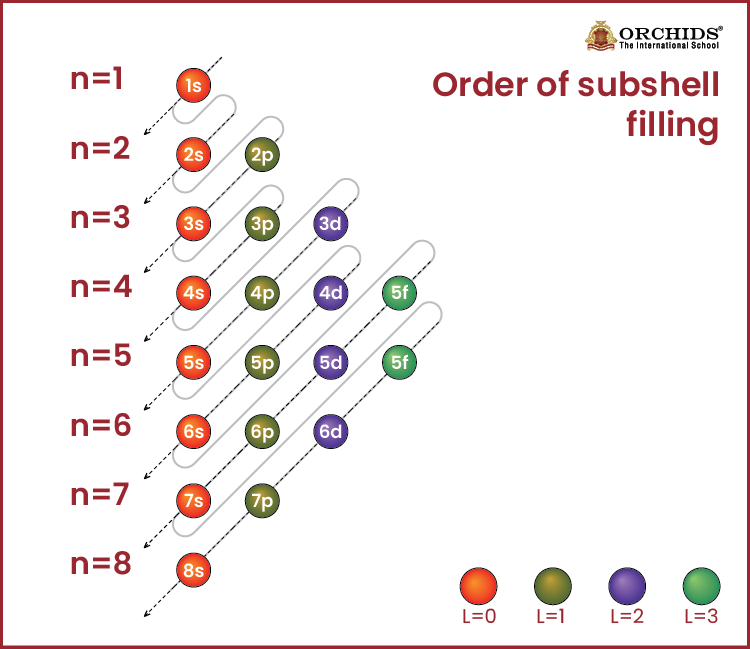
Imagine placing old books on a shelf. You are only able to stack the books starting from the bottom row up, which is why the electrons develop in the same order in an atom. The order of filling provides the basis for predicting the electronic configurations of atoms. Electronic configurations are vital to understanding the chemical behavior of atoms.
Features of the Aufbau Principle
Here are some of the notable aspects that govern the Aufbau Principle:
- Electrons always occupy the lowest energy orbital that is available first.
- With each increase in the atomic number of an atom, a single electron is added in the order of the Aufbau Principle.
- Application of the Aufbau Principle generally occurs in the order of the n + l rule (the principal quantum number, n) + (the azimuthal quantum number, l).
- The order of fillings using the Aufbau principle is important in predicting the reactivity and stability of elements.
Determining Electronic Configuration Using the Aufbau Principle
To apply the Aufbau Principle and write the electron configuration of an element, follow these steps:
- Know the atomic number – This tells you how many electrons are present.
- Use the filling order – Remember the sequence in which orbitals fill. A common one is:
1s → 2s → 2p → 3s → 3p → 4s → 3d → 4p → 5s → 4d → 5p, and so on. - Place electrons accordingly – Assign the right number of electrons into each orbital in order of increasing energy.
For example, for Oxygen (atomic number 8):
Configuration: 1s² 2s² 2p⁴
This means the first two electrons go into the 1s orbital, the next two in 2s, and the remaining four occupy 2p.
Common Error in Understanding the Aufbau Principle
- One common error is thinking that electrons fill orbits through the predicted ordering without exception.
- In reality, there are elements in which electrons will fill orbitals, or possibly shift between orbitals, differently than expected in order to obtain additional stability.
Exceptions to the Aufbau Principle
Although the Aufbau Principle works in most cases, certain elements do not strictly follow the predicted electron configuration. These exceptions usually occur to increase the atom’s stability.
Here are a few examples:
- Chromium (atomic number 24)
- Expected configuration: 1s² 2s² 2p⁶ 3s² 3p⁶ 4s² 3d⁴
- Actual configuration: 1s² 2s² 2p⁶ 3s² 3p⁶ 4s¹ 3d⁵
- Why? Half-filled d orbitals offer greater stability.
- Copper (atomic number 29)
- Expected configuration: 1s² 2s² 2p⁶ 3s² 3p⁶ 4s² 3d⁹
- Actual configuration: 1s² 2s² 2p⁶ 3s² 3p⁶ 4s¹ 3d¹⁰
- Why? A fully filled d orbital is more stable.
These variations are a reminder that while rules guide us, nature sometimes optimises for better results.
But as seen with elements like chromium and copper, electron arrangements may deviate from predicted patterns for the sake of increased stability.
Understanding this helps learners avoid rigid thinking and encourages a more atomic behaviour.
As we have learned that how the Aufbau Principle is more than a guideline; it is a powerful means of understanding the internal structure of atoms. If we understand how electrons occupy particular orbitals, we can rationalise the periodic table, chemical properties, and bonding patterns. Depending on your orientation, each important property, and how this principle is important to mastering chemistry.
Frequently Asked Questions on Aufbau Principle
1. What are the important points of the Aufbau principle?
Electrons fill up atomic orbitals starting from the lowest energy level, following a predictable order. This helps us understand how atoms build up their structure step by step.
2. What are the limitations of the Aufbau principle?
The rule doesn't always apply perfectly-especially for elements like chromium or copper-because actual electron arrangements sometimes favour more stability over the predicted order.
3. Who discovered the Aufbau principle?
The Aufbau concept was shaped by several scientists, but it mainly builds on Niels Bohr’s atomic model and was refined over time through quantum mechanics.
4. What elements break the Aufbau principle?
Some elements, like chromium and copper, don't follow the standard order because they gain extra stability from half-filled or fully filled orbitals.
5. Why do some elements not follow the Aufbau principle?
In certain atoms, the energy difference between orbitals is so small that electrons shift to create more balanced and stable configurations.
6. How does the Aufbau principle help in chemistry?
It acts like a guide for writing electron configurations, helping us predict how atoms behave, bond, and where they fit in the periodic table.
Science isn't just a subject, it's the way of seeing the world. Curious how Orchids The International School teaches it that way? Talk to our admissions team.
Admissions Open for 2026-27
What type of concept pages would you prefer?
CBSE Schools In Popular Cities
- CBSE Schools in Bangalore
- CBSE Schools in Mumbai
- CBSE Schools in Pune
- CBSE Schools in Hyderabad
- CBSE Schools in Chennai
- CBSE Schools in Gurgaon
- CBSE Schools in Kolkata
- CBSE Schools in Indore
- CBSE Schools in Sonipat
- CBSE Schools in Delhi
- CBSE Schools in Rohtak
- CBSE Schools in Bhopal
- CBSE Schools in Aurangabad
- CBSE Schools in Jabalpur
- CBSE Schools in Jaipur
- CBSE Schools in Jodhpur
- CBSE Schools in Nagpur
- CBSE Schools in Ahmednagar
- CBSE School In Tumkur











Orchids The International School is one of India's leading chains of CBSE and ICSE schools, with 130+ schools across the country.