

Hydrolysis: Types and Reactions Explained with Examples
Hydrolysis is a chemical reaction in which water helps break larger molecules into smaller parts. It plays a vital role in chemistry, biology, and everyday life.
The word comes from “hydro” (water) and “lysis” (to split). In this process, a water molecule reacts with a chemical bond, causing it to split and form new products.
This article aims to explain hydrolysis and its types so learners can easily understand the process and its applications.
Table of Contents
- Must-Know Facts About Hydrolysis
- What is Hydrolysis
- Types of Hydrolysis
- Frequently Asked Questions on Hydrolysis

Must-Know Facts About Hydrolysis!
|
What is Hydrolysis?
Hydrolysis is a special type of chemical reaction where water helps to break a bigger molecule into smaller parts.
The word comes from:
- Hydro = water
- Lysis = breaking or splitting
In this process, a water molecule is used up. One part of the broken molecule takes a hydrogen atom (H), and the other part takes a hydroxyl group (OH) from the water. This makes two new, separate substances.
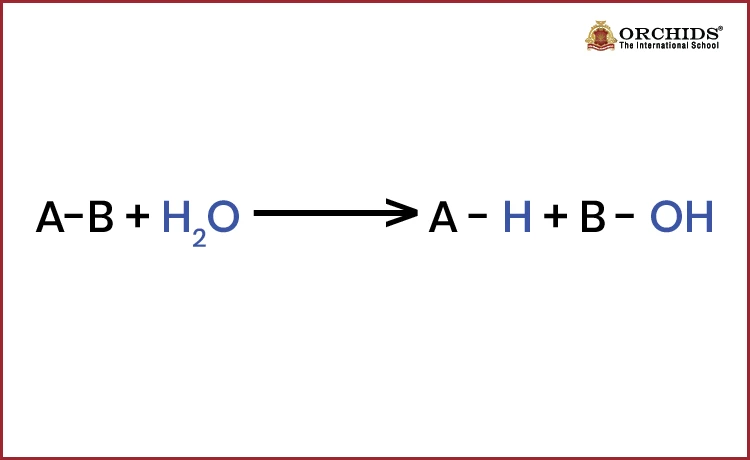
Hydrolysis happens everywhere in your body, in nature, in factories, and even deep underground in rocks.
Types of Hydrolysis
Hydrolysis is categorised into 4 types:
1. Acid Hydrolysis, in which water breaks chemical bonds with the help of an acid (usually a strong acid like hydrochloric acid, HCl). The acid acts as a catalyst, meaning it speeds up the reaction without being used up.
What happens is:
- The acid donates protons (H⁺) that make the molecule’s bonds weaker.
- Water then adds hydrogen (H) to one side of the bond and hydroxyl (OH) to the other side.
Let's take an example!
Breaking an ester into an alcohol and a carboxylic acid:
Ester + Water → Alcohol + Acid (in the presence of HCl)
Its Uses:
- Making flavouring agents and perfumes.
- Breaking down fats and oils in food processing.
- Laboratory preparation of acids and alcohols.
2. Base hydrolysis happens when water breaks bonds with the help of a strong base such as sodium hydroxide (NaOH) or potassium hydroxide (KOH).
Unlike acid hydrolysis, base hydrolysis is usually irreversible.
What happens is:
- The base provides hydroxide ions (OH⁻) that directly attack the bond, breaking it apart.
- The products are often salts and alcohol structure.
Let's take an example!
Breaking an ester into soap (salt of a fatty acid) and glycerol:
Fat/Oil + NaOH → Soap + Glycerol
Its Uses:
- Soap-making (saponification).
- Producing biodiesel.
- Breaking down fats in the industry.
3. Enzymatic hydrolysis is nature’s way of breaking down molecules, using special proteins called enzymes. It happens in living organisms during digestion, metabolism, and other biological processes.
What happens is:
- Enzymes bind to large molecules and position water in the right place to break bonds efficiently.
- The process is a highly specific one; an enzyme usually acts on one type of molecule.
Let's take an example!
- Amylase breaks starch into sugars.
- Protease breaks proteins into amino acids.
- Lipase breaks fats into fatty acids and glycerol.
Its Uses:
- Digestion in animals and humans.
- Making dairy products (cheese, yoghurt).
- Producing bioethanol from plant material.
4. Salt hydrolysis happens when a salt reacts with water to form an acidic or basic solution. This occurs because salts are made from acids and bases, and depending on their strength, they can change the pH of water.
What happens is:
- Salts from a strong acid and a strong base (like NaCl) do not hydrolyse; they remain neutral.
- Salts from a weak acid and a strong base (like sodium acetate) make the solution basic.
- Salts from a strong acid and a weak base (like ammonium chloride) make the solution acidic.
Also Read: Acid,Base and Salts
Let's take an example!
Sodium acetate (from weak acetic acid and strong NaOH) reacts with water to produce hydroxide ions (OH⁻), making the solution basic.
Its Uses:
- Making buffer solutions.
- Adjusting pH in chemical processes.
- Analytical chemistry experiments.
Let's have a look below at the pictorial representation of how this varies for a better understanding!
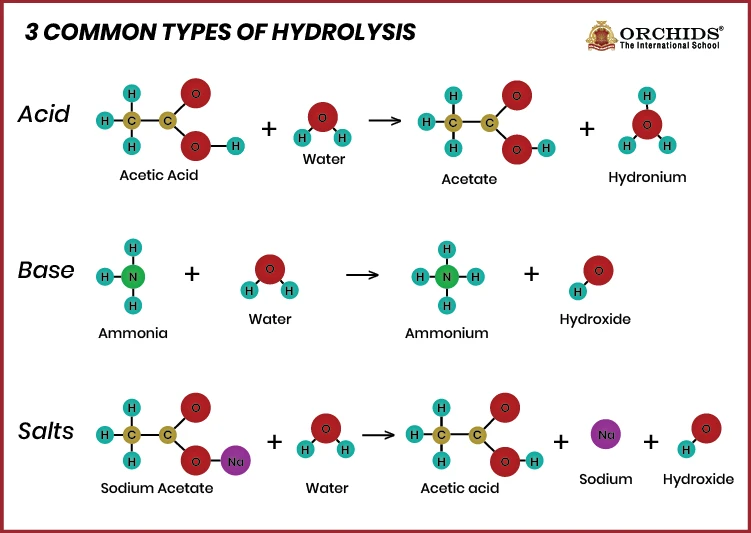
Till now, we get to know that how hydrolysis might sound like a complex chemistry word, but it’s simply water breaking things apart. It keeps you alive, helps industries make useful products, shapes the planet, and even cleans up the environment.
Next time you drink water, remember that in the right conditions, that same water can be a powerful chemical tool.
Frequently Asked Questions on Hydrolysis
1. What affects hydrolysis?
Hydrolysis can be influenced by factors like temperature, pH level, and the type of chemical bonds present. These conditions decide how quickly the reaction happens.
2. What is most prone to hydrolysis?
Compounds like esters, salts, and some proteins are most prone to hydrolysis. Their bonds are easily broken when exposed to water or certain enzymes.
3. What causes hydrolysis to break?
Hydrolysis breaks a molecule when water reacts with its bonds, splitting it into smaller parts. Heat, acids, bases, or enzymes can trigger this process.
4. What affects the speed of hydrolysis?
The speed of hydrolysis depends on temperature, concentration, pH, and the presence of catalysts. Higher temperatures or strong acids/bases usually make it faster.
5. What are the main types of hydrolysis?
The main types of hydrolysis are acid hydrolysis, base hydrolysis, enzymatic hydrolysis, and salt hydrolysis. Each type works differently but uses water to break bonds.
6. What are some important hydrolysis uses?
Hydrolysis uses include breaking down food during digestion, making soap from fats, and processing chemicals in industries. It is essential in both nature and manufacturing.
Science isn't just a subject, it's the way of seeing the world. Curious how Orchids The International School teaches it that way? Talk to our admissions team.
Admissions Open for 2026-27
What type of concept pages would you prefer?
CBSE Schools In Popular Cities
- CBSE Schools in Bangalore
- CBSE Schools in Mumbai
- CBSE Schools in Pune
- CBSE Schools in Hyderabad
- CBSE Schools in Chennai
- CBSE Schools in Gurgaon
- CBSE Schools in Kolkata
- CBSE Schools in Indore
- CBSE Schools in Sonipat
- CBSE Schools in Delhi
- CBSE Schools in Rohtak
- CBSE Schools in Bhopal
- CBSE Schools in Aurangabad
- CBSE Schools in Jabalpur
- CBSE Schools in Jaipur
- CBSE Schools in Jodhpur
- CBSE Schools in Nagpur
- CBSE Schools in Ahmednagar
- CBSE School In Tumkur











Orchids The International School is one of India's leading chains of CBSE and ICSE schools, with 110+ schools across the country.