

Accuracy and Precision Difference in Chemistry
In science (especially in chemistry laboratories), we depend on measurements to make observations, record results, and conclude. Two essential words will frequently arise when discussing measurements: accuracy and precision, which create confusion as sound the same, but they have different meanings and have different functions.
This page explains the difference between Accuracy and precision, which helps us to judge how correct and consistent a measurement is, with examples and tips.
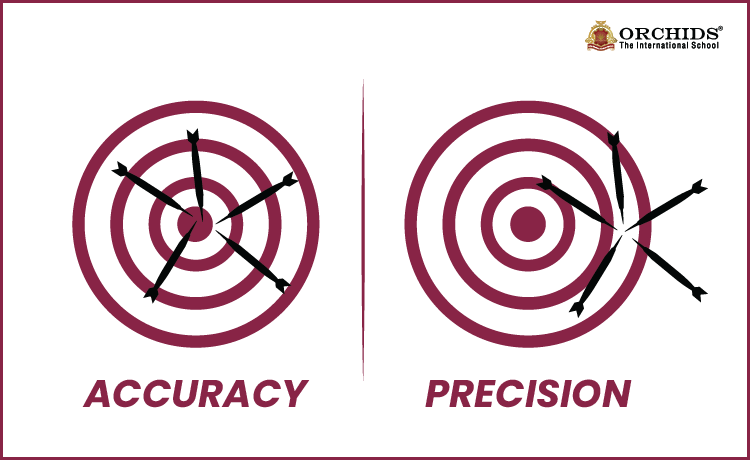
Table of Contents
- What is Accuracy?
- What is Precision?
- Distinguish Between Accuracy and Precision with Examples
- Conclusion
- Frequently Asked Questions on Accuracy and Precision Difference in Chemistry

What is Accuracy?
Accuracy refers to how close your measured value is to the actual value. Think of it as a measure of correctness.
Let's understand it better !!
-
Real-Life Example:
You're baking a cake and the recipe asks for 250g of flour. You weigh it and your scale shows 249.9g.
That's very close to the required amount - meaning your measurement is accurate.
-
A scientific example:
We know that pure water boils at 100°C. If your thermometer reads 100.1°C, we say the result is accurate because it is within a reasonable distance of the expected value.
What is Precision?
Precision describes the degree to which you can repeat a measurement and get the same result. It does not mean that the results are correct, only that they are repeatable.
-
Real-Life Example:
You weigh a packet of rice three times and get:
1)480g
2)480g
3)480g
The measurements are the same every time. So, they are precise. But if the actual weight was 500g, then while the results are precise, they are not accurate.
-
Scientific Example:
A student records the boiling point of a liquid three times as:
1)103.0°C
2)103.1°C
3)103.0°C
The values are very close to one another, so they are precise. However, if the actual boiling point is 100°C, they are not accurate.
Distinguish Between Accuracy and Precision
|
Aspect |
Accuracy |
Precision |
|
Definition |
Closeness to the true value |
Closeness of repeated measurements |
|
Focus |
Correctness |
Consistency |
|
Possible to Have |
Without Precision |
Without Accuracy |
|
Goal in Experiments |
To get correct results |
To ensure reliability |
Below are the illustrations that help us to understand the difference between Accuracy and Precision in a better way.
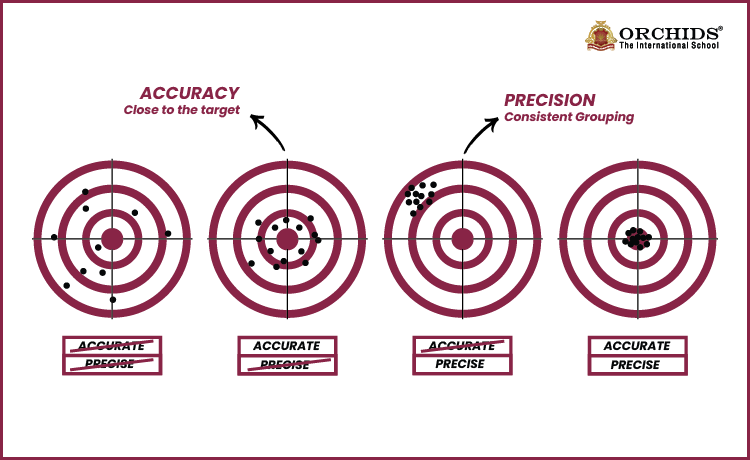
Imagine you're shooting arrows at a target:
- Accurate and Precise: All arrows hit close to the bullseye and land together.
- Accurate but Not Precise: Arrows hit around the bullseye, but are scattered.
- Precise but Not Accurate: Arrows land far from the bullseye but all together.
- Neither Accurate Nor Precise: Arrows are scattered and far from the bullseye.
Conclusion
Distinguishing between accuracy and precision is helpful when interpreting scientific data, and both are important in chemistry. When practical, we want our results to be accurate so that they are meaningful, and precise so that they are repeatable.
Keep these two ideas in mind, and whether you are experimenting with a classroom or analysing data in real life, you will become a more thoughtful and accurate observer!
Frequently Asked Questions on Accuracy and Precision Difference in Chemistry
1. Is accuracy dependent on precision?
No, accuracy and precision are independent. You can be accurate without being precise, and vice versa-it depends on how close your results are to the target versus to each other.
2. Can you be accurate but not precise?
Yes, it's possible. A result can be close to the actual value (accurate) but scattered or inconsistent (not precise).
3. Is accuracy necessary for precision?
Not at all. You can have very precise results that are far from the true value-meaning precise but not accurate.
4. How to improve accuracy vs precision?
To improve accuracy, check calibration and reduce bias. For better precision, focus on consistency, repeat methods carefully, and reduce random errors.
5. What is the accuracy and precision difference?
Accuracy measures how close a measurement is to the true value, while precision focuses on how reliably you can repeat that measurement-even if it’s wrong.
6. How do you distinguish between accuracy and precision?
You can think of accuracy as hitting the bullseye, while precision is hitting the same spot again and again even if it’s far from the center.
Science isn't just a subject, it's the way of seeing the world. Curious how Orchids The International School teaches it that way? Talk to our admissions team.
Admissions Open for 2026-27
What type of concept pages would you prefer?
CBSE Schools In Popular Cities
- CBSE Schools in Bangalore
- CBSE Schools in Mumbai
- CBSE Schools in Pune
- CBSE Schools in Hyderabad
- CBSE Schools in Chennai
- CBSE Schools in Gurgaon
- CBSE Schools in Kolkata
- CBSE Schools in Indore
- CBSE Schools in Sonipat
- CBSE Schools in Delhi
- CBSE Schools in Rohtak
- CBSE Schools in Bhopal
- CBSE Schools in Aurangabad
- CBSE Schools in Jabalpur
- CBSE Schools in Jaipur
- CBSE Schools in Jodhpur
- CBSE Schools in Nagpur
- CBSE Schools in Ahmednagar
- CBSE School In Tumkur











Orchids The International School is one of India's leading chains of CBSE and ICSE schools, with 110+ schools across the country.