

Saponification: Reactions and Mechanism Explained
Have you ever wondered how soap is made from oils and fats? The answer lies in a fascinating chemical process called saponification. It is one of the most important reactions in organic chemistry and forms the basis of soap manufacturing around the world. During this process, fats or oils react with an alkali to produce soap and glycerol.
This article covers saponification, reactions and mechanisms explained with examples with effects to build a strong foundation in this important chemistry concept.
Table of Contents
- What is Saponification
- Saponification Reaction Mechanism
- Examples of Saponification Reactions
- One-Step vs Two-Step Saponification
- Factors Affecting Saponification
- Uses of Saponification
- Frequently Asked Questions on Saponification

What is Saponification?
Saponification is the chemical process through which soap is produced from fats or oils. In this reaction, esters present in fats and oils react with a strong alkali such as sodium hydroxide (NaOH) or potassium hydroxide (KOH).
The reaction breaks down the ester molecules into glycerol and salts of fatty acids. These fatty acid salts are what we commonly call soap.
This process has been used for centuries and remains the foundation of commercial soap manufacturing today.
The word saponification comes from the Latin word sapo, which means soap.In other words, Saponification is the alkaline hydrolysis of an ester in the presence of sodium hydroxide or potassium hydroxide to produce alcohol and the sodium or potassium salt of a carboxylic acid (soap).
In simple words:
Fat/Oil + Alkali → Soap + Glycerol
The reaction converts naturally occurring fats and oils into useful cleansing agents.
Lets Discuss Saponification Reaction
The general saponification reaction can be represented as:
Ester + Base → Alcohol + Soap
For triglycerides:
Triglyceride + NaOH → Glycerol + Sodium Fatty Acid Salt
General Characteristics of the Reaction
- It is an alkaline hydrolysis reaction.
- It is generally irreversible.
- Heat is often used to speed up the reaction.
- Produces soap and glycerol as products.
But the question is what is Saponification Value?
The saponification value is the number of milligrams of potassium hydroxide (KOH) required to completely saponify 1 gram of fat or oil.
Why saponification value is Important?
- Determines the quality and purity of fats and oils.
- Helps assess their suitability for soap production.
What does it Interpret?
- Higher saponification value → Shorter fatty acid chains.
- Lower saponification value → Longer fatty acid chains.
Saponification Reaction Mechanism
The saponification mechanism occurs in several steps:
Step 1: Nucleophilic Attack
The hydroxide ion attacks the carbonyl carbon of the ester group.
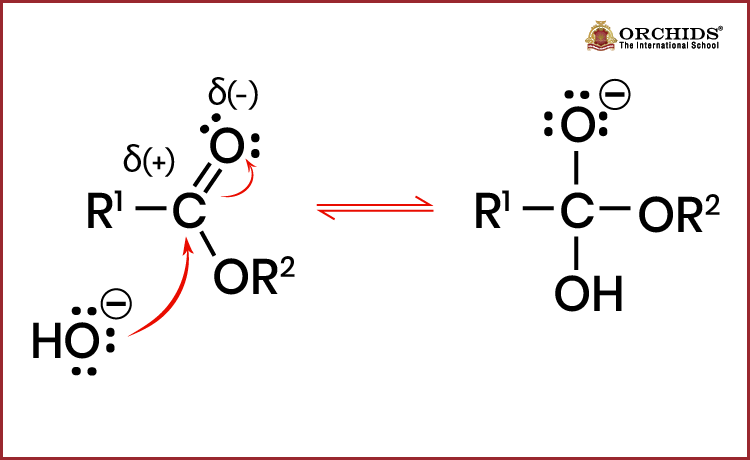
Step 2: Formation of an Intermediate
A tetrahedral intermediate is formed temporarily.
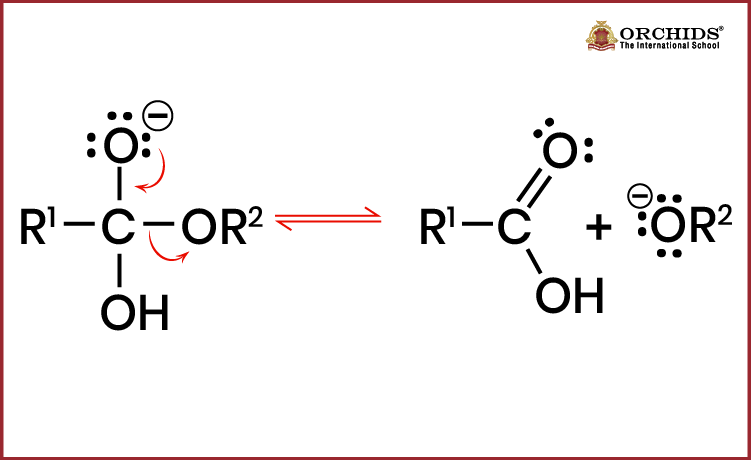
Step 3: Breaking of Ester Bond
The intermediate breaks down, releasing an alcohol group.
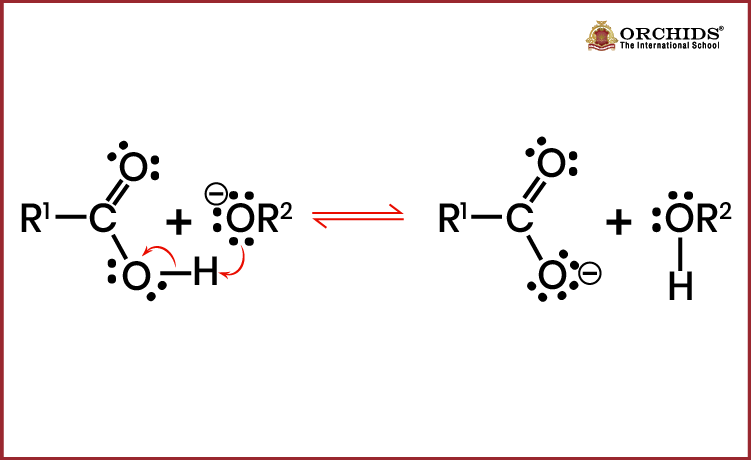
Step 4: Formation of Soap
The carboxylic acid formed reacts with the alkali to produce the corresponding soap.
Result
The final products are:
- Glycerol
- Sodium or potassium salts of fatty acids
These salts act as cleansing agents.
Also Read: Carbon Compounds
Examples of Saponification Reactions
Example 1: Sodium Soap Formation
When triglycerides react with sodium hydroxide:
Triglyceride + 3NaOH → Glycerol + 3 Sodium Fatty Acid Salts
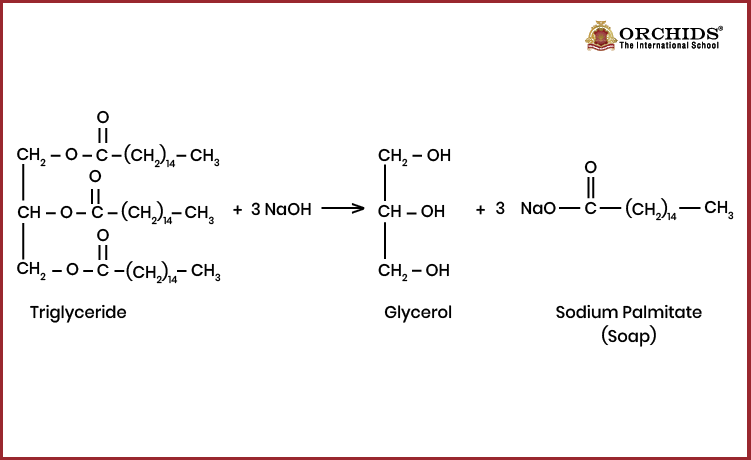
The sodium salts formed are hard soaps commonly used for bathing and laundry.
Example 2: Potassium Soap Formation
When potassium hydroxide is used:
Triglyceride + 3KOH → Glycerol + 3 Potassium Fatty Acid Salts
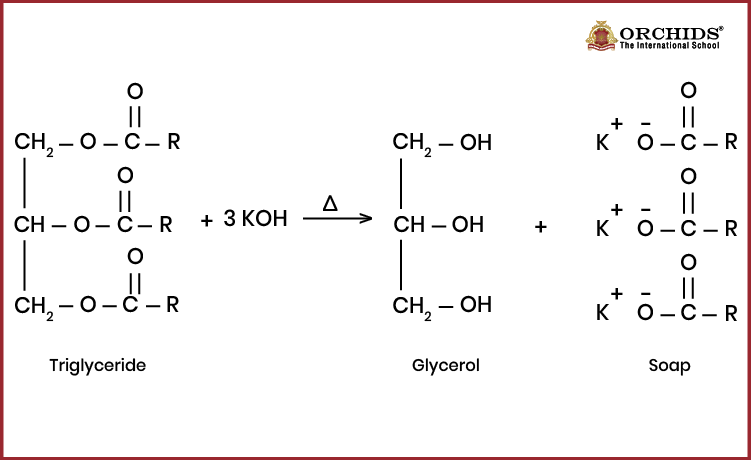
The potassium salts produced are softer soaps often used in liquid soaps.
One-Step vs Two-Step Saponification
Saponification can occur through either a one-step or a two-step process.
One-Step Process: Triglycerides react directly with a strong base to produce soap and glycerol.
Two-Step Process:
- Steam hydrolysis produces glycerol and fatty acids.
- Fatty acids react with alkali to form soap.
|
Feature |
One-Step Saponification |
Two-Step Saponification |
|
Process |
Direct reaction with alkali |
Hydrolysis followed by neutralisation |
|
Products |
Soap and glycerol formed together |
Fatty acid formed first |
|
Industrial Use |
Common |
Used in specialised processes |
|
Steps Involved |
Single step |
Two separate steps |
Factors Affecting Saponification
Several factors influence the rate and efficiency of saponification.
- Temperature, Higher temperatures increase the reaction rate.
- Concentration of Alkali, More concentrated alkali speeds up the reaction.
- Type of Fat or Oil, Different oils have different fatty acid compositions, affecting soap formation.
- Mixing,Proper stirring ensures complete reaction.
- Reaction Time, Adequate time is required for full conversion into soap.
Uses of Saponification
Saponification has numerous applications in daily life and industry.
- In Soap Manufacturing, Saponification is primarily used for the production of soaps from fats and oils.
- In Wet Chemical Fire Extinguishers, It helps extinguish fires caused by cooking oils and fats.
- In the Cosmetic Industry, Used in the manufacture of soaps, skincare, and personal care products.
- In the Pharmaceutical Industry, Applied in the preparation of certain medicines and pharmaceutical products.
- In Production of Glycerol,the glycerol obtained is used in medicines, cosmetics, food products, and explosives.
- In Cleaning Applications, Saponification produces soaps used for laundry, bathing, household, and industrial cleaning.
Read More: Soaps and Detergents
Till now we have learned that Saponification is a vital chemical process responsible for the production of soaps from fats and oils.The reaction has significant industrial, domestic, and commercial importance, ranging from soap manufacturing and fire safety to pharmaceutical applications.
Frequently Asked Questions on Saponification
1. What is the important reaction of saponification?
The saponification reaction is the alkaline hydrolysis of fats or oils that produces soap and glycerol. It is the fundamental chemical process used in soap manufacturing worldwide.
2. What are the two types of saponification?
The two main types of saponification are one-step saponification and two-step saponification. Both methods convert fats into soap, but they differ in the number of stages involved.
3. What is the mechanism of saponification reaction?
The saponification reaction mechanism involves the attack of hydroxide ions on the ester bond of fats or oils. This breaks the ester linkage and forms glycerol along with fatty acid salts (soap).
4. Is saponification basic or acidic?
Saponification is a basic reaction because it occurs in the presence of strong alkalis such as sodium hydroxide (NaOH) or potassium hydroxide (KOH). These bases help convert fats and oils into soap.
5. What is the normal range of saponification value?
The saponification value varies depending on the type of fat or oil being analysed. Generally, most edible oils have saponification values ranging between 180 and 260 mg KOH per gram of oil.
6. Which soap is 100% natural?
A soap made entirely from natural oils, fats, and plant-based ingredients without synthetic additives is often considered 100% natural. Such soaps are commonly produced through the saponification reaction using natural raw materials.
7. What is saponification?
If you are wondering what is saponification, it is the chemical process in which fats or oils react with a strong alkali to form soap and glycerol. This reaction is the basis of traditional and industrial soap production.
Science isn't just a subject, it's the way of seeing the world. Curious how Orchids The International School teaches it that way? Talk to our admissions team.
Admissions Open for 2026-27
What type of concept pages would you prefer?
CBSE Schools In Popular Cities
- CBSE Schools in Bangalore
- CBSE Schools in Mumbai
- CBSE Schools in Pune
- CBSE Schools in Hyderabad
- CBSE Schools in Chennai
- CBSE Schools in Gurgaon
- CBSE Schools in Kolkata
- CBSE Schools in Indore
- CBSE Schools in Sonipat
- CBSE Schools in Delhi
- CBSE Schools in Rohtak
- CBSE Schools in Bhopal
- CBSE Schools in Aurangabad
- CBSE Schools in Jabalpur
- CBSE Schools in Jaipur
- CBSE Schools in Jodhpur
- CBSE Schools in Nagpur
- CBSE Schools in Ahmednagar
- CBSE School In Tumkur











Orchids The International School is one of India's leading chains of CBSE and ICSE schools, with 110+ schools across the country.