

Barium Sulphate (BaSO₄)
Barium Sulphate (BaSO₄) is an interesting white, crystalline compound that you might not notice every day, yet it plays a vital role in medicine, industry, and science.
An interesting fact is that, from helping doctors capture clear X-ray images of the digestive system to strengthening drilling fluids and industrial materials, BaSO₄ quietly makes our lives safer and more efficient.
This article provides a complete understanding of BaSO₄, including its chemical structure, properties, preparation methods, and its uses in everyday life and industry.
Table of Contents
- What is Barium Sulphate?
- Properties of Barium Sulphate
- Preparation of Barium Sulphate
- Chemical Reactions of Barium Sulphate
- Uses of Barium Sulphate
- Frequently Asked Questions on Barium Sulphate (BaSO₄)

What is Barium Sulphate?
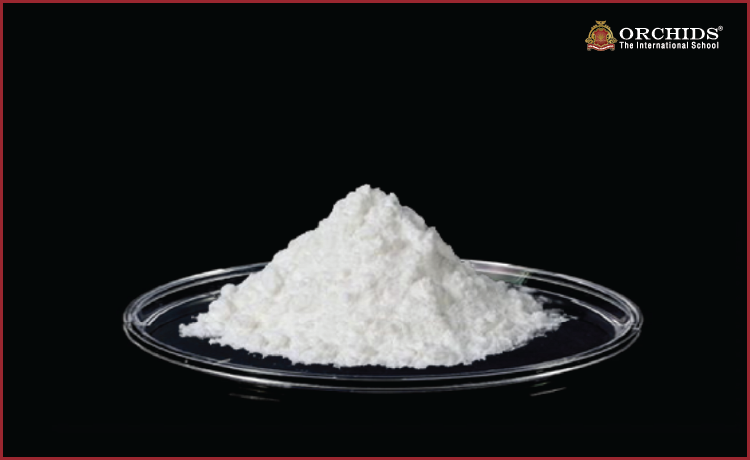
When it comes to its occurrence in nature, it is found naturally as the mineral barite. It is dense, stable, and completely non-toxic in its insoluble form. Barium Sulphate (BaSO₄) is a white, crystalline, non-toxic compound, in appearance.
Let's discuss its Chemical structure of Barium Sulphate!
Barium Sulphate (BaSO₄) is an inorganic chemical compound made of barium cations (Ba²⁺) and sulphate anions (SO₄²⁻).
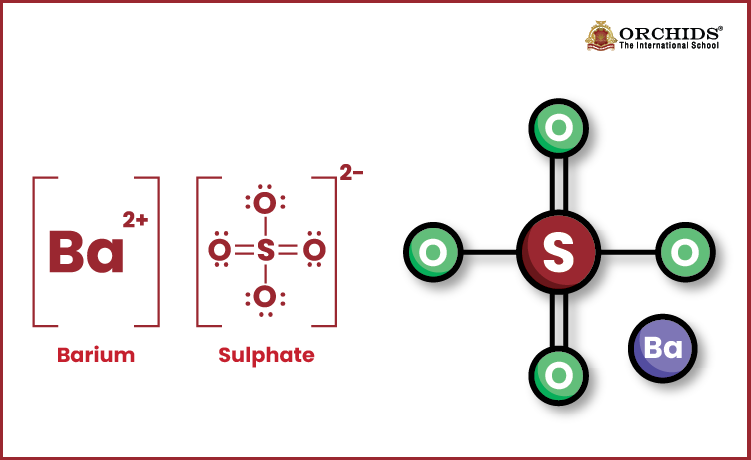
Interestingly, Barium Sulphate consists of a single barium ion (Ba²⁺) paired with a sulphate ion (SO₄²⁻). In the sulphate ion, the sulfur atom is centrally bonded to four oxygen atoms in a tetrahedral arrangement.
BaSO4\text{BaSO}_4BaSO4
But what makes the struture more stable?
The answer lies in its crystal lattice arrangement makes the compound extremely stable and insoluble in water, which is why it is safe for medical applications.
Apart from that, Barium Sulphate shows the trends which easily help us to distinguish them.
Properties of Barium Sulphate
|
Property |
Details |
|
Molecular Formula |
BaSO₄ |
|
Molecular Weight |
233.38 g/mol |
|
Appearance |
White crystalline solid |
|
Density |
4.5 g/cm³ |
|
Melting Point |
1580 °C |
|
Boiling Point |
1600 °C |
|
Solubility |
Insoluble in water, soluble in concentrated acids |
|
Odour |
Odourless |
|
Toxicity |
Non-toxic in its insoluble form |
Interesting Fact: Its high density and white colour make it ideal for medical imaging, especially X-rays of the gastrointestinal tract.
Also, Students can check out the details on Barium for a better understanding of concepts.
Preparation of Barium Sulphate
Barium Sulphate is primarily obtained from barite (BaSO₄). Impure barite is first converted to barium sulfide (BaS) by heating with coke.
The soluble BaS is then treated with sulfuric acid (H₂SO₄) to form pure BaSO₄:
This process produces a stable, insoluble compound suitable for medical and industrial applications.
Chemical Reactions of Barium Sulphate
- Barium Sulphate is chemically very stable due to its insolubility, but it can react with strong acids to produce soluble barium salts:
This property is used in laboratories for converting BaSO₄ into other barium compounds for industrial purposes.
2. When heated to very high temperatures (above 1400 K), BaSO₄ undergoes thermal decomposition to produce barium oxide and sulfur dioxide:
This decomposition requires significant heat and is mostly relevant in high-temperature industrial applications.
3. Reduction with Carbon; Barium Sulphate can react with carbon (coke) at elevated temperatures (~600 °C) to form barium sulfide (BaS) and carbon monoxide:
This carbothermal reduction is a standard industrial method for producing barium sulfide from natural barite.
4. Reaction of Barium Sulfide with Sulfuric Acid, Barium sulfide (BaS) produced by reduction can react with sulfuric acid to regenerate barium sulfate and release hydrogen sulfide (H₂S) gas:
This reaction is commonly used in laboratories to obtain pure BaSO₄ from BaS.
Uses of Barium Sulphate
1. Medical ApplicationsIt is used as a radio-opaque agent for X-ray imaging of the gastrointestinal tract (“barium meal” or “barium swallow”).
Also, it helps doctors detect disorders in the stomach, intestines, or oesophagus without being absorbed into the body.
2. Industrial Applications
- Oil & Gas Drilling adds weight to drilling fluids to maintain pressure and prevent blowouts.
- In Construction, it is used in concrete and radiation shielding due to its high density.
- Itacts as a filler to increase density and improve consistency in the Plastics & Paints industries.
- In Ceramics & Alloys, it enhances durability and stability in specialised materials.
3. In Other Applications like:
- It is used in adhesives, paper coatings, rubber, and catalyst supports.
- It acts as a pH stabiliser in soil testing and other chemical processes.
As we learned that Barium Sulphate (BaSO₄) is far more than just a white solid. Its chemical stability, high density, and non-toxic nature make it an essential compound in medicine, industry, and research.
Frequently Asked Questions on Barium Sulphate (BaSO₄)
1. What is barium sulfate?
Barium sulfate is a white, crystalline compound composed of barium and sulfate ions. It is widely used in medical imaging, industry, and as a filler in various products.
2. What is the barium sulfate formula?
The chemical formula of barium sulfate is BaSO₄, showing one barium ion bonded to one sulfate ion. Its stability and insolubility make it safe for many applications.
3. Mention the Barium sulfate use.
Barium sulfate is used as a radiopaque agent for X-rays, in drilling fluids, paints, plastics, and as a filler to improve material density. Its non-toxic nature allows safe use in medicine.
4. What is the principle of barium sulfate?
The principle of barium sulfate in medical imaging is that it absorbs X-rays efficiently, allowing doctors to clearly view the digestive tract without being absorbed into the body.
5. What is the colour of barium sulfate?
Barium sulfate appears as a bright white crystalline solid, making it easy to identify and use in paints, coatings, and medical preparations.
6. What happens when barium sulfate is heated?
Barium sulfate is very stable; even on heating, it does not decompose easily and retains its chemical structure unless exposed to extremely high temperatures.
7. Does barium sulfate react with water?
No, barium sulfate is insoluble in water, which is why it is safe for medical uses and does not dissolve in bodily fluids.
8. What is another name for barium sulfate?
Barium sulfate is also known as barite in its natural mineral form, commonly found in rocks and used industrially.
9. Where does barium come from?
Barium comes from minerals like barite (BaSO₄) and witherite (BaCO₃), which are mined and processed to obtain barium compounds for various uses.
Science isn't just a subject, it's the way of seeing the world. Curious how Orchids The International School teaches it that way? Talk to our admissions team.
Admissions Open for 2026-27
What type of concept pages would you prefer?
CBSE Schools In Popular Cities
- CBSE Schools in Bangalore
- CBSE Schools in Mumbai
- CBSE Schools in Pune
- CBSE Schools in Hyderabad
- CBSE Schools in Chennai
- CBSE Schools in Gurgaon
- CBSE Schools in Kolkata
- CBSE Schools in Indore
- CBSE Schools in Sonipat
- CBSE Schools in Delhi
- CBSE Schools in Rohtak
- CBSE Schools in Bhopal
- CBSE Schools in Aurangabad
- CBSE Schools in Jabalpur
- CBSE Schools in Jaipur
- CBSE Schools in Jodhpur
- CBSE Schools in Nagpur
- CBSE Schools in Ahmednagar
- CBSE School In Tumkur











Orchids The International School is one of India's leading chains of CBSE and ICSE schools, with 110+ schools across the country.