

All About Calcium Carbonate (CaCO₃): Structure, Uses, and Applications
Calcium carbonate (CaCO₃) is one of the first chemicals students encounter, whether as chalk on the classroom board, the marble floor beneath them, or the shells collected on a beach. It is a naturally occurring compound found in rocks, sea organisms, and even inside the human body. Though it is Simple in appearance, yet beneficial, calcium carbonate plays a major role in industries, construction, medicine, and environmental processes.
This article provides insight into what calcium carbonate is, how it is formed, its chemical behaviour, and its practical applications in real life, through clear explanations and relatable examples.
Table of Contents
- What Is Calcium Carbonate?
- Properties of Calcium Carbonate
- Calcium Carbonate Commercial Production
- Synthesis of Calcium Carbonate
- Applications and Uses of Calcium Carbonate
- Frequently Asked Questions on Calcium Carbonate

What Is Calcium Carbonate?
Calcium carbonate is an inorganic compound. It appears as a white, odourless, tasteless powder or crystalline solid. Calcium Carbonate Formula is represented by CaCO₃. Calcium carbonate is non-toxic, widely available, and extremely important in construction, manufacturing, and biological systems.

It occurs naturally in several forms, such as:
- Chalk is a soft, porous form
- Limestone is a sedimentary rock
- Marble is a hard, crystalline form
- Calcite is a pure mineral form
- Shells and corals are biological sources
The fact that all these forms are chemically identical but differ in hardness, crystal structure, and appearance.
But what about Calcium Carbonate Structure
Calcium carbonate contains Calcium ion (Ca²⁺) and Carbonate ion (CO₃²⁻), where carbon is centrally bonded to three oxygen atoms in a trigonal planar arrangement.
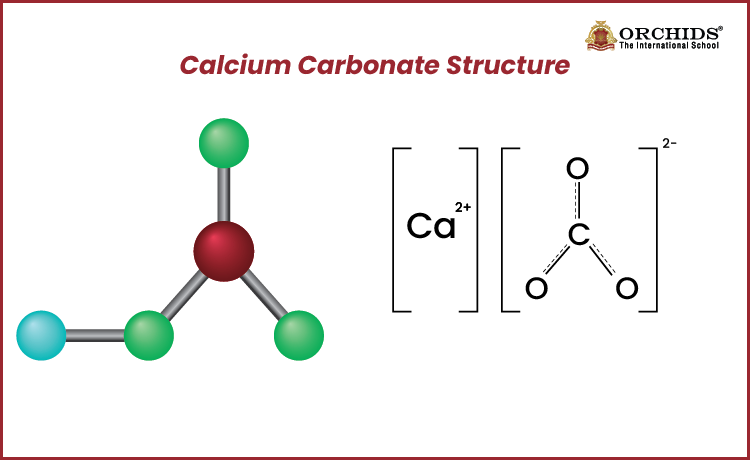
Its crystal structure varies with its form:
- Calcite → trigonal
- Aragonite → orthorhombic
- Vaterite → rare, unstable hexagonal form
These different structures explain why chalk is soft, but marble is hard.Next comes Calcium Carbonate is showing some physical and chemical trends which help us to identify it among all others.
Properties of Calcium Carbonate (CaCO₃)
Physical Properties
|
Property |
Description |
|
Chemical formula |
CaCO₃ |
|
Molar mass |
100 g/mol |
|
Nature |
Insoluble in water, soluble in acids |
|
Occurrence |
Found in chalk, limestone, marble, shells, pearls, and coral |
|
Medicinal role |
Used as an antacid and calcium supplement |
|
Industrial role |
Used in cement, paints, ceramics, plastics, glass, and cosmetics |
Chemical Properties
1. Thermal Decomposition
This forms quicklime (CaO), a key ingredient in cement.
2. Reaction With Acids
Reacts with dilute acids to release carbon dioxide:
This is why acids fizz when poured on chalk or limestone.
Calcium Carbonate Commercial Production
Industrially, calcium carbonate is produced in two major grades, depending on the desired purity and particle size:
- Ground Calcium Carbonate GCC is made by mining natural calcium carbonate deposits such as limestone, chalk, or marble. These natural rocks are crushed, ground, and sometimes classified into different particle sizes.
Key Features of GCC
- Natural origin is directly sourced from the earth.
- When it comes to the Crystal shape is mostly irregular and rhombohedral, meaning the particles look uneven and naturally shaped.
- Particle size has a wider range of particle sizes, from coarse to very fine.
- It has slightly lower brightness compared to PCC because it is naturally occurring.
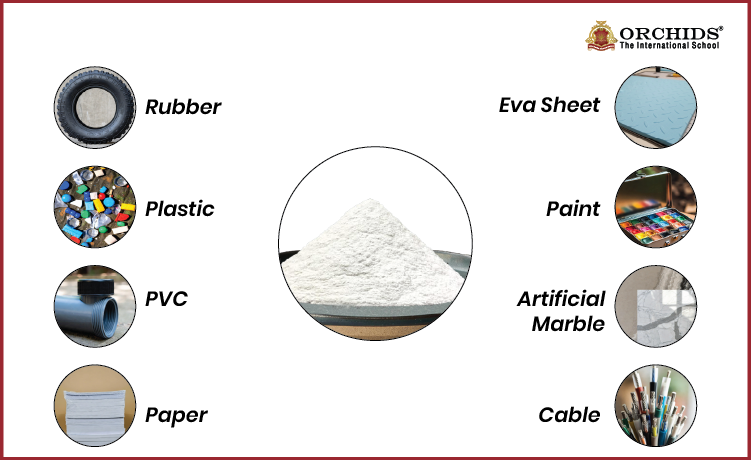
Where GCC is commonly used
- Paints and coatings
- Paper industry
- PVC pipes
- Construction materials (cement, tiles, plaster)
- Rubber and plastics
The fact that GCC is often chosen when cost-effectiveness and bulk use matter.
2. Precipitated Calcium Carbonate (PCC) is produced synthetically by a controlled chemical process, usually by reacting calcium hydroxide with carbon dioxide.
Key Features of PCC
- PCC is made in thelab/industry and is created through a chemical precipitation process.
- PCC particles are uniform, smooth, and regular, and the shape can be controlled (scalenohedral, rhombohedral, spherical, etc.).
- When it comes to its Particle size, it is much smaller and more consistent, giving more predictable performance.
- PCC typically has higher purity, higher brightness, and is less abrasive.
Where PCC is commonly used
- High-brightness papers
- Toothpaste
- Food and pharma applications
- Specialty paints
- Sealants and adhesives
- Cosmetics
Because PCC is purer and finer, it is used where high whiteness, smoothness, and precision are needed.
Synthesis of Calcium Carbonate
1. By Passing CO₂ Through Slaked Lime
This is the most common laboratory and industrial method.
If excess CO₂ is passed:
2. By Double Displacement Reaction
This produces a fine precipitate of calcium carbonate.
Frequently Asked Questions on Calcium Carbonate
1. What are the important uses of calcium carbonate?
Calcium carbonate is widely used in industries, medicine, and agriculture. Knowing the calcium carbonate formula and the molar mass of calcium carbonate helps in understanding its applications better.
2. What should I avoid when taking calcium carbonate?
When taking calcium carbonate, avoid mixing it with certain medications.
3. What are some interesting facts about calcium carbonate?
Calcium carbonate occurs naturally in rocks, shells, and pearls.
4. What type of matter is calcium carbonate?
Calcium carbonate is a solid, naturally occurring mineral. Knowing what is calcium carbonate and its chemical formula of calcium carbonate helps identify it.
5. What is another name for calcium carbonate?
Calcium carbonate is also known as limestone or chalk. The calcium carbonate formula and molar mass of calcium carbonate make it easy to study scientifically.
Science isn't just a subject, it's the way of seeing the world. Curious how Orchids The International School teaches it that way? Talk to our admissions team.
Admissions Open for 2026-27
What type of concept pages would you prefer?
CBSE Schools In Popular Cities
- CBSE Schools in Bangalore
- CBSE Schools in Mumbai
- CBSE Schools in Pune
- CBSE Schools in Hyderabad
- CBSE Schools in Chennai
- CBSE Schools in Gurgaon
- CBSE Schools in Kolkata
- CBSE Schools in Indore
- CBSE Schools in Sonipat
- CBSE Schools in Delhi
- CBSE Schools in Rohtak
- CBSE Schools in Bhopal
- CBSE Schools in Aurangabad
- CBSE Schools in Jabalpur
- CBSE Schools in Jaipur
- CBSE Schools in Jodhpur
- CBSE Schools in Nagpur
- CBSE Schools in Ahmednagar
- CBSE School In Tumkur











Orchids The International School is one of India's leading chains of CBSE and ICSE schools, with 130+ schools across the country.