

Understanding Chemical Change: How Rusting of Iron Happens in Real Life
Have you ever noticed how iron objects like gates or tools slowly turn reddish-brown over time? This common change is called rusting, and it is a perfect example of a chemical change. A chemical change occurs when a substance transforms into a completely new substance with different properties. Unlike physical changes, these changes are usually permanent and cannot be reversed.
This article helps us to help students understand the concept of chemical change through the simple and relatable example of the rusting of iron.
Table of Contents
- What is a Chemical Change
- Characteristics of chemical change
- Frequently Asked Questions (FAQs) on Chemical Change

What is a Chemical Change?
A change involving the conversion of a substance into a new substance or substances with different sets of properties is known as a chemical change.
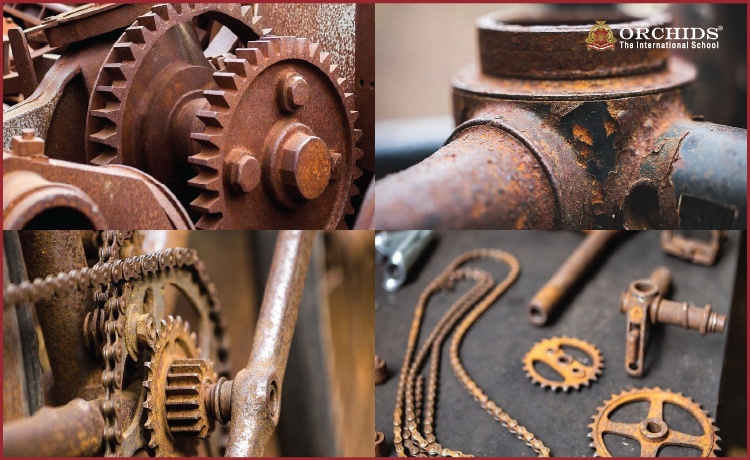
For example, rusting of iron, curdling of milk, burning of magnesium ribbon, a reaction between vinegar and baking soda, a reaction between copper sulphate solution and iron nail and browning of fruits.
Characteristics of chemical change
• A chemical change is usually permanent and irreversible.
• A completely new substance is formed, which has new sets of chemical and physical properties.
• During a chemical change, heat or light may be emitted or absorbed.
• Specific conditions are required for the completion of a chemical change.
Let's understand with an example of Rusting of iron
We often see reddish-brown deposition on iron objects left outside in moist air. This reddish-brown deposition is rust. The process of formation of rust is called rusting. You must have observed rust on iron objects like the iron benches in the garden, agricultural tools, iron pipes, window grills, bridges, etc. gets rusted.
Conditions required for rusting are:
• Presence of water or water vapour, that is, moisture.
• Presence of oxygen
So, iron articles are rusted when they come in contact with moist air.
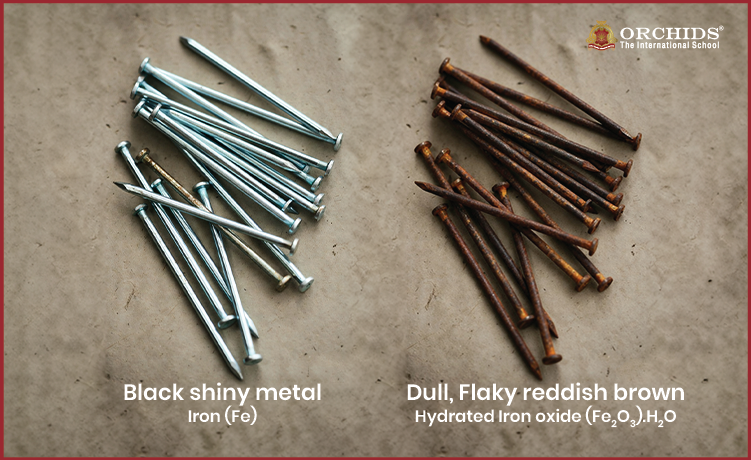
If the air in a place has high moisture, then iron rusts faster. Thus, rusting of iron is faster in coastal areas because the air at those places contains more water vapour. The presence of salt in water also speeds up the process of rusting.
Ships are made of iron, Some parts of the ship remain submerged under seawater, while the portion that remains above the surface has water droplets clinging to its outer surface. Due to moisture and the presence of salt in sea water Even the painted ships get rusted.
Rusting of iron is considered a chemical change because:
• It is an irreversible and permanent change.
• A new substance with different properties is formed.
• A chemical reaction takes place.
The chemical reaction: Iron reacts with atmospheric oxygen in the presence of moisture to form a substance called iron oxide (rust).
Iron + Oxygen + Water → Iron oxide
Fe + O₂ + H₂O → Fe₂O₃ (Rust)
As we have learned, that how Chemical changes are an essential part of our daily lives, even though we may not always notice them. Rusting of iron is a simple yet important example that helps us understand how new substances are formed through chemical reactions. It shows that factors like moisture and oxygen play a key role in such changes.
Frequently Asked Questions (FAQs) on Chemical Change
1. What is a chemical change?
A chemical change is a process where a substance turns into a new substance with different properties. It is usually permanent and cannot be reversed easily.
2. Why is rusting considered a chemical change?
Rusting forms a new substance called iron oxide with different properties. This makes it a permanent and irreversible chemical change.
3. What are the conditions required for rusting?
Rusting needs moisture (water or water vapour) and oxygen. Without these two, rusting cannot take place.
4. Why does rusting happen faster in coastal areas?
Coastal areas have high moisture and salt in the air, which speeds up rusting. Salt water increases the rate of corrosion.
5. Can rusting be prevented?
Yes, rusting can be prevented by painting, oiling, or coating iron surfaces. These methods stop contact with air and moisture.
Science isn't just a subject, it's the way of seeing the world. Curious how Orchids The International School teaches it that way? Talk to our admissions team.
Admissions Open for 2026-27
What type of concept pages would you prefer?
CBSE Schools In Popular Cities
- CBSE Schools in Bangalore
- CBSE Schools in Mumbai
- CBSE Schools in Pune
- CBSE Schools in Hyderabad
- CBSE Schools in Chennai
- CBSE Schools in Gurgaon
- CBSE Schools in Kolkata
- CBSE Schools in Indore
- CBSE Schools in Sonipat
- CBSE Schools in Delhi
- CBSE Schools in Rohtak
- CBSE Schools in Bhopal
- CBSE Schools in Aurangabad
- CBSE Schools in Jabalpur
- CBSE Schools in Jaipur
- CBSE Schools in Jodhpur
- CBSE Schools in Nagpur
- CBSE Schools in Ahmednagar
- CBSE School In Tumkur











Orchids The International School is one of India's leading chains of CBSE and ICSE schools, with 110+ schools across the country.