

Laser
Lasers are powerful beams of light that can travel miles into the sky or even cut through metal. Although they may seem like modern technology, lasers have been around for over 60 years. You may have wondered after knowing that the first working laser was created by Theodore H. Maiman at Hughes Research Laboratories in 1960. Back then, lasers were a breakthrough in science and technology.
This article serves as a complete and easy-to-follow guide to understanding what a laser is, how it works, its characteristics, and real-life applications.
Table of Contents
- What is a Laser?
- How does a laser work?
- Important Characteristics of a Laser
- Types of Laser
- Real Life Uses of Laser
- Frequently Asked Questions on Laser

What is a Laser?
A laser is a special device that makes atoms or molecules emit light and then amplifies it to create a narrow, focused beam. Lasers can produce light in visible, infrared, or ultraviolet colours.
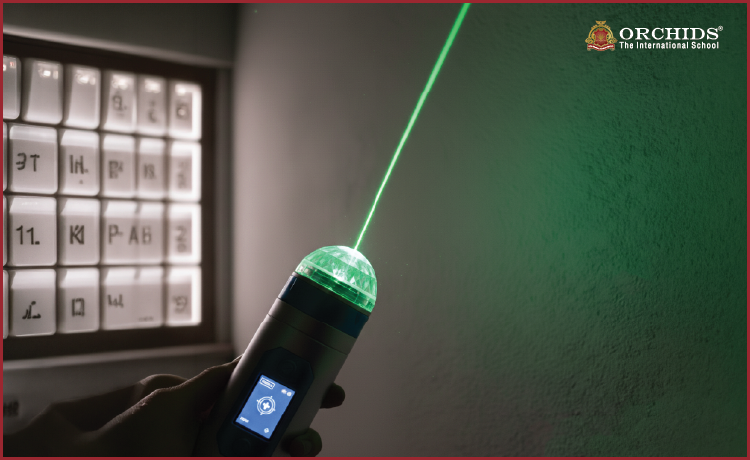
But what is the full form of laser?
The full form of Laser is Light Amplification by Stimulated Emission of Radiation.
Now, one important question arises here: do Flashlight and Laser produce the same light?
The answer is no, they do not. While both of them produce light, a flashlight emits incoherent, scattered light that spreads out and dims with distance. In contrast, a laser emits coherent, focused light that stays narrow, bright, and travels long distances without spreading.
Nowadays, lasers are all around us, in homes, offices, and shopping centres. We might not notice them, but lasers play a role in our everyday lives. But how exactly do they work? Let's discuss,
How does a laser work?
A laser produces a coherent electromagnetic field, where all the waves move together in the same frequency and rhythm.
Here is a visual representation of the working of a laser,
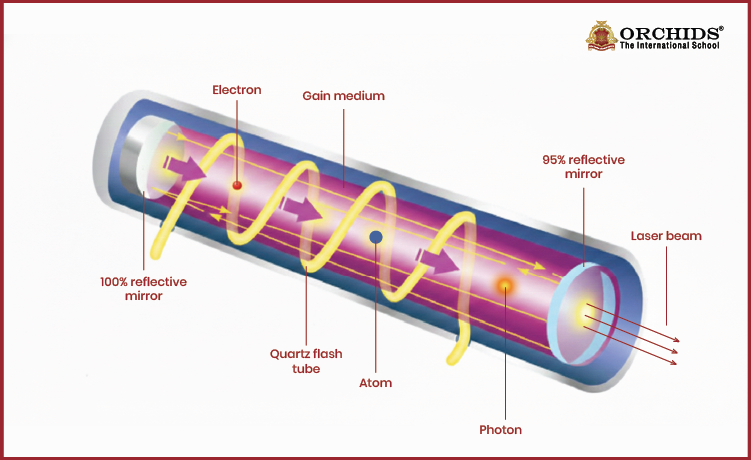
Observe it and try to understand how it works step by step:
-
A resonant cavity (the gain medium) is filled with a material (solid, liquid, or gas) that determines the laser’s wavelength.
-
Energy is pumped into this medium from an external source, creating a population inversion (more atoms in the excited state than the lower state).
-
Light or photons are generated by stimulated emission. An excited atom emits a photon when hit by another photon, producing identical photons.
-
There are two mirrors at the ends of the cavity:
-
One is fully reflective (100%), reflecting almost all the light into the cavity.
-
The other is partially reflective (95%) (output coupler), allowing some light to escape as the laser beam.
-
The light bounces back and forth between the mirrors, amplifying in intensity each time it passes through the gain medium.
-
The cavity length is designed so that the reflected waves reinforce each other, such as constructive interference.
-
Coherent light exits through the partially reflective mirror, forming the laser beam.
-
The output can be a continuous beam or a series of short, intense pulses, depending on the laser’s design.
In short, a laser works by exciting electrons, creating a chain reaction of light, and letting that light escape as a bright, concentrated beam.
Important Characteristics of a laser
Laser light is very different from ordinary light. Its main characteristics are:
-
A laser light has a Monochromatic nature. Laser light has only one colour or wavelength, unlike regular light, which has many colours mixed.
-
Another important property of a laser is Coherence. The waves in a laser move together in sync, meaning they have the same frequency and phase.
-
Laser light also shows a noticeable Directionality property. While normal light spreads out in all directions, laser light travels in a tight, straight beam.
For example, a torch spreads its light widely, but a laser beam stays narrow even over long distances.
-
Laser light is extremely bright or has high Intensity compared to regular light. Even a small 1 mW helium-neon (He-Ne) laser can be brighter than sunlight in its beam because of its coherence and direction.
Types of Laser
Lasers come in different types depending on the material they use to produce light:
-
Gas Lasers use gases like CO₂ or helium-neon. They are used in laser cutting, welding, barcode scanners, and surgery.
-
Solid-State Lasers Use solids mixed with rare-earth elements, like ruby or Nd: YAG lasers. Used in medicine, LIDAR, and material processing.
-
Fibre lasers are A type of solid-state laser using optical fibres. They produce precise, straight beams and are efficient and small.
-
Liquid (Dye) Lasers Use liquid dyes. They can produce many colours and are used in medicine, spectroscopy, and isotope separation.
-
Semiconductor (Diode) Lasers are Small lasers found in laser pointers, printers, and scanners. They convert electricity directly into laser light.
Real Life Uses of Laser
Lasers are everywhere around us, from helping us in laser treatment in medicine, technology, industry, to the military. Let's discuss a few of them,
-
Laser treatment in the Medical Field can perform bloodless surgeries, remove kidney stones, treat cancer, and correct eye lens problems.
-
In Communications, they help send information over long distances in optical fibre networks, satellites, underwater communication, and space technology.
-
In Industry, lasers cut glass and metals, trim electronic circuits, and help in automobile manufacturing and heat treatment.
-
In Science and Technology, scientists use lasers to study particles, measure atoms, and even prove that light travels at the same speed in all directions.
-
In the Military, lasers are used in range finders to measure distances, for precise night surveillance, and in gyroscopes to detect tiny rotations in moving objects.
-
CO₂ laser-based Cutting Tools are widely used because they are precise, fast, and require no sharpening. Robot-guided lasers also cut fabrics such as denim to improve speed, accuracy, and efficiency.
Till now, we have seen how Lasers are unique sources of light, monochromatic, and highly directional. From medicine and industry to communication and science, they play an important role in modern technology. Understanding how lasers work and their properties helps us appreciate their power, precision, and countless real life applications.
Frequently Asked Questions on Laser
1. What is the full form of “LASER”?
The full form of LASER is Light Amplification by Stimulated Emission of Radiation.
2. How does a laser actually work?
A laser works by exciting atoms or molecules in a medium (solid, gas, or liquid). When these atoms return to their normal energy state, they release photons. These photons bounce between mirrors, stimulate more light, and eventually form a strong, focused beam.
3. Why is laser light different from ordinary light?
Laser light is special because it is coherent (the waves move together), monochromatic (one colour or wavelength), and highly directional (travels in a narrow beam).
4. Are there different types of lasers?
Yes, there are gas lasers (like CO₂ or helium-neon), solid-state lasers (like ruby or Nd: YAG), fibre lasers, liquid/dye lasers, and semiconductor (diode) lasers.
5. What are common uses of lasers in real life?
Lasers are used in medicine (surgery, vision correction), industry (cutting, welding), communication (fibre optics), science (measurements, holography), and even in the military (range finders, guidance).
6. Are lasers dangerous? Can they hurt your eyes?
Yes. Laser beams are very focused and intense, so they can damage eyes or skin if not handled properly. Even low-power lasers can be harmful if misused.
7. Can laser light pass through the body or cause cancer?
Most everyday lasers, like pointers, do not go deep into the body or cause cancer. However, high-power lasers can be dangerous, so they must always be used carefully.
8. Who invented the laser?
The laser was invented by Theodore Maiman, who built the first working laser in 1960 at Hughes Research Laboratories.
Science isn't just a subject, it's the way of seeing the world. Curious how Orchids The International School teaches it that way? Talk to our admissions team.
Admissions Open for 2026-27
What type of concept pages would you prefer?
CBSE Schools In Popular Cities
- CBSE Schools in Bangalore
- CBSE Schools in Mumbai
- CBSE Schools in Pune
- CBSE Schools in Hyderabad
- CBSE Schools in Chennai
- CBSE Schools in Gurgaon
- CBSE Schools in Kolkata
- CBSE Schools in Indore
- CBSE Schools in Sonipat
- CBSE Schools in Delhi
- CBSE Schools in Rohtak
- CBSE Schools in Bhopal
- CBSE Schools in Aurangabad
- CBSE Schools in Jabalpur
- CBSE Schools in Jaipur
- CBSE Schools in Jodhpur
- CBSE Schools in Nagpur
- CBSE Schools in Ahmednagar
- CBSE School In Tumkur











Orchids The International School is one of India's leading chains of CBSE and ICSE schools, with 110+ schools across the country.