

Barometer: Types, Uses, and Applications Explained
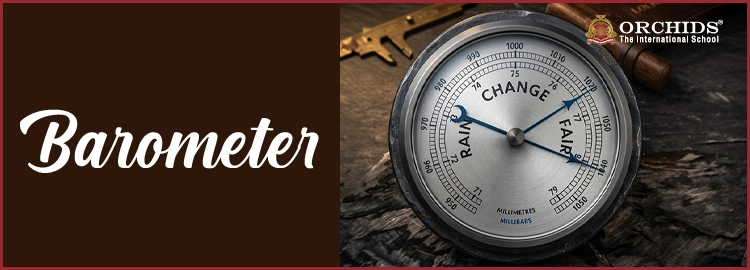
A barometer might look like a simple device in Physics, but it plays a big role in understanding the world around us. Think of it as a quiet helper that keeps track of the air pressing down on us, helping predict the weather, measure altitude, and even guide aeroplanes safely. You’ll find barometers used in weather stations, aircraft, and even at home by people who love tracking changes in the atmosphere. They help us understand what’s happening in the air around us and prepare for shifts in the weather. This article will walk you through how barometer works, types of barometers, and why it’s such an important tool in everyday life.
Table of Contents
- Understanding the Barometer and Its Types
- How to Make a Simple Barometer at Home
- Real-Life Uses of a Barometer
- Frequently Asked Questions on Barometer

Understanding the Barometer and Its Types
Have you ever wondered how we can predict the weather or know the air pressure around us? That’s where a barometer comes in. Simply put, a barometer is a device that measures the pressure of air. By showing how heavy the air is at a particular place, it can help forecast weather changes and even determine altitude. It’s like a quiet helper keeping track of the air above us.
But where did this idea come from? The story goes back to 1643, when Italian scientist Evangelista Torricelli made an interesting discovery. He realised that air has weight and can push on a column of mercury. This simple experiment proved that air exerts pressure and laid the foundation for modern weather forecasting. Even today, barometers work on the same basic principle.
So, what types of barometers exist? The two main kinds are,
- Mercury Barometers
- Aneroid Barometers
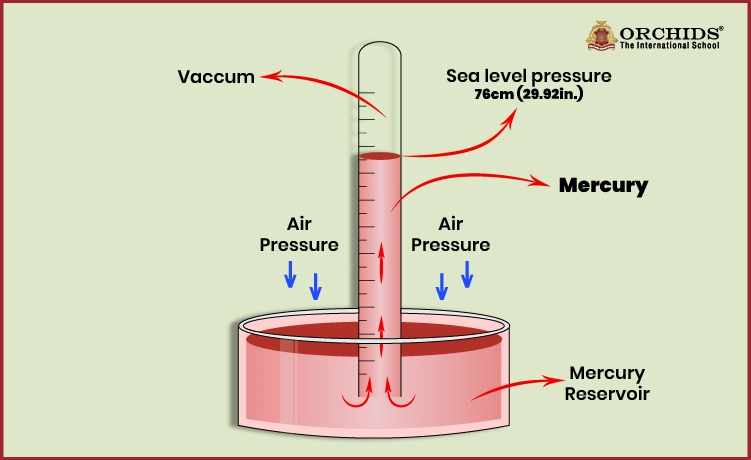
Let us take a closer look. You might be wondering, how does a mercury barometer actually work? The design is simple but clever. It consists of,
- A glass tube closed at one end
- Mercury inside the tube
- A small cup called a cistern is at the bottom
Here is the process of how a barometer works: the tube is filled with mercury and then inverted into the cistern. Mercury rises until its weight balances the air pressure above it. At sea level, the mercury usually reaches about 760 mm (30 inches).
Why mercury, you might ask? The answer lies here,
Mercury is very dense, so the tube can stay reasonably small. If we used water, the tube would need to be over 10 metres high, hardly practical! And how does it help predict the weather?
- When air pressure is low, the mercury drops, which often signals rain or storms.
- When air pressure is high, the mercury rises, usually bringing clear skies.
To put it simply: harder air push → mercury rises; lighter push → mercury falls.
But not all barometers use mercury. Have you heard of aneroid barometers? These don’t use any liquid at all. Instead, they rely on a small, flexible metal box called an aneroid capsule, made from a beryllium-copper alloy. Levers and springs connect the capsule to a pointer or dial.
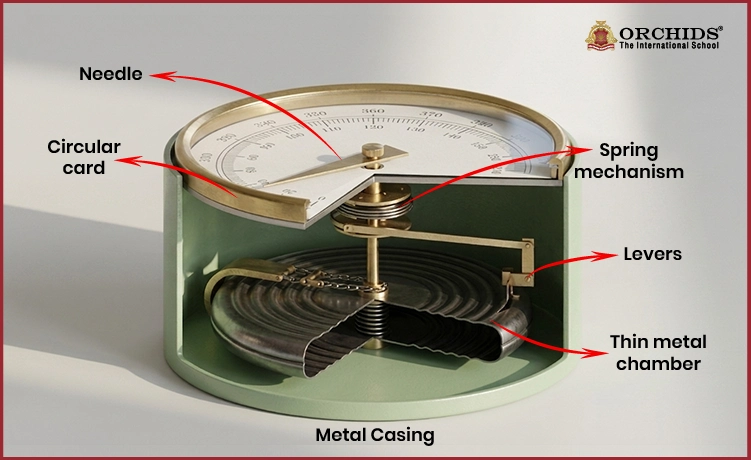
In short: air pressure pushes → mercury or capsule moves → pointer shows the reading → we get a hint of the weather!
When the air pressure changes, the capsule expands or contracts, and the pointer moves to show the reading. The great thing about aneroid barometers is that they are portable, safe, and easy to use and perfect for homes, aeroplanes, and ships.
How to Make a Simple Barometer at Home?
Making a barometer at home is a fun and easy way to learn about air pressure and the weather. You don’t need to be a scientist, just a few simple items and some curiosity!
Step 1: Gather Materials
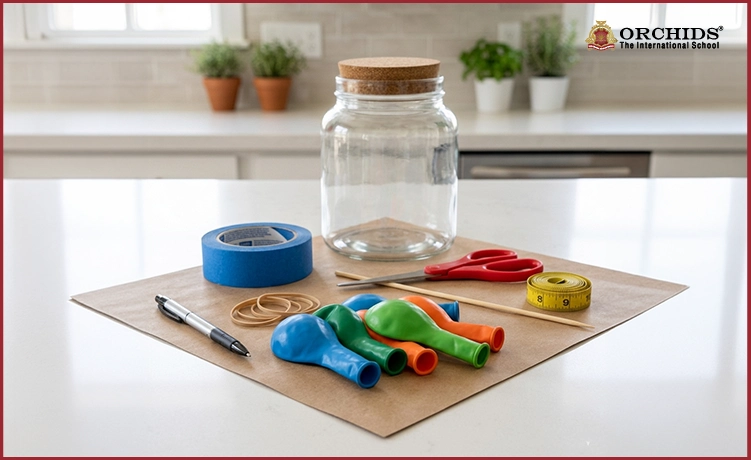
Before you start, collect these things:
- Balloon
- Rubber band
- Jar
- Straw
- Tape
- Cardboard or thick paper
- Permanent marker
Step 2: Prepare the Balloon
- Cut the top off the balloon.
- Stretch it tightly over the jar opening and secure it with a rubber band. This will act as the air-sensitive surface of your barometer.
Step 3: Attach the Straw
- Tape a straw on the centre of the balloon so that about one-third hangs over the edge. This will act as the pointer to show air pressure changes.
Step 4: Create the Scale
- Draw three lines on a piece of cardboard or paper labelled 'Low', 'Moderate', and 'High'.
- Tape the card behind the jar so the straw points to “Moderate” when starting.
Step 5: Watch and Learn
- When air pressure is low, the balloon swells and the straw points downward.
- When air pressure is high, the balloon is pushed in and the straw points upward.
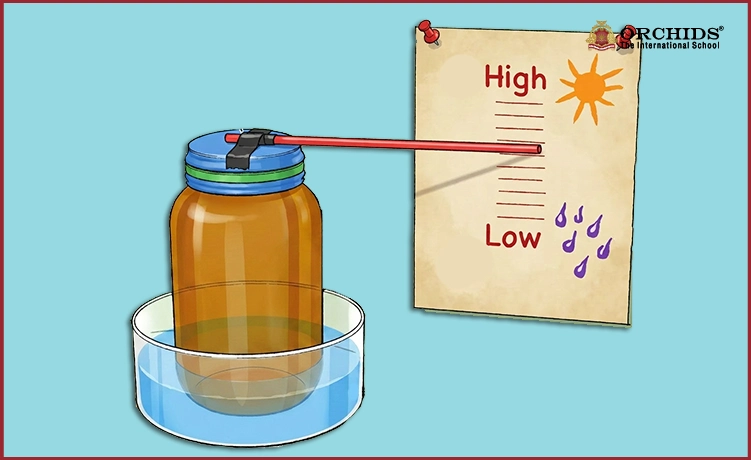
This simple DIY barometer lets you see air pressure in action. It’s a hands-on way to understand how the atmosphere works and can make a great school project or a fun home experiment.
Real-Life Uses of a Barometer
Barometers are not just tools for science experiments; they play an important role in our everyday lives. But what exactly can they do? Let’s take a closer look at real-life uses of a Barometer.
- By tracking air pressure, barometers help forecast the weather. Falling pressure usually signals storms, while rising pressure indicates clear skies.
- They are useful for measuring altitude, as air pressure changes with height. Pilots and climbers can use this information to understand their elevation.
- In addition to altitude, barometers help pilots monitor air pressure for safe flying, ensuring smoother and safer journeys.
- It also plays a role in space and defence. They measure atmospheric conditions that can track the flight path of missiles and satellites.
In this article, we learned that barometers may look simple, but they are powerful instruments that reveal the invisible force of air around us. From Torricelli’s mercury barometer to modern aneroid versions, they help us predict weather, measure altitude, and monitor air pressure for science and aviation.
Frequently Asked Questions on Barometer
1. Why do we need a barometer?
A barometer measures air pressure, helping us predict the weather, track atmospheric changes, and even check altitude.
2. Who came up with the barometer?
Italian scientist Evangelista Torricelli invented the barometer in 1643 after discovering that air has weight.
3. How does a mercury barometer show air pressure?
It uses a glass tube filled with mercury. High air pressure pushes the mercury up, and low pressure makes it fall.
4. Why is mercury preferred over water in barometers?
Mercury is very dense, which allows for a smaller tube and gives accurate readings compared to water.
5. Is it possible to make a barometer at home?
Yes! Various types of barometers can be created using a balloon, a jar, a straw, and a card. You can build a simple barometer to see air pressure changes.
6. How are mercury and aneroid barometers different?
Mercury barometers use liquid to measure pressure, while aneroid barometers use a sealed metal capsule and levers to detect changes.
Science isn't just a subject, it's the way of seeing the world. Curious how Orchids The International School teaches it that way? Talk to our admissions team.
Admissions Open for 2026-27
What type of concept pages would you prefer?
CBSE Schools In Popular Cities
- CBSE Schools in Bangalore
- CBSE Schools in Mumbai
- CBSE Schools in Pune
- CBSE Schools in Hyderabad
- CBSE Schools in Chennai
- CBSE Schools in Gurgaon
- CBSE Schools in Kolkata
- CBSE Schools in Indore
- CBSE Schools in Sonipat
- CBSE Schools in Delhi
- CBSE Schools in Rohtak
- CBSE Schools in Bhopal
- CBSE Schools in Aurangabad
- CBSE Schools in Jabalpur
- CBSE Schools in Jaipur
- CBSE Schools in Jodhpur
- CBSE Schools in Nagpur
- CBSE Schools in Ahmednagar
- CBSE School In Tumkur











Orchids The International School is one of India's leading chains of CBSE and ICSE schools, with 130+ schools across the country.