

Halley’s Comet
Halley’s Comet is arguably the most famous of all comets. It is a periodic comet that returns to Earth roughly every 76 years. The last time it graced our skies was in 1986, and stargazers are eagerly waiting for its return in 2061. Named after the English astronomer Edmond Halley, this comet captured human imagination when Halley realised that the comets sighted in 1531, 1607, and 1682 were actually the same comet returning over and over. This article is a complete guide for students to know about Halley's comet, from where it comes and its structure and composition in detail.
Table of Contents

What is Halley's Comet?
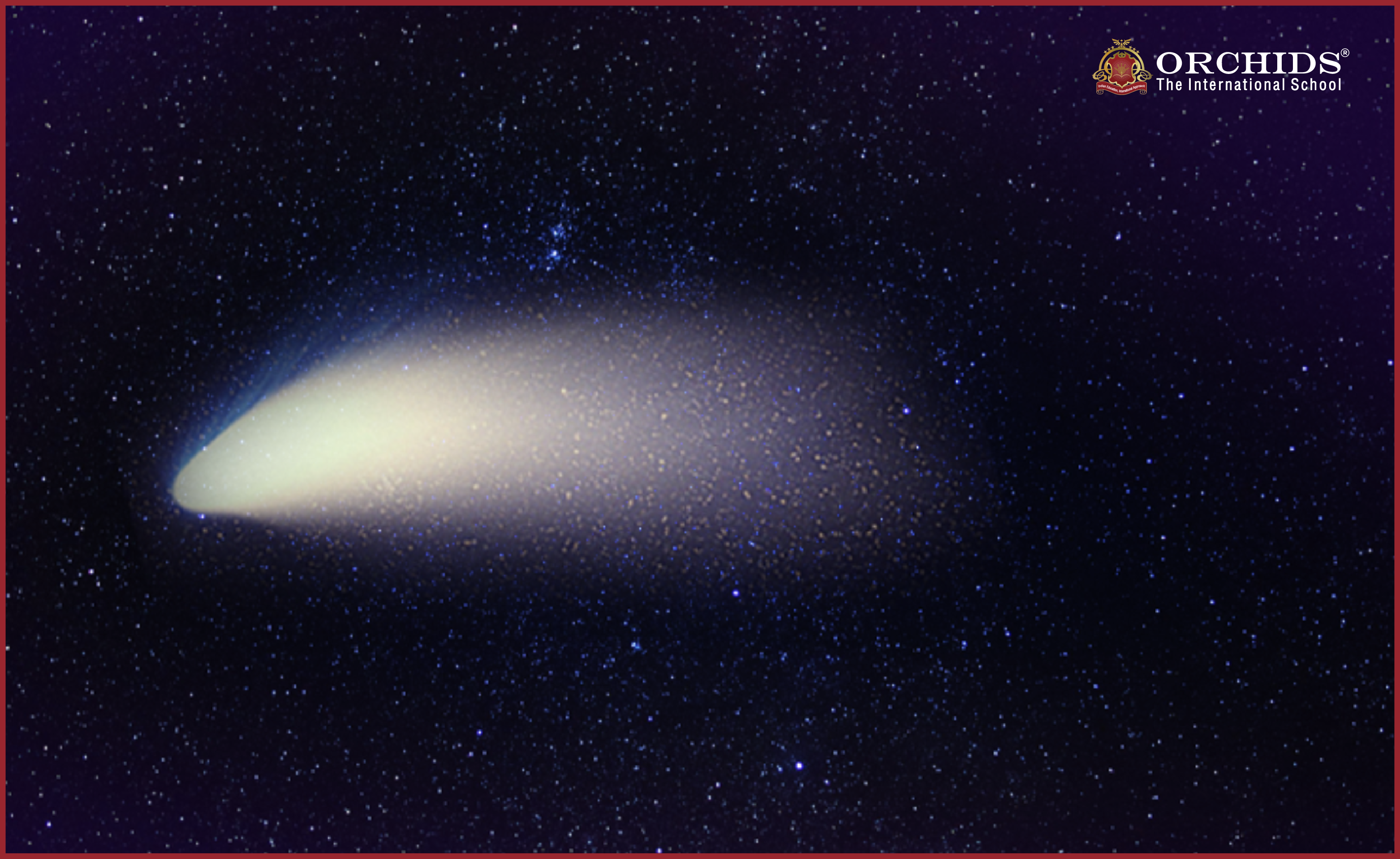
Halley’s Comet is a bright comet that orbits the Sun roughly every 76 years. It is visible from Earth with the naked eye, making it one of the few comets that can be spotted without a telescope. Its return is eagerly anticipated, and it has impressed astronomers and stargazers for centuries.
Curious to know what exactly the origin and orbit of Halley’s Comet are? Let’s explore.
Origin and Orbit of Halley's Comet
Have you ever looked up at the night sky and seen a bright streak of light? If so, you might have been looking at a comet. One of the most famous of these is Halley’s Comet. Halley’s Comet is known as a cosmic traveller because of its long and incredible journey around the Sun. But where did it actually originate?
Scientists believe it originated from the Kuiper Belt, a distant region at the edge of our Solar System filled with icy rocks and debris left over from its formation about 4.6 billion years ago. Now you might be curious to know who discovered the Kuiper Belt? Let's discuss,
It was named after the astronomer Gerard Kuiper, who proposed the existence of this icy region in the 1950s. These icy blocks sometimes get nudged closer to the Sun, warming up and forming the bright, glowing comets we see from Earth.

Halley’s Comet is a short-period comet, meaning it completes its journey around the Sun in about 74 to 76 years. Its orbit is highly elliptical and retrograde, moving opposite to the planets.
And interestingly, this unusual motion gives Halley a high velocity relative to Earth, which is why it streaks across the sky so spectacularly. So next time you look up at the stars, imagine this icy traveller racing along its ancient path, a relic from the dawn of our Solar System!
When Was Halley’s Comet Last Seen?
Halley’s Comet is one of the most famous comets in history, with an orbit around the Sun of roughly 74 to 76 years. But when did we actually see it last? The most recent appearance was on 8 February 1986.
Although it wasn’t particularly bright to the naked eye that year, it still made history. For the first time, spacecraft were used to capture detailed images of its icy nucleus, to reveal the heart of a comet.
Interestingly! For stargazers and scientists alike, it was a cosmic moment to remember.
Next Halley's Comet
If you missed it in 1986, but no need to worry! Because Halley will return. Its next perihelion is predicted on 28 July 2061, giving a new generation the thrill of watching this legendary comet streak across the night sky.
After that, it’s expected to make another appearance around 27 March 2134. Halley’s journey reminds us that some celestial events are timeless, returning like clockwork, linking generations through a shared sense of wonder at the universe.
Now that we know where Halley’s Comet comes from, when we have seen it, let’s look at what it is made of.
Structure and Composition of Halley's Comet
As Halley approaches the Sun, it releases jets of gases from its surface. This creates a bright ion tail and a fainter tail made of dust particles. Now, you may wonder after knowing that the ion tail forms a coma, which can extend up to 100,000 km and contains volatiles like water, methane, ammonia, and carbon dioxide.
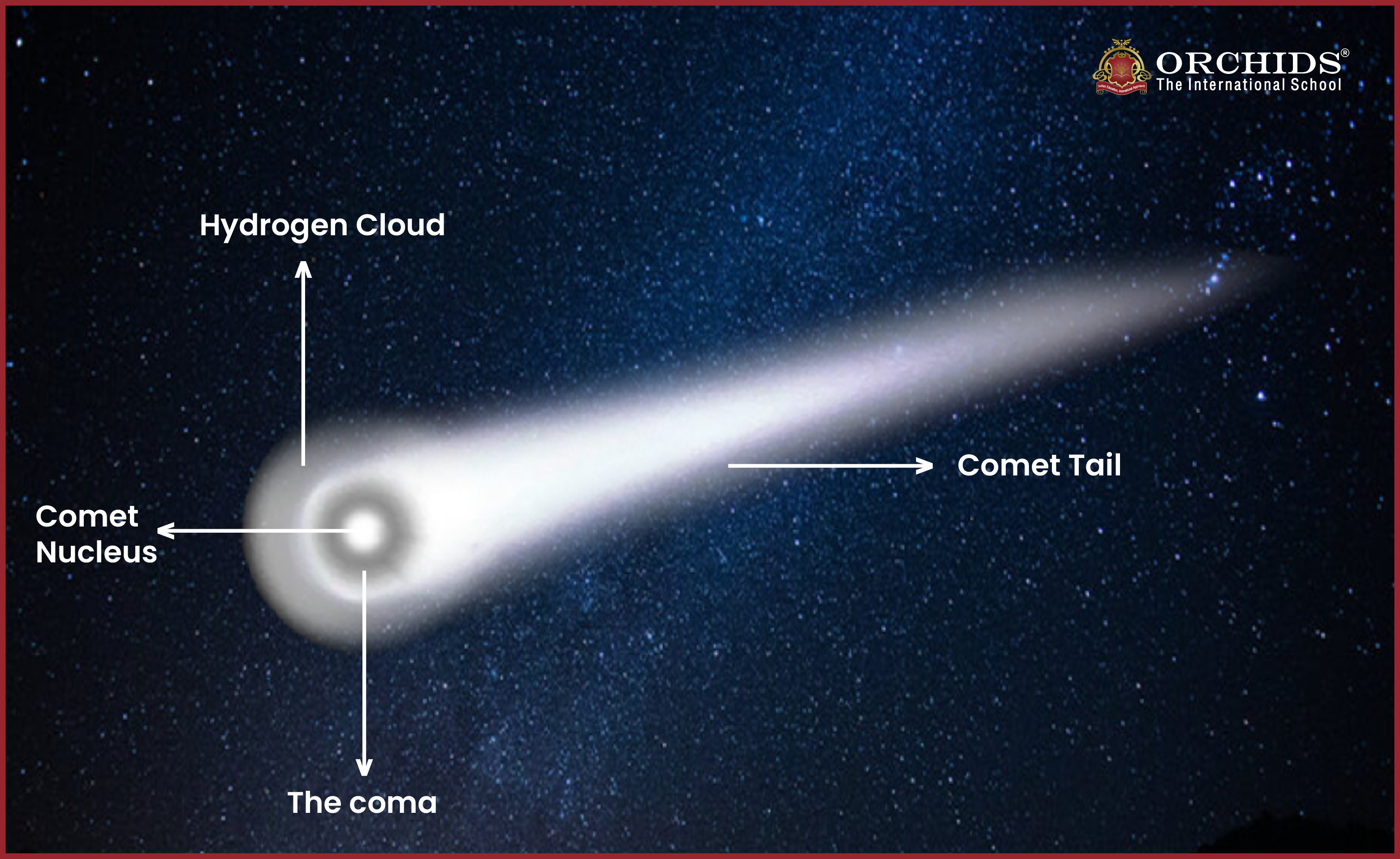
But here’s the most surprising part: the nucleus of Halley’s Comet is small, roughly 15 km long, 8 km wide, and 8 km thick. It is just like a tiny icy snowball at the heart of a cosmic fireworks display! With a mass of about 242.5 billion tons and a low density of 0.6 g/cm³, it’s light enough to glide gracefully along its orbit.
Most of the gases released from the comet are water (80%), followed by carbon monoxide (17%) and carbon dioxide (3 to 4%), along with traces of hydrocarbons.
So far, we learned that Halley’s Comet is an interesting cosmic traveller, returning roughly every 76 years to light up our night sky. From its icy origins to its glowing tail, it connects generations of stargazers and scientists, giving us a glimpse into the wonders of our Solar System. Its next visit in 2061 will be another chance to witness this timeless celestial show.
Frequently Asked Questions on Halley’s Comet
1. What is Halley's Comet?
Halley's Comet is a bright comet that orbits the Sun roughly every 76 years. It’s famous for being visible to the naked eye from Earth.
2. When is the Halley Comet date for its next appearance?
The Halley Comet date for its next close approach to Earth is predicted to be in 2061. It will be an amazing sight for stargazers.
3. When was Halley's Comet last seen?
Halley's Comet, last seen in the night sky, was in 1986. People worldwide got a rare glimpse of its glowing tail.
4. When will be the next Halley's Comet?
The next Halley's Comet will appear in 2061, giving a new generation a chance to see this spectacular comet.
5. How often does Halley's Comet appear?
Halley's Comet appears roughly every 76 years, making each sighting a once-in-a-lifetime experience for many.
6. Can the Halley Comet be seen without a telescope?
Yes, Halley's Comet can be spotted with the naked eye during its closest approach, though binoculars or a telescope enhance the view.
7. Why is the Halley Comet so famous?
Halley's Comet is famous for its predictable orbit and historical sightings, recorded by astronomers for over two thousand years.
Science isn't just a subject, it's the way of seeing the world. Curious how Orchids The International School teaches it that way? Talk to our admissions team.
Admissions Open for 2026-27
What type of concept pages would you prefer?
CBSE Schools In Popular Cities
- CBSE Schools in Bangalore
- CBSE Schools in Mumbai
- CBSE Schools in Pune
- CBSE Schools in Hyderabad
- CBSE Schools in Chennai
- CBSE Schools in Gurgaon
- CBSE Schools in Kolkata
- CBSE Schools in Indore
- CBSE Schools in Sonipat
- CBSE Schools in Delhi
- CBSE Schools in Rohtak
- CBSE Schools in Bhopal
- CBSE Schools in Aurangabad
- CBSE Schools in Jabalpur
- CBSE Schools in Jaipur
- CBSE Schools in Jodhpur
- CBSE Schools in Nagpur
- CBSE Schools in Ahmednagar
- CBSE School In Tumkur











Orchids The International School is one of India's leading chains of CBSE and ICSE schools, with 110+ schools across the country.