

Colour of Sunlight
The colour of sunlight might seem yellow to our eyes, but in reality, it is actually white! And you may wonder after knowing that this white light is made up of seven different colours that combine, just like the colours you see in a rainbow. We already know that sunlight has different shades depending on how we see the world, bright mornings, colourful skies, and beautiful rainbows all exist because of it!
This article helps students understand the true colour of sunlight, how it splits into different colours through a simple experiment, and why the Sun sometimes appears yellow, orange, or even red.
Table of Contents
- Understanding Sunlight
- Demonstrating the Colour of Sunlight through an Activity
- Why Does the Sunlight Appear Red, Orange, or Yellow?
- Frequently Asked Questions on Colour of Sunlight

Understanding Sunlight
Sunlight is the natural light that comes directly from the Sun. It travels as electromagnetic waves, and the part we can see is in the form of visible light.
When someone asks, “What is the colour of the Sun?”, most people quickly answer yellow or white. Some may even say red or orange, thinking of dawn and dusk. But surprisingly, all these answers are incorrect!
In reality, Sunlight is actually made up of seven different colours, including violet, indigo, blue, green, yellow, orange, and red.
We often learn that the Sun is a “hot red ball,” but its true colour is white because it emits all the colours of visible light together. It is only due to Earth’s atmosphere that the Sun appears yellow, orange, or red at different times of the day.
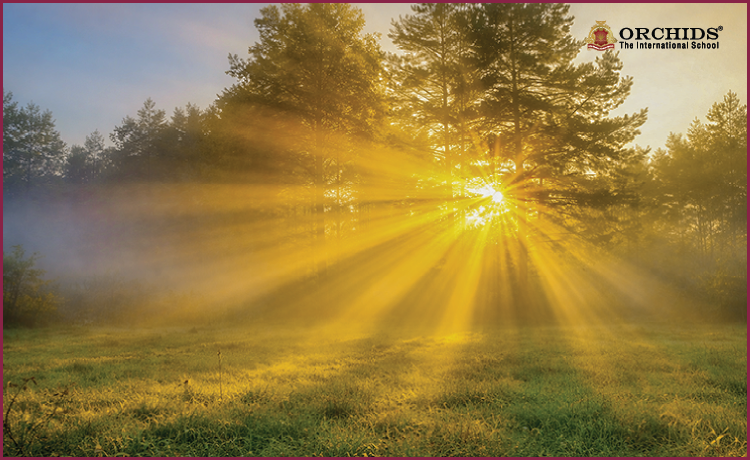
We already know, when sunlight reaches Earth, it helps plants grow, lights up our surroundings, and makes it possible for us to see colours. Without sunlight, life on Earth would not exist!
But how exactly does sunlight consist of a mixture of seven different colours?
Wondering if this is really true? Yes, it is! And the best part is, we can prove it by a simple activity.
Demonstrating the colour of Sunlight through an Activity
To perform this activity, we require a glass prism and, white sheet of paper. Next, let's discuss the steps needed to follow this activity.
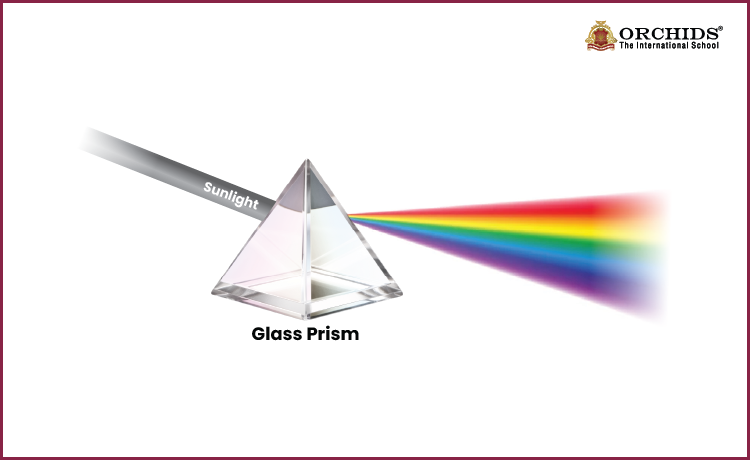
- Take a glass prism and go to a slightly darkened room.
- Position the prism in such a way that direct sunlight enters the room through a small hole in the window shutter and falls on the prism.
- Fix the white sheet of paper on the opposite wall where the refracted sunlight from the prism will fall.
- Observe the pattern formed on the paper carefully.
Here, you will notice that the sunlight splits into a beautiful spectrum of colours, just like a rainbow! Interesting, isn't it?
All seven colours, i.e Violet, Indigo, Blue, Green, Yellow, Orange, and Red, will be on a paper sheet.
From this, it can be concluded,
|
“Sunlight is a mixture of seven colours. When these colours combine, they form white light, which is what we normally see as sunlight.” |
Now that we know sunlight is a mixture of different colours, another question arises: why don’t we see sunlight directly as seven colours?
Even though sunlight is made up of seven colours, we do not see them separately when we look at the Sun directly. What is the reason behind this?
This happens because of the way sunlight interacts with Earth’s atmosphere. Let’s understand how this works.
When the Sunlight enters the atmosphere of Earth, it gets affected by airmolecules, dust, smoke, and pollution. These tiny particles scatter the light in different directions. We already know that each colour in the spectrum has a different wavelength:
- Blue and violet, which have shorter wavelengths, are scattered the most.
- Colours with longer wavelengths, like red and orange, scatter much less.
Because all these colours are scattered in different amounts and mix back together, our eyes see the sunlight as white, not as a spectrum of seven colours.
Why Does the Sunlight Appear Red, Orange, or Yellow?
Have you ever wondered why the Sun looks bright yellow at noon but turns orange or deep red during sunrise and sunset? The colour of sunlight changes because of the way it travels through the atmosphere of Earth at different times of the day. Let’s discuss how exactly it happens!
- Sunlight at Noon
At noon, the Sun is directly overhead, and sunlight travels the shortest distance through the atmosphere. This affects how the colour of the sun appears to us.
➔ Only a small amount of scattering of light happens.
➔ Blue light scatters the most, which makes the sky look blue.
➔ The light that finally reaches our eyes appears yellowish, making sunlight look bright white-yellow during noon.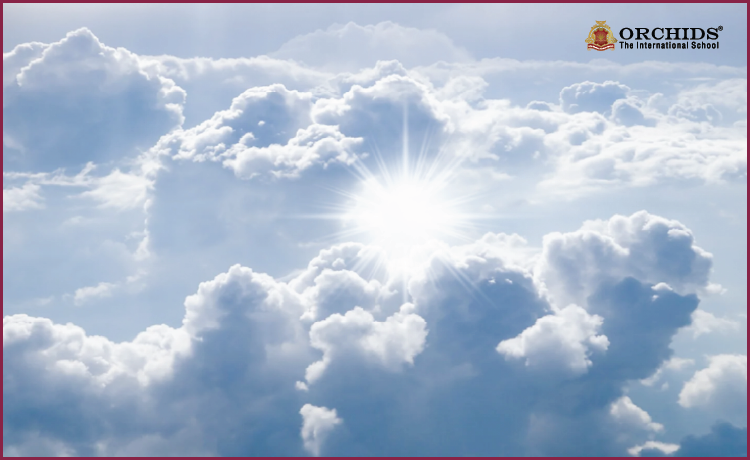
- Sunlight in the Morning and Evening
During sunrise and sunset, sunlight travels a much longer path through the atmosphere of Earth, which changes its colour dramatically.
➔ The Sun is close to the horizon, so the light must pass through more air, dust, and particles.
➔ More scattering happens, removing most of the blue and even some yellow light.
➔ Only the longer wavelengths, which are orange and red, reach our eyes.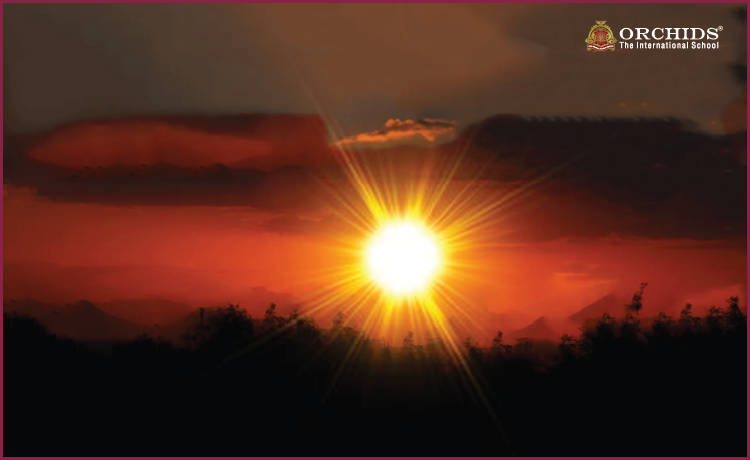
This is why sunlight appears orange or red during dawn and dusk, creating the beautiful sky colours we often see.
Till now, we have seen that the colour of sunlight may appear different throughout the day, but in reality, it is pure white light made of seven colours. From creating rainbows to painting the sky orange and red, sunlight plays an important role in how we see the world.
Frequently Asked Questions on Colour of Sunlight
1. What is the colour of a sun?
The colour of sunlight is actually white because it contains all 7 colours of sunlight mixed. When combined, these colours appear white to our eyes.
2. What is the colour temperature of sunlight?
The colour of sunlight has a temperature of about 5,500K–6,500K, which gives it a bright white tone with a soft yellowish tint.
3. Why does sunlight split into seven colours when we pass through a prism?
A prism separates the 7 colours of sunlight because each colour bends at a different angle. This creates the VIBGYOR spectrum you see on the wall.
4. Why does the sky appear blue even though sunlight is white?
Short-wavelength colours like blue scatter the most in the atmosphere. This scattering gives the sky its blue colour while the colour of sunlight remains white.
5. Why does the Sun look yellow during the day?
The colour of the sun during the afternoon appears yellowish. This happens because sunlight travels a shorter path, and most blue light scatters away.
6. Why does sunlight look orange or red at sunrise and sunset?
During sunrise and sunset, sunlight travels farther through the atmosphere. Most colours scatter away, leaving only red and orange light.
7. Can we see all seven colours of sunlight without a prism?
Yes, through a rainbow! Raindrops act as natural prisms, revealing the 7 colours of sunlight beautifully across the sky.
8. Is the Sun golden or yellow?
The Sun is not truly yellow or golden; it actually emits all colours of light, which combine to appear white. It only looks yellow from Earth because the atmosphere scatters some colours more than others.
Science isn't just a subject, it's the way of seeing the world. Curious how Orchids The International School teaches it that way? Talk to our admissions team.
Admissions Open for 2026-27
What type of concept pages would you prefer?
CBSE Schools In Popular Cities
- CBSE Schools in Bangalore
- CBSE Schools in Mumbai
- CBSE Schools in Pune
- CBSE Schools in Hyderabad
- CBSE Schools in Chennai
- CBSE Schools in Gurgaon
- CBSE Schools in Kolkata
- CBSE Schools in Indore
- CBSE Schools in Sonipat
- CBSE Schools in Delhi
- CBSE Schools in Rohtak
- CBSE Schools in Bhopal
- CBSE Schools in Aurangabad
- CBSE Schools in Jabalpur
- CBSE Schools in Jaipur
- CBSE Schools in Jodhpur
- CBSE Schools in Nagpur
- CBSE Schools in Ahmednagar
- CBSE School In Tumkur











Orchids The International School is one of India's leading chains of CBSE and ICSE schools, with 110+ schools across the country.