

Reflection of Light
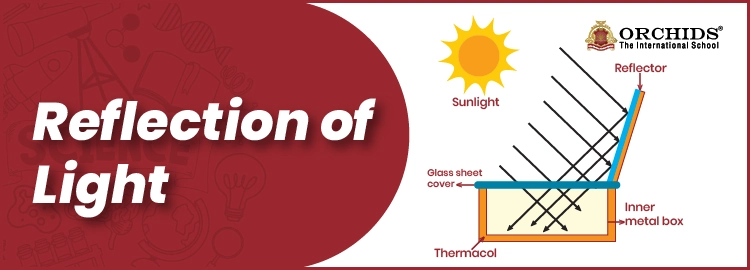
Reflection of Light is how simple things turn into mirrors of wonder. Light helps us to see things around us, but have you ever wondered? How do we see such things, how we see ourselves in a mirror, or how shiny objects sparkle? It all happens because of the reflection of light. This article is a complete guide to learn more about reflection of light, laws of reflection, what are the types of reflection, and their real-time applications in detail.
Table of Contents
- What does it mean by Reflection?
- Laws of Reflection
- Types of Reflection of Light
- Application of Reflection of Light in Everyday Life
- Frequently Asked Questions on Reflection of Light

What does it mean by Reflection?
When a ray of light approaches a boundary between two different media and bounces back into the same medium, this change in the direction of the light ray is known as Reflection of Light. Have you ever noticed how a ray of sunlight hits the surface of the water of a swimming pool and then sparkles on to a nearby wall or ceiling?
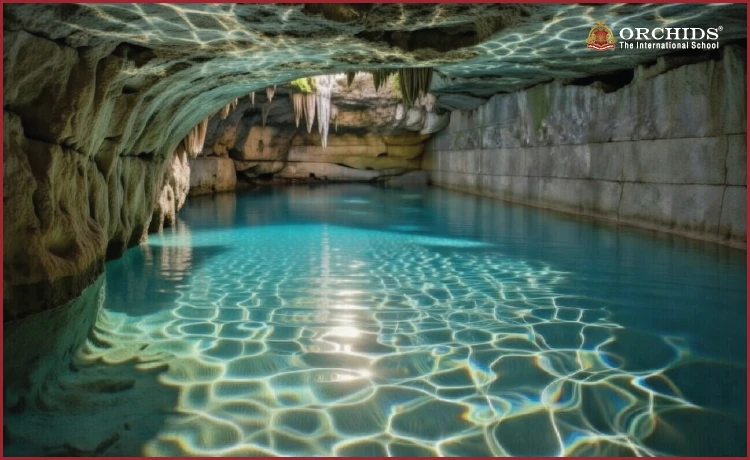
The phenomenon behind this is the Reflection of light. That little shimmer happens because light bounces off the surface of water and turns it into a mirror that reflects the glow of the sky.
But here is the important question: how exactly does reflection of light take place? Lets discuss
When a ray of light approaches a smooth, polished surface and gets reflected in the same medium, this phenomenon is known as reflection of light.
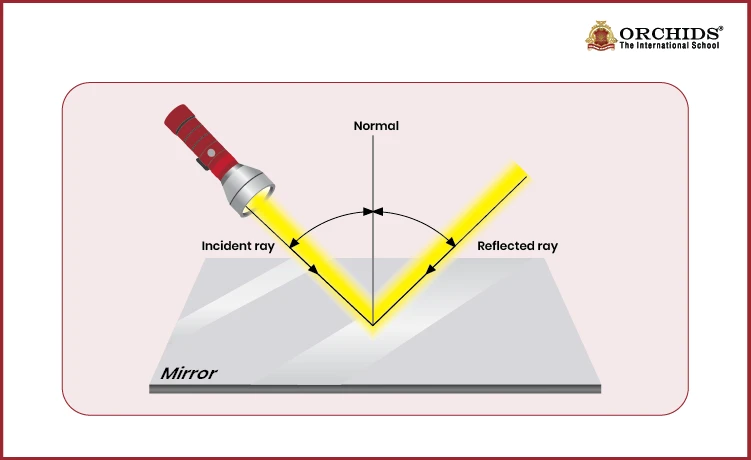
Observe the above image. The light ray that lands on the surface of the mirror is known as the Incident ray. The light ray that gets reflected from the surface of the mirror is known as the Reflected ray. An imaginary line that is perpendicular to the mirror or reflecting surface is known as the Normal.
Have you ever thought: how are mirrors created? Let's discuss,
A mirror is made of glass coated with a uniform and very thin layer of a highly reflective substance, such as aluminum or silver. This coating ensures that almost all the incident light is reflected evenly.
To protect the reflective layer from tarnishing or getting scratched, it is coated with one or more protective layers that keep the mirror surface durable and long-lasting.
Laws of Reflection
Whenever light reflects from any kind of shiny and smooth surface, it follows two rules. And these rules are known as the laws of reflection.
Let's consider a plane mirror as shown in the figure,
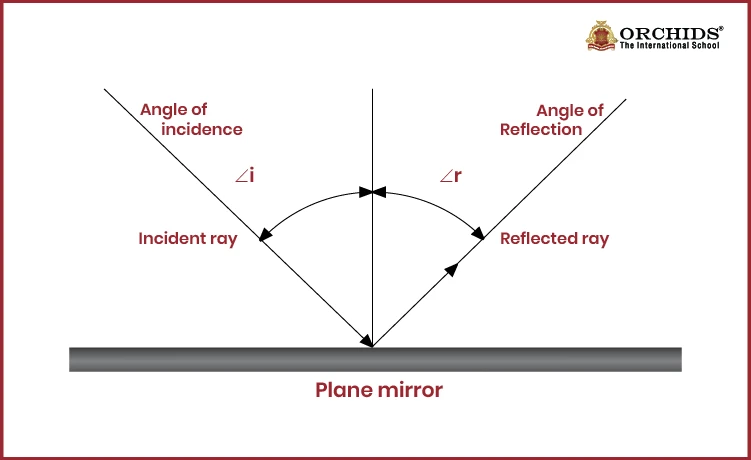
Here we can clearly observe that the incident ray of light is falling on the plane mirror at point P, and the incident ray is making a certain angle with the normal, this angle is called the Angle of Incidence. And it is denoted by i.
Also, we can see that the incident ray is getting reflected from the plane mirror with the same angle of incidence, and this angle is called the angle of reflection. And it is denoted by r.
Now, let’s understand the Laws of Reflection in detail!
There are two laws of reflection-
- Angle of reflection is always equal to the angle of incidence.
Angle of incidence ( )= Angle of reflection( ) - The incident ray, normal, and the reflected ray all lie in the same plane.
Here are some Fun Facts you must know about the Laws of reflection:
|
Types of Reflection of Light
1. Regular (Specular) Reflection of Light
Regular or Specular Reflection takes place when light rays strike a smooth and shiny surface, such as a mirror or clean water, and bounce back in the same direction.
-Reflection-of-Light.webp "Regular (Specular) Reflection of Light")
Because all the reflected rays remain parallel, it creates a bright, sharp, and well-defined image. The reflection is referred to as the specular reflection of light.
2. Diffuse (Irregular) Reflection of Light
Diffuse Reflection occurs when light rays fall on a rough or uneven surface, such as paper, wood, or a wall, and are scattered in many directions. In the above diagram, we can see that the surface is uneven, and each part reflects light at different angles. The reflected rays do not remain parallel, and no clear image will be formed. Even though we can’t see a sharp reflection, this scattered light helps us see non-shiny objects around us.
3. Multiple Reflection of Light
Do you know that multiple reflections are similar to regular reflections? The difference is that this type of reflection takes place with more than one reflective surface. In multiple reflection, more than one mirror will be placed, so according to their placement and angle, multiple reflections will take place.
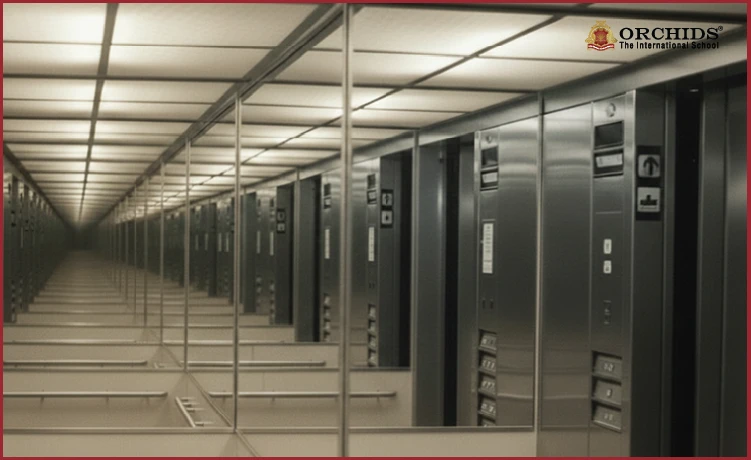
The number of images formed between two mirrors is given by,
From the above, it can be concluded that, if the angle between mirrors is small, then more images will be created, and if the mirrors are placed parallel to each other, the number of images will become infinite.
Application of Reflection of Light in Everyday Life
Do you think Reflection of light is just a classroom concept?
No, reflection of light is not just a classroom concept; it is beyond that. It plays a very crucial role in our day-to-day lives! Here are some real-life applications:
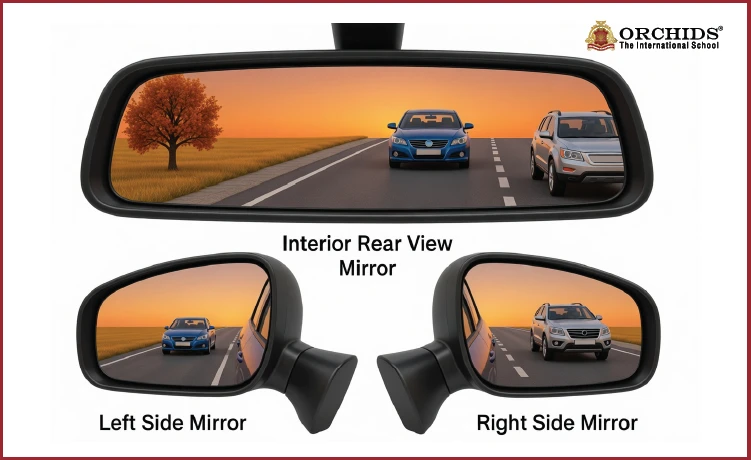
1. The Rear-View or Side Mirrors, which are used on all types of vehicles, such as cars, bikes, and buses, work based on the reflection of light.
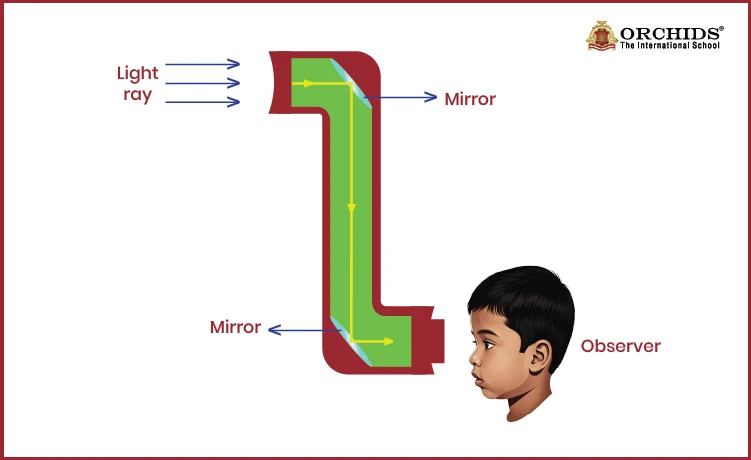
2. Periscope allows submarine operators or soldiers in trenches to see what they can’t see directly. A periscope uses two plane mirrors, which are placed at 45° angles.
3. In Solar cookers, concave mirrors are used to reflect and concentrate sunlight onto a small area to increase the temperature and cook food. Similarly, Solar Panels also use reflective surfaces to maximise sunlight absorption so they can generate a greater amount of electricity.
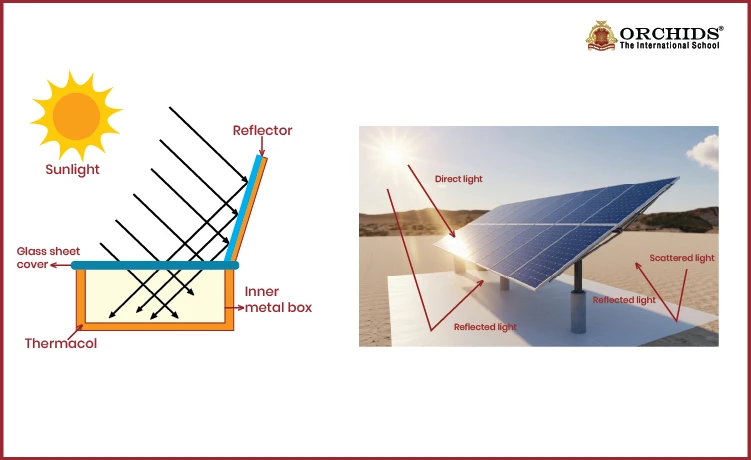
Solar Cooker and Solar Panel
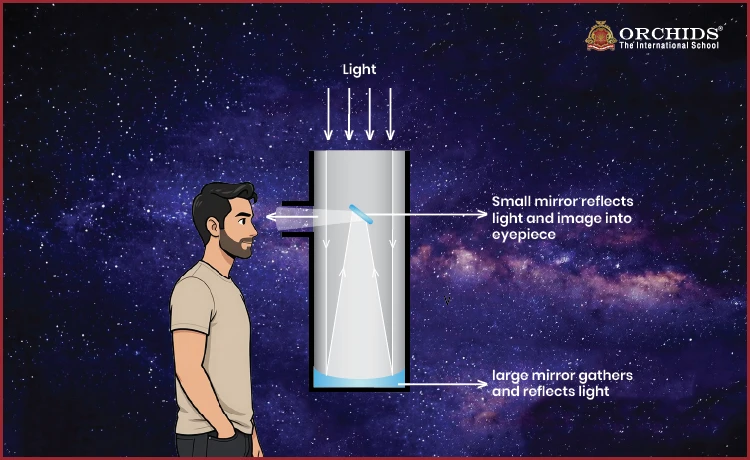
4. Curved mirrors are used in reflecting telescopes to collect and focus light from distant stars and planets. This reflection-based design allows astronomers to see far into space with clear, magnified images.
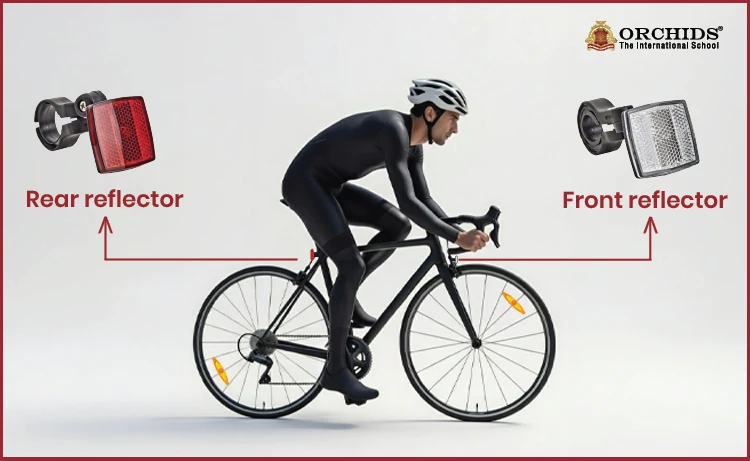
5. Reflectors on bicycles, road signs, and safety jackets are made using materials that send back light from vehicle headlights toward the source. This helps drivers notice cyclists or signs even in the dark.
In this article, so far, you have learnt how the reflection of light helps us to see this beautiful world. This phenomenon seems very simple, but its powerful principles help us to guide science and technology, and make our lives easier.
Frequently Asked Questions on Reflection of Light
1. What is the reflection of light?
The process of light rays bouncing back after striking a polished surface instead of passing through it is known as Reflection of light.
2. What are the basic laws of reflection?
There are two laws of reflection:
1. The angle of incidence is always equal to the angle of reflection.
2. The incident ray, the reflected ray, and the normal all lie in the same plane.
3. How many types of reflection are there?
There are two main types:
Regular reflection: This type of reflection usually happens on smooth, shiny, and polished surfaces like mirrors, and the reflected rays of light are always parallel to each other.
Diffuse reflection: This type of reflection usually happens on rough surfaces, such as walls, and the rays of light get scattered in all possible directions.
4. Why do we see images in a mirror?
A phenomenon called regular reflection is responsible for seeing images in a mirror. The smooth, shiny, and polished surface of the mirror reflects the rays of light in all possible ways by following the laws of reflection. These reflected rays enter our eyes, allowing us to see the objects clearly.
5. Can all surfaces reflect light?
Yes, every surface reflects light, but how it reflects light totally depends on the nature of the surface. Smooth, shiny surfaces reflect light clearly ( plane mirrors), while rough surfaces scatter light in all possible directions (walls).
6. How is the reflection of light used in everyday life?
Reflection is everywhere! Some examples:
-
Mirrors for grooming
-
Rearview mirrors in cars
-
Solar cookers and solar panels
-
Reflectors that work as road signs at night
7. What is the difference between specular and diffuse reflection?
In the Specular type of reflection, light reflects at the same angle of incidence so that you see a clear image. But in the Diffuse type of reflection, light scatters in many possible directions; you see brightness but no clear image.
Science isn't just a subject, it's the way of seeing the world. Curious how Orchids The International School teaches it that way? Talk to our admissions team.
Admissions Open for 2026-27
What type of concept pages would you prefer?
CBSE Schools In Popular Cities
- CBSE Schools in Bangalore
- CBSE Schools in Mumbai
- CBSE Schools in Pune
- CBSE Schools in Hyderabad
- CBSE Schools in Chennai
- CBSE Schools in Gurgaon
- CBSE Schools in Kolkata
- CBSE Schools in Indore
- CBSE Schools in Sonipat
- CBSE Schools in Delhi
- CBSE Schools in Rohtak
- CBSE Schools in Bhopal
- CBSE Schools in Aurangabad
- CBSE Schools in Jabalpur
- CBSE Schools in Jaipur
- CBSE Schools in Jodhpur
- CBSE Schools in Nagpur
- CBSE Schools in Ahmednagar
- CBSE School In Tumkur











Orchids The International School is one of India's leading chains of CBSE and ICSE schools, with 110+ schools across the country.