

Pressure: Understanding Force on Surfaces For Class 8
Pressure is a physical quantity that tells us how force is distributed over a given area. Have you ever wondered why a nail with a sharp end is easier to hammer into a table than a flat-ended nail, even if you apply the same force? This happens because of pressure. It explains why some surfaces penetrate or resist forces differently.
In this article, we will understand what is pressure and learn how to calculate it using some numerical examples.
Table of Contents
- Understanding What Pressure Is
- Examples and Numericals on Pressure
- Factors Affecting Pressure
- Frequently Asked Questions on Pressure

Understanding What Pressure Is
Look at the two pictures below. Which nail will be easier to hammer into the table if the same force is applied in both cases?
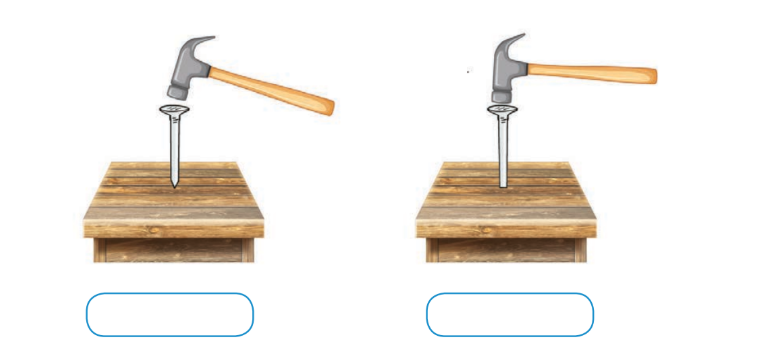
Even though the force applied in both cases is the same, the nail with the sharp end is easier to insert. This happens because of pressure.
So pressure can be defined as,
“Pressure is the amount of force pushing straight onto a surface, spread over the area it acts on.”
Though the forces applied in both instances in the above activity are the same, the nail with a sharp end is preferred as it will be easier to insert it into the table. This is due to the physical quantity pressure.
Pressure is defined as the force acting per unit area. Mathematically, it can be expressed as,
The S.I. unit of pressure is pascal (Pa) or N · m-2.
Numericals on Calculating Pressure
Example 1: If a force of 50 N is applied on an area of 5 m2, calculate the pressure.
Solution: Force = 50 N , Area = 5 m2
=
= 10 Nm-2 or Pa
Example 2: Calculate the pressure if a force of 2000 N is applied on an area of 40 m2.
Solution: Force = 2000 N , Area = 40 m2
=
= 50 Nm-2 or Pa
Factors Affecting Pressure
Pressure does not just appear out of nowhere; it depends on how much force is applied and over what area. There are two main factors that affect pressure:
1. Pressure is directly proportional to force. The greater the force, the more the pressure, and the less the force, the less the pressure.
2. Pressure is inversely proportional to area. The greater the area, the less the pressure, and the lesser the area, the more the pressure.
Till now, we have seen that pressure is a fundamental concept in physics that affects everyday life. From nails and knives to walking on snow or lying on soft sand, pressure explains how forces interact with surfaces.
Frequently Asked Questions on Pressure
1. What is the unit of pressure?
The SI unit of pressure is Pascal (Pa).
1 Pascal = 1 Newton of force applied on 1 square meter of area (1 Pa = 1 N/m²).
2. Why does a sharp knife cut better than a blunt one?
A sharp knife has a smaller cutting area. The same force on a smaller area creates more pressure, making it easier to cut.
3. Why does a needle pierce a balloon while a finger cannot?
The needle has a very small tip, which concentrates the force on a tiny area, creating high pressure that bursts the balloon.
4. What factors affect pressure?
Pressure depends on the force applied, which means that with more force, there will be more pressure. Area of contact means a smaller area, then more pressure, or a larger area, there will be less pressure.
5. Is pressure only in solids?
No. Pressure exists in solids, liquids, and gases. For example, air pressure around us or water pressure at the bottom of a tank.
Science isn't just a subject, it's the way of seeing the world. Curious how Orchids The International School teaches it that way? Talk to our admissions team.
Admissions Open for 2026-27
What type of concept pages would you prefer?
CBSE Schools In Popular Cities
- CBSE Schools in Bangalore
- CBSE Schools in Mumbai
- CBSE Schools in Pune
- CBSE Schools in Hyderabad
- CBSE Schools in Chennai
- CBSE Schools in Gurgaon
- CBSE Schools in Kolkata
- CBSE Schools in Indore
- CBSE Schools in Sonipat
- CBSE Schools in Delhi
- CBSE Schools in Rohtak
- CBSE Schools in Bhopal
- CBSE Schools in Aurangabad
- CBSE Schools in Jabalpur
- CBSE Schools in Jaipur
- CBSE Schools in Jodhpur
- CBSE Schools in Nagpur
- CBSE Schools in Ahmednagar
- CBSE School In Tumkur











Orchids The International School is one of India's leading chains of CBSE and ICSE schools, with 110+ schools across the country.