

Layers of the Earth
Layers of the Earth describe how our Earth is built from the inside out, with each layer playing a unique role in shaping the world. From the thin crust, where life exists, to the intensely hot core at the centre, these layers help explain natural events such as earthquakes, volcanoes, mountain formation, and even Earth’s magnetic field. This article provides insights into these layers in detail, helping them understand what lies beneath our feet and how each layer plays an important role in shaping our planet.
Table of Contents
- Layers of the Earth
- Inner Core
- Outer Core
- Mantle
- Crust
- How the Layers of the Earth Apply to Real Life
- Frequently Asked Questions on Layers of the Earth

Layers of the Earth
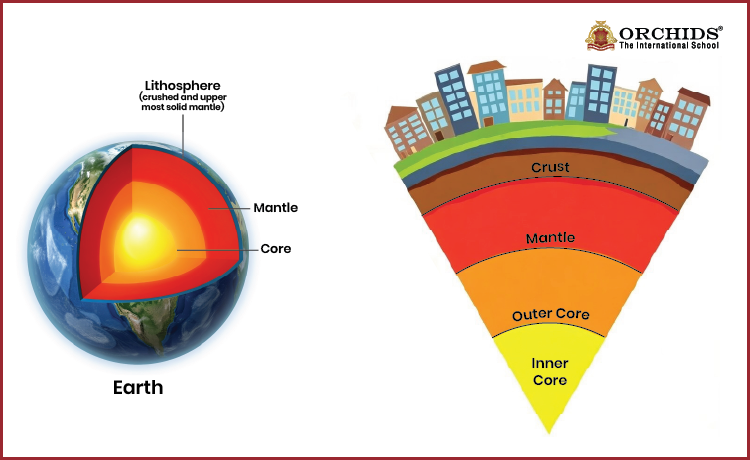
Have you ever wondered what lies beneath our feet? The Earth may look solid from the outside, but deep inside, it is made up of different layers, each with its own materials, temperature, and properties. Earth is made up of four major layers, and they are,
-
Inner Core
-
Outer Core
-
Mantle
-
Crust
Scientists believe that when the planet was still very hot, the heavier and denser materials sank toward the centre, while the lighter ones rose to the surface. That’s the reason why the outer layer is made of lighter rocks and granites, while the deepest layer contains heavy metals like iron and nickel.To discuss all layers in detail. Have a look at the layers of the Earth diagram given below,
Inner Core
The inner core is the centre and the hottest part of the Earth.
It is solid and mainly made of iron and nickel. Temperatures at the inner core can reach up to 5,500°C, making it extremely hot, almost like a giant engine powering our Earth.
Even though it is extremely hot, the inner core remains solid because the pressure is so high that the atoms cannot move freely. They are squeezed tightly and can only vibrate.
You may wonder after knowing that it measures about 1,220 km in radius. This core plays an important role in maintaining the magnetic field of the Earth and also contributes to geodynamic processes.
Outer Core
The outer core lies just outside the inner core. It is made of liquid iron and nickel. Its temperature ranges from 4000°F to 9000°F.
It is about 1,400 miles thick and located roughly 1,800 miles beneath the crust.
Unlike the inner core, the outer core remains liquid because the pressure here is lower, allowing the metals to move freely. Interestingly, the flow of this liquid metal is responsible for creating the Earth’s Geomagnetic field.
Such magnetism is why compass needles point north and is essential for protecting our planet from solar radiation.
Mantle
The mantle is the thickest layer, which is 84% of the Earth’s volume of the Earth, about 2,900 km deep. It is made of semi-molten rock called magma. The upper mantle is harder, while the lower part becomes softer and starts to melt.
Temperatures range from 1600°F at the top to 4000°F near the bottom. The mantle behaves like slow-moving asphalt. This movement happens because of the large temperature differences between its top and bottom layers.
These slow currents in the mantle are the reason Earth’s tectonic plates move, causing earthquakes and volcanic activity.
Crust
The crust is the outermost and thinnest layer, just less than 1% of Earth’s volume, and the one we live on. It ranges from 0 to 60 km in thickness. It is solid and made of rock.
Crust is divided into two parts:
Continental crust forms the land, and Oceanic crust, which lies under the oceans. Compared to the mantle and core below, it is like a thin shell covering a very hot interior.
All terrestrial life, seas, rocks, soil, and landforms are part of the crust. Earthquakes and volcanoes, as discussed in projects like Shield Volcano, originate here due to shifting plates.
How the Layers of the Earth Apply to Real Life
-
Understanding Earth’s layers helps explain natural disasters like plate tectonics, earthquakes, and volcanic eruptions.
-
Knowledge of the mantle and core supports research on geothermal energy and changes in the Earth’s magnetic field.
-
Concepts of Earth’s internal structure are used in modern technologies, including gyroscope navigation.
-
The layers of the Earth diagram is commonly used in classrooms to simplify learning about Earth’s structure.
Till now, we have learned about the Layers of the Earth, which gives us a clearer picture of the amazing world beneath our feet. Even though we only see the crust, there is an entire hidden world below, full of heat, movement, and powerful forces that shape the mountains, oceans, and landscapes we see today.
Frequently Asked Questions on Layers of the Earth
1. What does the interior of the Earth consist of?
The interior of the Earth is made of four major layers: the inner core, the outer core, the mantle, and the crust. Each layer has different temperatures, densities, and materials that shape how our planet behaves.
2. Why do we study the layers of the Earth diagram?
The layers of the Earth diagram helps students visualise what lies beneath the surface. It simplifies complex structures and makes it easier to understand how each layer works.
3. What are the 3 layers of the Earth in simple terms?
The 3 layers of the Earth are often explained as the crust, mantle, and core. This basic model helps young learners quickly understand Earth’s main structure.
4. How are the different layers of the Earth formed?
The different layers of the Earth formed when heavier materials sank toward the centre, and lighter ones rose to the top. This early separation created the structure we study today.
5. Which layer is the hottest in the interior of the Earth?
The inner core is the hottest region in the interior of the Earth. Its temperature can reach up to 5,500°C, making it hotter than the surface of the sun.
6. Why is the layers of the earth diagram useful for students?
The layers of the Earth diagram breaks down a difficult topic into simple visuals. It helps kids clearly see how the planet is built, especially during lessons and projects.
7. What are the three layers of the Earth?
The three layers of the Earth are the crust, mantle, and core. This basic model helps students easily understand Earth’s main internal divisions.
8. Which is the innermost layer of the Earth?
The innermost layer of the Earth is the inner core. It is extremely hot, solid, and made mostly of iron and nickel.
9. The thinnest layer of the Earth is the?
The thinnest layer of the Earth is the crust. It’s the layer we live on, and compared to the layers below, it’s just like a thin shell around the planet.
Science isn't just a subject, it's the way of seeing the world. Curious how Orchids The International School teaches it that way? Talk to our admissions team.
Admissions Open for 2026-27
What type of concept pages would you prefer?
CBSE Schools In Popular Cities
- CBSE Schools in Bangalore
- CBSE Schools in Mumbai
- CBSE Schools in Pune
- CBSE Schools in Hyderabad
- CBSE Schools in Chennai
- CBSE Schools in Gurgaon
- CBSE Schools in Kolkata
- CBSE Schools in Indore
- CBSE Schools in Sonipat
- CBSE Schools in Delhi
- CBSE Schools in Rohtak
- CBSE Schools in Bhopal
- CBSE Schools in Aurangabad
- CBSE Schools in Jabalpur
- CBSE Schools in Jaipur
- CBSE Schools in Jodhpur
- CBSE Schools in Nagpur
- CBSE Schools in Ahmednagar
- CBSE School In Tumkur











Orchids The International School is one of India's leading chains of CBSE and ICSE schools, with 130+ schools across the country.