

Types of Laser
Types of lasers are found in almost every modern technology, inside medical devices, communication systems, manufacturing machines, and even in everyday gadgets like barcode scanners and DVD players. Every type works differently depending on the material used to create its beam, whether it's a liquid dye, a gas, a solid crystal, a thin optical fiber, or a semiconductor chip.
This article helps students understand the meaning, different types of lasers, and why certain lasers are used for surgery, others for cutting metal, and some for sending data across continents.
Table of Contents
What is a Laser?
LASER stands for Light Amplification by Stimulated Emission of Radiation. A laser is a device that produces a powerful, focused beam of light, so precise that it can travel long distances and even slice through solid metals.
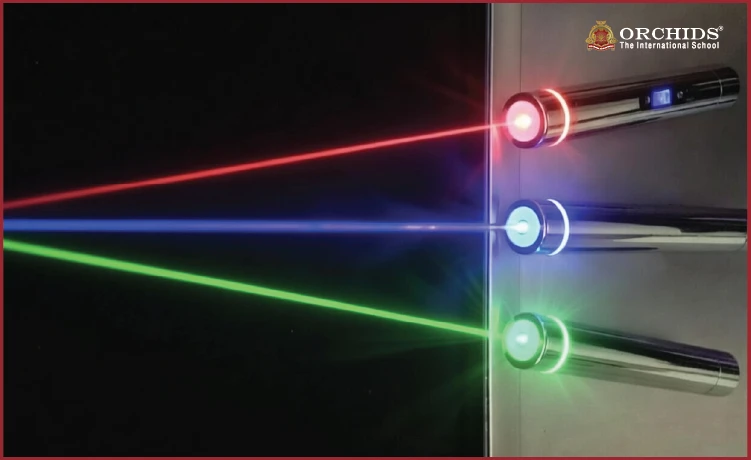
Do you know that the first practical laser was created in 1960 by Theodore H. Maiman at Hughes Research Laboratories? Since then, lasers have evolved rapidly and are now used in countless fields, including medicine, communication, manufacturing, research, and everyday technology.

Types of Laser
Lasers come in many different forms, and each type works differently based on the material used as its active medium. Let’s discuss the major types of lasers and understand what makes each one special.
Liquid (Dye) Lasers
Liquid Lasers, also known as dye lasers. This laser uses special liquid dyes as its active medium. These dyes, such as sodiumfluorescein, rhodamine B, and rhodamine 6G, are responsible for producing laser light when excited.
-Lasers.webp "Liquid (Dye) Lasers")
You may wonder after knowing that liquid lasers can produce many colours and are used in medicine, spectroscopy, and isotope separation. Because of their unique properties, dye lasers can generate a wide range of wavelengths, making them extremely versatile.
Now, let's discuss how a Liquid Laser Works.
To understand their working, imagine a colourful dye solution flowing through a narrow capillary tube. The dye, dissolved in solvents like water, alcohol, or ethylene glycol, is pumped continuously from a storage tank.
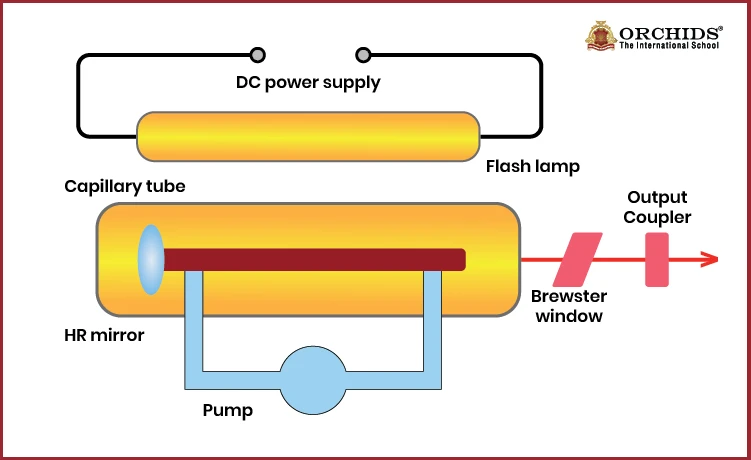
As the dye stream passes through the tube, it is excited by a flash lamp. This excitation creates the conditions needed for lasing.
Next, the emerging light passes through a Brewster window, which helps reduce reflection losses, and finally reaches a 50% reflective output coupler. This partially reflective mirror lets some light escape as the laser beam.
Because of the nature of the dyes, liquid lasers can be tuned to emit a wide range of wavelengths. In fact, the maximum output wavelength typically reaches around 618 nm.
Now, let’s take a closer look at where these lasers are used,
Applications of Liquid Lasers
Liquid lasers are widely used in medical treatments and serve as powerful tools in research laboratories. Their ability to produce tunable wavelengths makes them particularly valuable in scientific experiments.
With their usefulness in mind, let’s move on to what makes them stand out.
Advantages of Liquid Lasers
- They offer up to 25% higher efficiency compared to many other lasers.
- The emitted wavelengths can be easily varied across a broad spectrum.
- They produce laser beams with smaller diameters.
- Their beam divergence is very low (0.8 to 2 milliradians), making the beam more focused and stable.
However, despite these benefits, liquid lasers come with certain limitations as well.
Disadvantages of Liquid Lasers
- They are generally more expensive due to the dyes and specialised components used.
- Achieving a specific wavelength requires additional filters, adding to the overall cost.
- Identifying the exact dye component responsible for lasing can be challenging, making the system harder to optimise.
Gas laser
Gas lasers are a type of laser where the active medium is made up of gases or vapours. When these gases are energised, they emit light that forms a steady and powerful laser beam. Because different gases behave differently, gas lasers are grouped into a few major categories. Let’s look at them one by one.
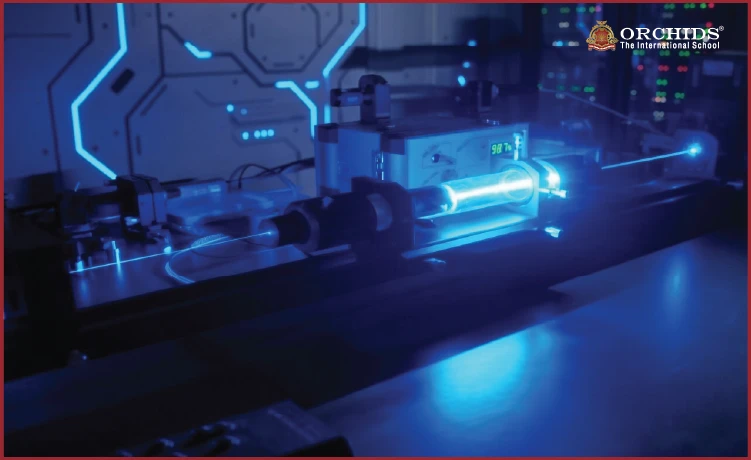
To understand gas lasers better, it helps to know how they are classified. Broadly, there are three main types, each with its own unique working principle and applications.
- Atomic gas lasers use neutral atoms as their active medium. The most popular example is the Helium–Neon (He-Ne) laser, known for producing a stable, low-power red beam.
- Molecular gas lasers rely on molecules instead of atoms. The best-known one is the CO₂ laser, which is highly efficient and capable of generating very high power.
- Ion gas lasers use ionised gas particles as the active medium. A well-known example is the argon ion laser, which produces intense blue-green light.
Solid-State Lasers
Solid-state lasers are a type of laser where the active medium is a solid material. Instead of gases or liquids, these lasers use glass or crystalline substances to generate laser light.
Let's discuss how a Solid-State Laser Works
To understand their work, let’s break it down. In solid-state lasers, the glass or crystal acts as a host material. Into this host, tiny amounts of special ions, which are called dopants, are added. This process is known as doping.
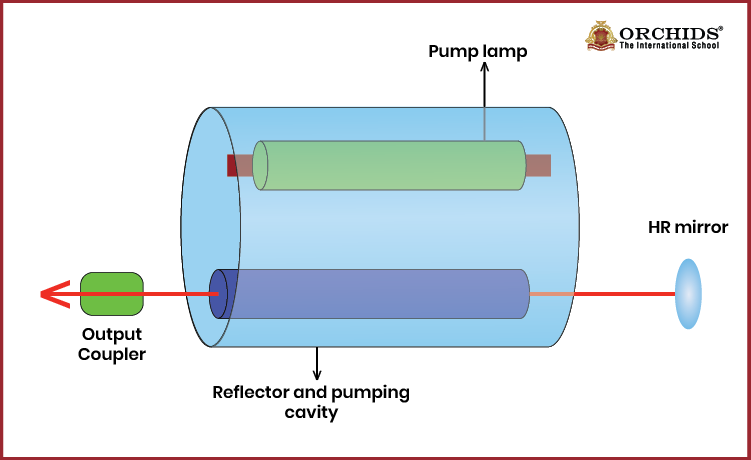
The dopants commonly used include rare-earth elements such as terbium (Tb), erbium (Eu), and cerium (Ce). These ions help the material absorb energy and then release it as laser light.
The host materials can be,
- Ytterbium-doped glass
- Neodymium-doped yttrium aluminium garnet (Nd:YAG)
- Neodymium-doped glass
- Sapphire
Among these, Nd:YAG is the most widely used because it offers excellent performance and stability.
Applications of Solid-State Lasers
Solid-state lasers serve a variety of purposes, such as:
- They make drilling precise holes in metals faster and more efficiently.
- In medicine, push-type solid-state lasers are used in procedures like endoscopy.
- The military is targeting and using range-finding systems due to their accuracy.
Advantages of Solid-State Lasers
- They are economical, especially in terms of their overall build and operation.
- Their construction is straightforward, making them easier to maintain.
- They can provide both continuous and pulsed output.
- The solid active medium ensures minimal material wastage.
- Overall, they offer high efficiency compared to many other laser types.
Despite their advantages, solid-state lasers come with certain limitations:
Disadvantages of Solid-State Lasers
- Their output power is relatively lower compared to some other laser systems.
- The beam divergence is not constant, ranging from 1 to 20 milliradians.
- Heat generated in the laser rod can lead to power loss, affecting performance over time.
Fiber Lasers
Fiber lasers are a type of solid-state laser using optical fibers. They produce precise, straight beams and are efficient and small.
How a Fiber Laser Works?
These optical fibers are doped with rare-earth elements like ytterbium, erbium, or thulium, which help generate a strong and stable laser beam.
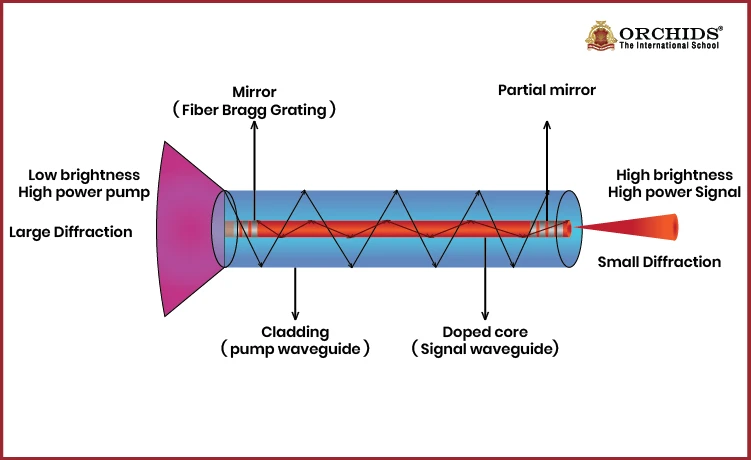
When light from a pump source (like laser diodes) is sent into the fiber, the dopant ions absorb energy. They then release this energy as laser light, which travels through the fiber core.
Because the fiber has natural waveguiding properties, the light remains confined and amplified over long distances, resulting in a strong, focused laser beam.
Applications of Fiber Lasers
- Used for laser marking to create permanent, high-contrast marks on metals and plastics such as barcodes, serial numbers, and logos.
- Laser cleaning is used to remove rust, paint, oxides, and surface contaminants without damaging the base material.
- In laser welding, to achieve high-precision, fast, and low-deformation welds in automotive, electronics, and precision industries.
- It is also used forlaser cutting to perform complex cuts with high accuracy and superior edge quality in metal fabrication and high-tolerance parts.
Advantages of Fiber Lasers
- Fiber lasers convert electrical energy into laser light very efficiently, reducing power consumption.
- The beam they produce isextremely fine and stable, allowing precise cutting, welding, marking, and engraving.
- Fiber lasers can operate continuously for long hours without performance drops.
Disadvantages of Fiber Lasers
- While economical in the long run, the upfront investment is higher compared to some other laser types.
- Although well-cooled, high-power fiber lasers can face thermal issues if not managed properly.
- Fiber lasers cannot be tuned across a wide spectrum; their wavelength is fixed by the doped fiber material.
- If the optical fiber is damaged, repairs can be difficult and costly due to the integrated design.
Semiconductor (Diode) Lasers
Semiconductor lasers are compact, lightweight lasers that look similar in size to everyday electronic components. Although their operation resembles that of an LED, the light they produce has all the characteristics of a true laser beam, focused, coherent, and highly directional.
How a Semiconductor Laser Works
The active material used in most semiconductor lasers is gallium arsenide (GaAs). Because of this, they are often called Gallium Arsenide Lasers.
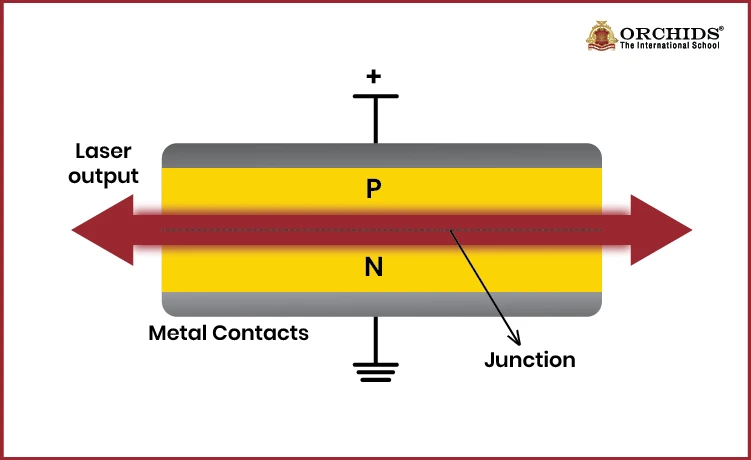
Their working principle closely resembles that of a PN junction diode under forward bias. When a DC power supply is connected to the P and N layers through metal contacts, electrons and holes are injected into the junction. This process is why semiconductor lasers are also known as Injection Lasers.
When these charge carriers recombine in the active region, they release energy in the form of laser light.
Applications of Semiconductor Lasers
Semiconductor lasers are widely used due to their speed and efficiency. Some key applications include:
- In Digital data transmission can be pulsed rapidly at different rates and pulse widths.
- In Optical fiber communication, they act as reliable light sources for long-distance data transfer.
Advantages of Semiconductor Lasers
- Their small size and compact structure make them extremely versatile.
- They are cost-effective, making them suitable for mass production.
- The power consumption is very low, making them ideal for portable devices.
Disadvantages of Semiconductor Lasers
- The beam divergence is very high (125-400 milliradians), much greater than many other laser types.
- The output beam often has an irregular shape due to the short and rectangular structure of the active medium.
- Their performance is highly dependent on temperature, which can affect stability and output.
So far, we learned that lasers may seem complex, but their differences become easy to understand once you know what each type is made of and how it produces light. From hospitals and research labs to industries and communication networks, lasers have become essential tools in modern technology.
Frequently Asked Questions on Types of Laser
1. What is a laser in simple words?
A laser is a device that emits a focused, high-intensity beam of light through a process known as stimulated emission.
2. What is the full form of LASER?
LASER stands for Light Amplification by Stimulated Emission of Radiation. It describes the process through which laser light is generated.
3. What are the different types of lasers?
The major types of lasers include gas lasers, solid-state lasers, semiconductor lasers, and liquid (dye) lasers.
4. How do lasers work?
Lasers work by exciting atoms in a medium, causing them to release photons in a synchronised manner. This creates a narrow, powerful light beam with high coherence and precision.
5. Where are lasers commonly used?
Lasers are used in medicine, manufacturing, communication, defence, research, and everyday devices like barcode scanners and laser printers.
6. What is the difference between laser light and normal light?
Laser light is monochromatic, coherent, and highly directional. Normal light spreads out, has multiple wavelengths, and lacks beam precision.
7. Are lasers harmful to humans?
Some high-power lasers can damage the eyes or skin if not handled safely. Low-power lasers used in everyday tools are safe when used properly.
Science isn't just a subject, it's the way of seeing the world. Curious how Orchids The International School teaches it that way? Talk to our admissions team.
Admissions Open for 2026-27
What type of concept pages would you prefer?
CBSE Schools In Popular Cities
- CBSE Schools in Bangalore
- CBSE Schools in Mumbai
- CBSE Schools in Pune
- CBSE Schools in Hyderabad
- CBSE Schools in Chennai
- CBSE Schools in Gurgaon
- CBSE Schools in Kolkata
- CBSE Schools in Indore
- CBSE Schools in Sonipat
- CBSE Schools in Delhi
- CBSE Schools in Rohtak
- CBSE Schools in Bhopal
- CBSE Schools in Aurangabad
- CBSE Schools in Jabalpur
- CBSE Schools in Jaipur
- CBSE Schools in Jodhpur
- CBSE Schools in Nagpur
- CBSE Schools in Ahmednagar
- CBSE School In Tumkur











Orchids The International School is one of India's leading chains of CBSE and ICSE schools, with 110+ schools across the country.