

Standard Units of Measurement: Complete Guide for Grade 6 Students
Standard Units of Measurement play an important role in making measurements accurate, consistent, and universally accepted. These standard units help us avoid confusion and ensure that measurements remain the same regardless of place or person.
In this article, we will understand standard units of measurement, SI units, fundamental quantities, and related concepts of units of measurement.
Table of Contents
- What are the Standard Units of Measurement?
- Numerical with Solution
- Important Rules for Writing Symbols of Units
- Frequently Asked Questions on Standard Units of Measurement

Did You Know?
|
What are the Standard Units of Measurement?
Standard units of measurement are those that have a fixed quantity (value) and therefore do not vary from person to person and place to place.
The standard units of measurement have the following features:
- It is convenient to use.
- Its value does not change with time and place.
There was a need to make measurements more scientific, uniform and convenient, so in October 1960, the 12th General Conference on Weights and Measures adopted the International System of Units to maintain uniformity all over the world. This system of units is called the SI unit. Its value does not change with respect to place or time.
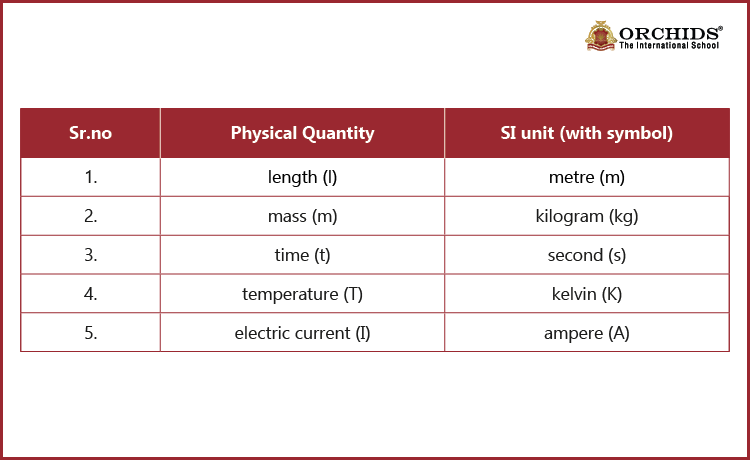
Some physical quantities and their SI units are mentioned below:
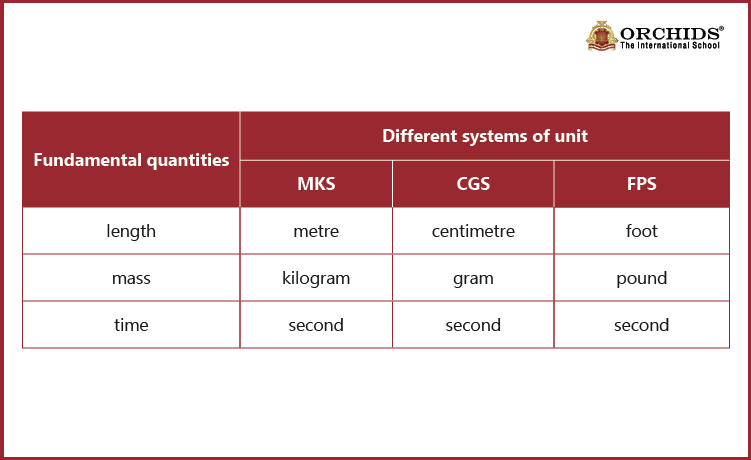
Different systems of units of measurement are:
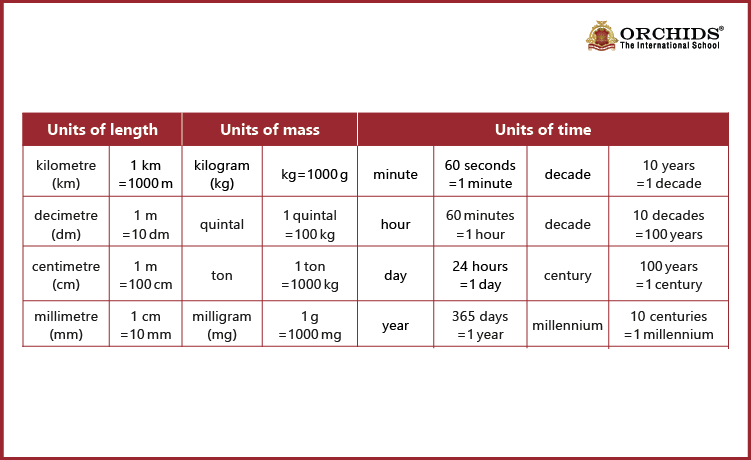
Some multiples and sub-multiples of units of measurement
Can you measure the distance between two atoms or two solar systems by using the unit 'metre'? Can you measure the mass of the Sun using the unit 'kg'? Can you measure the time of revolution of the Earth by using the unit 'seconds'?
Well, you can, but it will be very inconvenient for you. Thus, for the measurement of larger and smaller quantities, we use the multiple and sub-multiple units, respectively.
Some common units for measuring length, mass and time are given below:
The length and type of an object determine the kind of measuring tool that can be used.
- Large distances, e.g. distances between cities, are measured in kilometres.
- Astronomical distances, e.g., the distance between stars, are expressed in a unit called a light year. (A light year is equal to the distance travelled by light in one year. 1 light year = m)
- The units used for expressing extremely small distances, e.g. the diameter of a molecule or atom, are microns (μ) and angstroms (A). Nuclear distances are measured in fermi (fm). ̊
Numerical with Solution
The height of a person is 1.72m. Express it in cm and mm.
Solution:
(i) 1m = 100 cm
⸫ 1.72m = 1.72 × 100
= 172cm
(ii) 1m =1000mm
⸫ 1.72m = 1.72 × 1000
= 1720mm
Important Rules for Writing the Symbols of Units
- Symbols should never be followed by a full stop.
- Symbols are generally written in small letters.
- Symbols are never written in plural.
- Symbols derived from the names of scientists are written in capital letters, such as Newton (N), Kelvin (K). However, when these units are written in words, they are written in small letters, such as newton and kelvin.
In this article, we understood the importance of standard units of measurement and how they help in ensuring accurate and consistent measurements in everyday life.
Frequently Asked Questions on Standard Units of Measurement
1. What is a standard unit of measurement?
A standard unit of measurement is a fixed and universally accepted unit used to measure physical quantities. It does not change with place or person, ensuring accuracy and consistency in measurements.
2. What is the SI unit system?
The SI unit system (International System of Units) is a globally accepted system of measurement adopted in 1960 to maintain uniformity.
3. Which is a standard unit of measurement for length?
The standard unit of measurement for length in the SI system is the metre (m).
4. What are fundamental physical quantities?
Fundamental physical quantities are basic quantities that do not depend on any other quantities. Examples include length, mass, and time.
5. Can we use the same unit for all types of measurements?
No, different quantities require different units. For example, length is measured in metres, mass in kilograms, and time in seconds.
6. What are the rules for writing symbols of units?
Symbols of units should not have a full stop, are usually written in small letters, are never plural, and symbols based on scientists’ names are written in capital letters.
Science isn't just a subject, it's the way of seeing the world. Curious how Orchids The International School teaches it that way? Talk to our admissions team.
Admissions Open for 2026-27
What type of concept pages would you prefer?
CBSE Schools In Popular Cities
- CBSE Schools in Bangalore
- CBSE Schools in Mumbai
- CBSE Schools in Pune
- CBSE Schools in Hyderabad
- CBSE Schools in Chennai
- CBSE Schools in Gurgaon
- CBSE Schools in Kolkata
- CBSE Schools in Indore
- CBSE Schools in Sonipat
- CBSE Schools in Delhi
- CBSE Schools in Rohtak
- CBSE Schools in Bhopal
- CBSE Schools in Aurangabad
- CBSE Schools in Jabalpur
- CBSE Schools in Jaipur
- CBSE Schools in Jodhpur
- CBSE Schools in Nagpur
- CBSE Schools in Ahmednagar
- CBSE School In Tumkur











Orchids The International School is one of India's leading chains of CBSE and ICSE schools, with 110+ schools across the country.