

Fluid

A Fluid is a substance that has no fixed shape; it simply takes the shape of the container it’s in, and it can flow easily. We already know there are four states of matter, including solid, liquid, gas, and plasma. But have you ever wondered among this, why water flows so easily, why air moves around us, or how liquids behave differently from gases, even though both are fluids?
This article is a complete guide to studying what fluids really are, how they are classified, and the properties that make them unique in detail.
Table of Contents
- What is a Fluid?
- Classification of Fluids
- Properties of Fluids
- Types of Fluids
- Frequently Asked Questions on Fluid

What is a Fluid?
A fluid is any substance that keeps flowing because it undergoes continuous deformation. The interesting fact about fluid is, it does not have a definite shape; it adjusts and spreads out depending on the container it's in and responds immediately to any kind of external pressure.
You might have heard the word “fluid” so many times in daily life, for example, we always talk about engine fluids in vehicles, coolant fluids in refrigerators, or even cleaning fluids used at home. Here, all these examples remind us that fluids are everywhere and play important roles in our daily routines.
As we know, fluids can be liquids or gases, or any substance that cannot resist shearing or tangential force when at rest.
The interesting part is, when forces act on a fluid, it changes its shape continuously, and that is the reason why fluids are said to have zero shear modulus.
Classification of Fluids
Now that we know what fluids are and where we use them, let’s look at how they are classified. Fluids can be grouped in several ways depending on how they move or respond to different forces. Here’s how they are classified into different types:
-
Steady or Unsteady
-
Compressible or Incompressible
-
Viscous or Non-viscous
-
Rotational or Irrotational
Let's discuss each of them one by one,
- Fluids can first be understood as steady or unsteady fluids. A steady fluid has the same density at every point as it moves, while an unsteady fluid shows a change in velocity between any two points during flow.
- They can also be compressible or incompressible, depending on the Mach number.
- If the Mach number is less than 0.3, the fluid is considered incompressible. When the Mach number lies between 0.3 and 1, the fluid becomes compressible.
- Another way to classify fluids is by checking how thick or resistant they are. Viscous fluids, just like shampoo or motor oil, you might have observed, are thick and offer noticeable resistance to flow.
- On the other hand, non-viscous fluids show almost no internal friction and flow with ease; a good example is superfluid liquid helium.
- Fluids may also behave differently depending on how the elements within them rotate. In a rotational flow, the angles between the boundary lines of a fluid element change as it moves.
- In an irrotational flow, the fluid moves without altering these angles, keeping its motion more uniform.
- Finally, fluids can be studied based on whether they are at rest or in motion. Fluid statics deals with fluids at rest and the pressure they exert.
- while fluid dynamics focuses on fluids in motion and includes well-known fields like aerodynamics and hydrodynamics.
Properties of Fluids
Now that we understand how fluids are classified, it’s equally important to look at the properties that define their behaviour. These properties help us understand why different fluids act the way they do in real-life situations. Some of the key properties include:
-
Density is Mass per unit volume of a fluid, and its SI Unit:
An interesting part of the density of a substance varies with the volume of the substance.
Mathematically it can represented by,
-
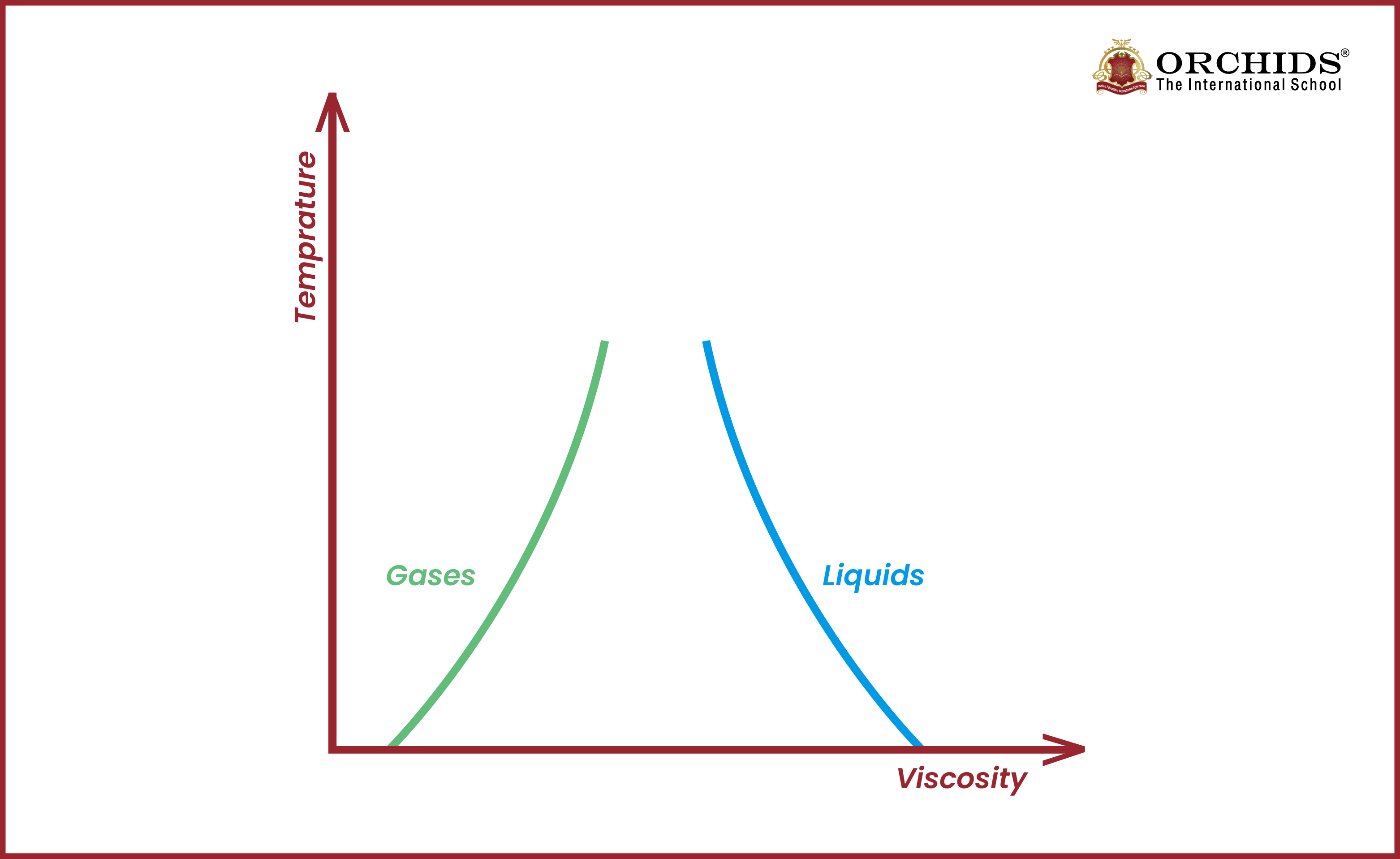
Viscosity is the resistance offered by a fluid to shear stress. A fluid that offers no resistance is called an inviscid fluid.
-
Temperature is the degree of hotness or coldness of a fluid, which is measured in Kelvin (SI unit), Celsius, or Fahrenheit.
-
Pressure is a force applied per unit area. In static fluids, it is known as hydrostatic pressure. It can be expressed as,
-
Specific Volume is the volume per unit mass. It is the reciprocal of density. And Unit:
-
Specific Weight (γ) is weight per unit volume.SI Unit is Unit: N/m³ Specific weight is related to density,
And most importantly about it is, the specific weight of fluid varies with temperature. -
Specific Gravity is the ratio of the specific weight of a fluid to that of a standard fluid. Specific gravity is also referred to as relative density. Specific gravity has no unit.
-
Surface Tension is the tendency of a liquid's surface to shrink to a minimum area due to cohesive forces.
But have you ever wondered how some insects manage to walk on water without sinking?
This phenomenon happens due to surface tension, which allows insects to stay on the water’s surface even though they are denser than water.
-
Vapour Pressure is the equilibrium pressure of vapour above its liquid at a given temperature. It increases with temperature.
-
Cavitation is the formation of bubbles when fluid pressure drops below the vapour pressure. These bubbles collapse suddenly and may cause damage to machine parts.
Types of Fluids
After learning about properties and classification, fluids can be categorised into several types based on how they behave during flow.
-
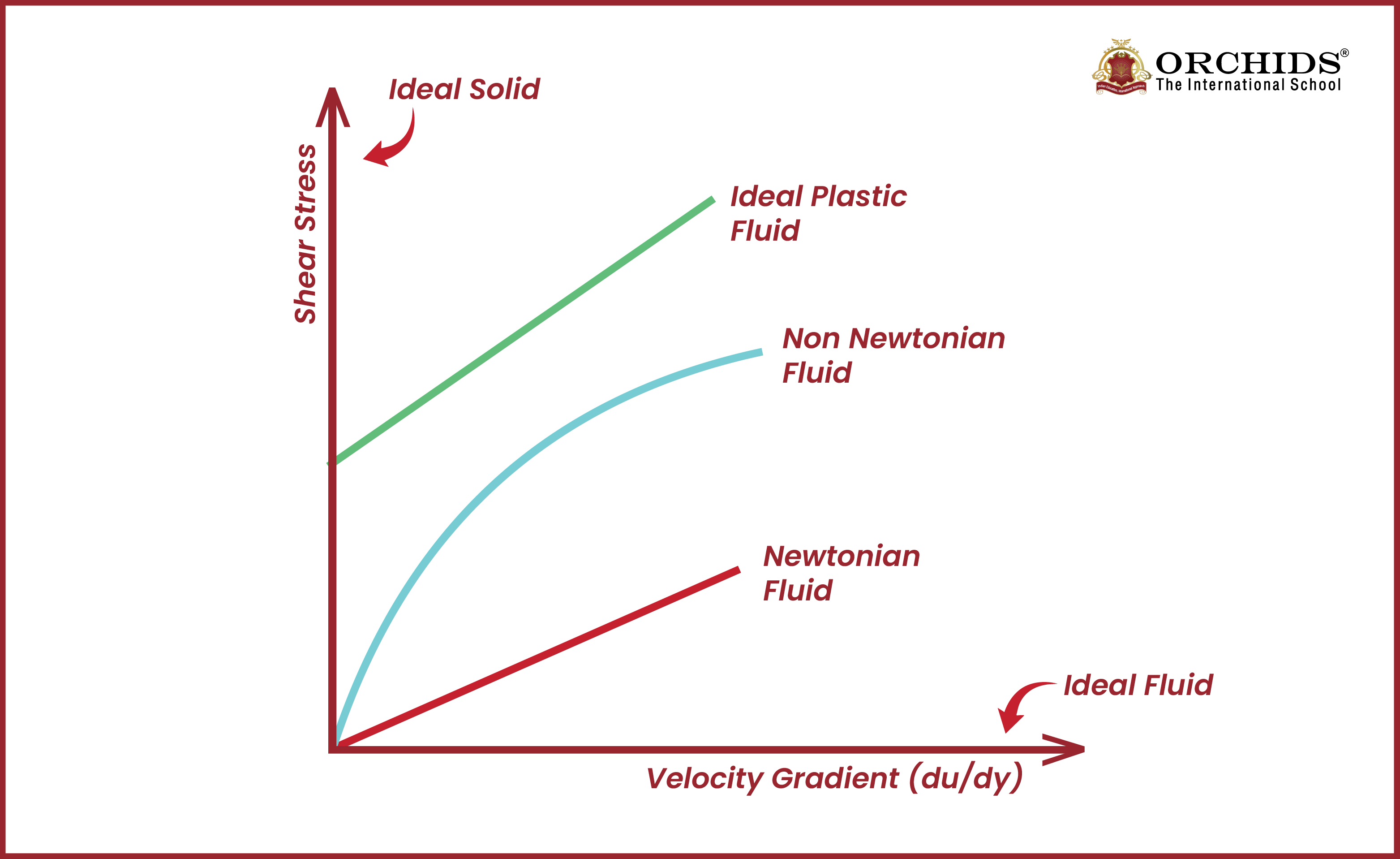
An ideal fluid is a perfect fluid that has no viscosity and cannot be compressed. It’s only a theoretical concept and does not exist in real life.
-
Every fluid we see around us is a real fluid because it has some amount of viscosity. Best examples of ideal fluids are Kerosene and castor oil.
-
A real fluid that abides by Newton’s law of viscosity is known as a Newtonian fluid. And best example of this is Hydrogen and water.
-
Fluids that do not abide by Newton’s law of viscosity are known as non-Newtonian fluids. Example: Oobleck and flubber
-
An ideal plastic fluid stays still until a certain minimum force is applied. After reaching that force, it flows smoothly with shear stress proportional to the velocity gradient.
-
An incompressible fluid is A fluid whose density does not change, even when pressure is applied. Example: The stream of water flowing at high speed from a garden hose pipe.
-
An incompressible fluid whose density does not change, even when pressure is applied, is called a compressible fluid. Example: gas, vapour, and steam. Obeys Newton’s law of viscosity. The best example is Hydrogen, water.
So far, we have learnt that fluids are an essential part of our daily lives, whether it’s the air we breathe, the water we drink, or the oils and gases used in machines. This helps us to understand many natural and technological processes around us.
Frequently Asked Questions on Fluid
1. What is fluid in physics?
Fluid in physics refers to any substance that can flow and take the shape of its container. It includes both liquids and gases that move easily when a force is applied.
2. What is the study of flowing fluids called?
The study of fluids in motion is known as fluid dynamics.
3. What is a steady fluid?
A steady fluid has constant density at every point while flowing.
4. True or False: Fluids do not oppose deformation?
This statement is true. Fluids cannot resist deformation due to shear stress.
5. Can you give some examples of fluids in physics?
Some common examples of fluids in physics are water, air, oil, and even honey. These substances can flow freely and do not have a fixed shape.
6. What is fluid pressure, and why is it important?
Fluid pressure is the force a fluid exerts per unit area on the walls of its container. Understanding fluid pressure helps us explain things like how syringes work or why dam walls are thicker at the bottom.
7. What are the main Properties of fluid?
The Properties of fluid include density, viscosity, temperature, pressure, and surface tension. These properties determine how a fluid flows and reacts to forces.
8. How does fluid pressure change with depth?
Fluid pressure increases as depth increases because the weight of the fluid above adds more force. This is why swimmers feel more pressure when they go deeper underwater.
9. Why are examples of fluids in physics useful in daily life?
Examples of fluids in physics help us understand everyday things like how blood flows, how vehicles use engine oil, or how air enables aircraft to fly. They show how fluids impact our routines in simple ways.
Science isn't just a subject, it's the way of seeing the world. Curious how Orchids The International School teaches it that way? Talk to our admissions team.
Admissions Open for 2026-27
What type of concept pages would you prefer?
CBSE Schools In Popular Cities
- CBSE Schools in Bangalore
- CBSE Schools in Mumbai
- CBSE Schools in Pune
- CBSE Schools in Hyderabad
- CBSE Schools in Chennai
- CBSE Schools in Gurgaon
- CBSE Schools in Kolkata
- CBSE Schools in Indore
- CBSE Schools in Sonipat
- CBSE Schools in Delhi
- CBSE Schools in Rohtak
- CBSE Schools in Bhopal
- CBSE Schools in Aurangabad
- CBSE Schools in Jabalpur
- CBSE Schools in Jaipur
- CBSE Schools in Jodhpur
- CBSE Schools in Nagpur
- CBSE Schools in Ahmednagar
- CBSE School In Tumkur











Orchids The International School is one of India's leading chains of CBSE and ICSE schools, with 110+ schools across the country.