

Volcano Eruption
A volcanic eruption happens when magma below the surface rises to the top of the mountain, causing gas and bubbles to appear. These eruptions are not just spectacular displays of nature; they also play a crucial role in shaping the Earth’s surface.
This article focuses on how volcanoes erupt, why they erupt, and the causes of these eruptions in detail.
Table of Contents
- What is a Volcano Eruption?
- The Process of a Volcano Eruption
- Reason Behind Volcano Eruption
- Major Causes of Volcanic Eruption
- Frequently Asked Questions on Volcano Eruption

What is a Volcano Eruption?
A volcano is like a natural window or opening on the surface of a planet or moon that allows super-hot material from deep inside the Earth to escape. When this hot molten rock, ash, and gases burst out, we call it a volcanic eruption. Interesting, right?
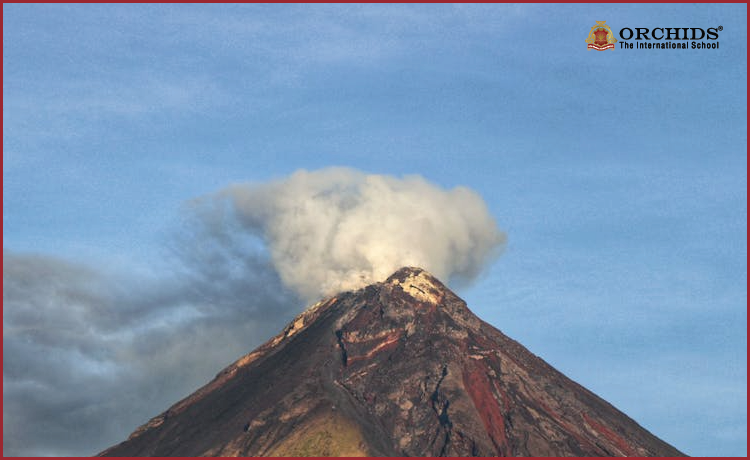
Volcanoes often form mountains because layers of lava, ash, and rocks pile up around the vent over time.
You will be amazed after knowing this: not all volcanoes behave the same way.
Active volcanoes have erupted recently or may erupt again soon.
Dormant volcanoes haven’t erupted for a long period, but still have the potential to erupt one day.
Extinct volcanoes are those that are unlikely to erupt again
The Process of a Volcano Eruption
Somewhere, in deep within the Earth, temperatures soar high enough to melt rocks into a thick, flowing substance called magma.
Let's discuss in detail how exactly Volcanoes Erupt,
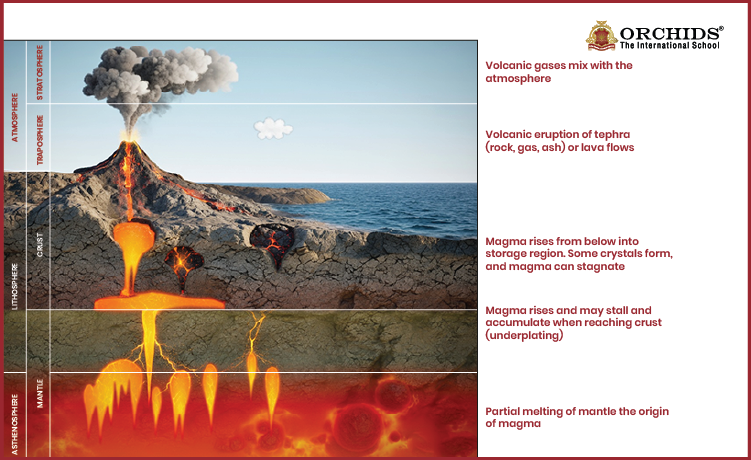
Magma is lighter than solid rock, so it gradually rises through the crust and collects in magma chambers.
Over time, pressure builds, and the magma forces its way through cracks or vents in the Earth's surface. Interestingly, when this happens, a volcanic eruption occurs, and the molten rock that flows out is called lava.
To understand eruptions better, it helps to know the Earth's structure. The outermost layer, the lithosphere, includes the crust and upper mantle.
The crust varies in thickness from 10 km to 100 km in mountainous regions and primarily consists of silicate rocks. Beneath it, the mantle is divided into the upper mantle (8-410 km), the transition zone (400-660 km), and the lower mantle (660-2891 km).
Pressure and temperature increase dramatically with depth, reaching up to 3000°C, which causes rock to melt and form magma.
Reason Behind Volcano Eruption
Magma is less dense than the surrounding solid rock, so it naturally rises toward the surface. During its ascent, gases like water vapour, carbon dioxide, and sulfur dioxide exsolve from the magma, creating bubbles.
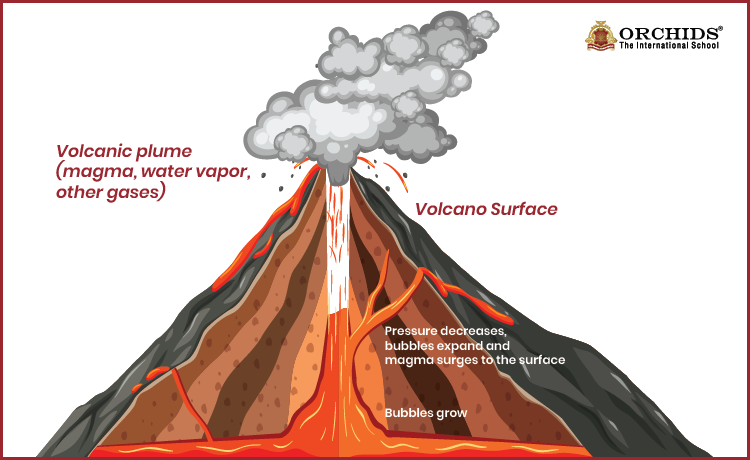
Above is a diagram showing magma rising, gas bubble formation, and volcanic eruption.
As the magma nears the surface, the volume of gas bubbles can reach up to 75%, increasing the pressure within the magma chamber. When this pressure becomes too high, the magma bursts out as lava, ash, and rocks.
The type of eruption depends largely on the viscosity of the magma:
- Low-viscosity magma flows easily, forming broad shield volcanoes.
- Thick, sticky magma creates the classic cone-shaped volcano.
- Extremely viscous magma accumulates in the vent, potentially leading to explosive lava dome eruptions.
Main Causes of Volcanic Eruption
The main factors that drive volcanic eruptions:
- Buoyancy of Magma is lighter than the solid rock around it, so it naturally rises toward the Earth’s surface.
- In Pressure from Dissolved Gases, Magma contains gases like water vapor, carbon dioxide, and sulfur dioxide. As magma moves up, these gases form bubbles that expand, building pressure and pushing the magma out.
In Tectonic Plate Movements, most volcanoes appear along the edges of tectonic plates, where the plates either pull apart or collide.
- Divergent Boundaries: Plates moving away from each other create cracks, allowing magma to rise and escape.
- Convergent Boundaries: When one plate slides under another, it melts and forms magma that can push its way to the surface.
Pressure from New Magma entering an existing magma chamber increases pressure, which can trigger an eruption.
Earthquakes can break the crust, opening paths for magma to escape, which can sometimes cause sudden eruptions.
Additionally, interactions between magma and water can trigger phreatomagmatic eruptions, while steam explosions from superheated groundwater cause phreatic eruptions.
Next, Magmatic eruptions occur due to gas decompression within the magma itself.
Types of Volcanic Eruptions
Volcanologists classify eruptions based on their intensity and characteristics. Some well-known types include:
- Hawaiian eruptions involve gentle, steady lava flows that can travel long distances.
- Strombolian eruptions are marked by intermittent bursts of lava, gas, and volcanic bombs.
- Vulcanian eruptions are short, explosive eruptions of viscous lava that often produce ash clouds.
- Pelean eruptions are known for powerful pyroclastic flows.
- Plinian eruptions are massive, sustained explosions that produce high-reaching ash columns and widespread ash fall.
- Surtseyan eruptions occur when lava interacts explosively with water, often in shallow seas or lakes.
Each eruption type creates unique landforms and deposits, shaping our planet over time.
Till now, we have learned that volcanoes may seem fierce and unpredictable, but they are also a natural part of how our planet reshapes itself. From gentle lava flows to powerful explosions, each eruption tells a story about the forces working deep within the Earth. By understanding why and how volcanoes erupt, we not only satisfy our curiosity but also learn to respect and live safely alongside these incredible natural phenomena.
Frequently Asked Questions on Volcano Eruption
1. What is a volcano?
A volcano is a natural opening in the Earth's crust through which molten rock, gases, and ash escape. It forms over time due to pressure and heat beneath the surface.
2. What is the eruption of a volcano?
The eruption of a volcano occurs when magma, gases, and ash are forcefully expelled onto the Earth’s surface. It can create lava flows, ash clouds, and even reshape the landscape.
3. What volcano is currently erupting?
Active volcanoes around the world, like Mount Etna in Italy or Kilauea in Hawaii, are examples of volcanoes currently erupting. These volcanoes are closely monitored for public safety.
4. What causes volcanic eruptions?
Volcanic eruptions are caused by magma rising due to buoyancy, pressure from dissolved gases, and stress on the crust above. When this pressure exceeds the rock strength, an eruption occurs.
5. Can you explain the volcano definition?
A volcano is a vent or rupture in the Earth's crust that allows hot lava, gases, and ash to escape. It can be dormant, active, or extinct based on its eruption history.
6. How many active volcanoes are there in the world?
There are over 1,500 active volcanoes on Earth that have erupted in modern times. Scientists keep track of them to predict eruptions and minimise risks.
Science isn't just a subject, it's the way of seeing the world. Curious how Orchids The International School teaches it that way? Talk to our admissions team.
Admissions Open for 2026-27
What type of concept pages would you prefer?
CBSE Schools In Popular Cities
- CBSE Schools in Bangalore
- CBSE Schools in Mumbai
- CBSE Schools in Pune
- CBSE Schools in Hyderabad
- CBSE Schools in Chennai
- CBSE Schools in Gurgaon
- CBSE Schools in Kolkata
- CBSE Schools in Indore
- CBSE Schools in Sonipat
- CBSE Schools in Delhi
- CBSE Schools in Rohtak
- CBSE Schools in Bhopal
- CBSE Schools in Aurangabad
- CBSE Schools in Jabalpur
- CBSE Schools in Jaipur
- CBSE Schools in Jodhpur
- CBSE Schools in Nagpur
- CBSE Schools in Ahmednagar
- CBSE School In Tumkur











Orchids The International School is one of India's leading chains of CBSE and ICSE schools, with 110+ schools across the country.