

Reflection on a Plane Mirror
Reflection on a Plane Mirror is one of the most common and interesting phenomena of physics that we experience in our everyday life. From looking at ourselves in a mirror while getting ready to using mirrors in vehicles, periscopes, and scientific instruments, plane mirrors play an important role in our daily activities. Have you ever wondered why your image appears exactly like you, why it looks upright, or why your left hand appears as your right in the mirror? All these interesting observations happen because of the reflection of light.
This article assists you in understanding how reflection happens in plane mirrors, the laws of reflection, and how plane mirrors form images and their characteristics in detail.
Table of Contents
- What is the Reflection of Light
- Different Types of Reflection
- Laws of Reflection
- How are Images formed in a Plane Mirror?
- Characteristics of the Image Formed by Plane Mirrors
- Frequently Asked Questions on Reflection on a Plane Mirror

What is the Reflection of Light?
Every morning while getting ready, you look into a plane mirror and see yourself smiling back; you are actually witnessing the reflection of the light phenomenon in action! But before that, do you know what plane mirrors are? Let's discuss in detail.
A plane mirror is not just any mirror; it's a perfectly flat, polished, shiny, and smooth surface that reflects light uniformly, which produces a very clear reflection.
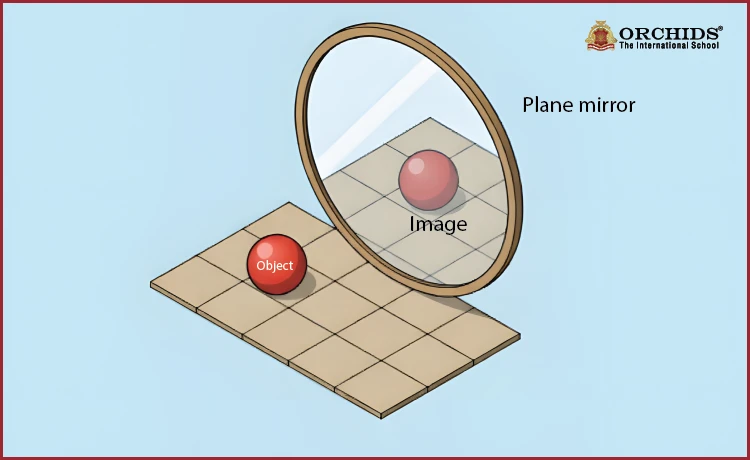
We already know that light always travels in straight lines. So, the reflection of light can be defined as,
| “When it strikes any smooth and shiny surface, it bounces back, and this phenomenon of light is known as Reflection of light.” |
The image below shows how reflection of light takes place on a plane mirror.
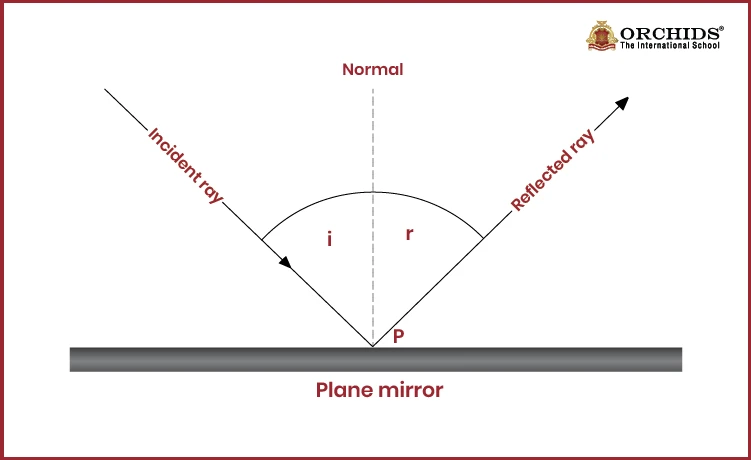
- A ray of light that strikes the mirror surface is called the Incident Ray, and the ray that bounces back is called the Reflected Ray.
- At the point P where the light hits the mirror, a line, i.e, shown as a dotted vertical line, is drawn at 90° to the surface, which is known as a Normal.
- The angle between the normal and the incident ray is known as the Angle of Incidence (i), and the angle between the normal and the reflected ray is known as the Angle of Reflection (r).
But here is a common question that arises: why do we see our reflection in a mirror but not on a wall?
The reason behind this is the nature and smoothness of the surface. Interestingly! A mirror is a smooth and polished surface that allows light rays to reflect in a uniform direction, while a rough wall scatters light in many directions. Now that we know how mirrors reflect light, let’s see how reflection actually happens in different situations.
Different Types of Reflections
Three main types of reflection take place according to the nature and smoothness of the reflecting surfaces. And they are:
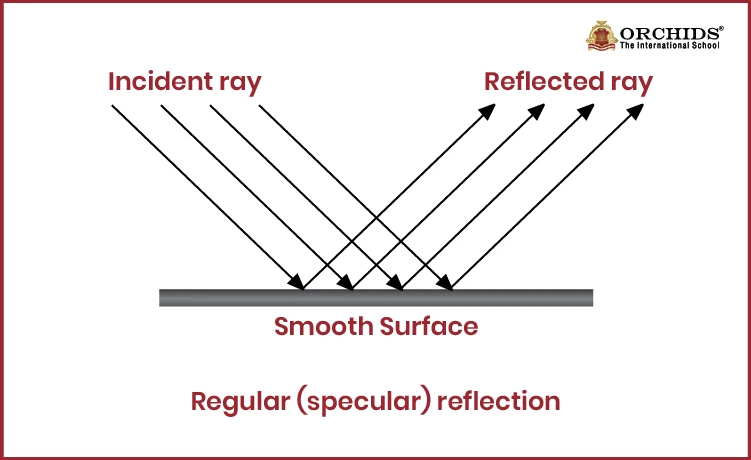
Regular (Specular) Reflection of light
In this type of reflection, light rays reflect off smooth surfaces such as mirrors and create a clear image.
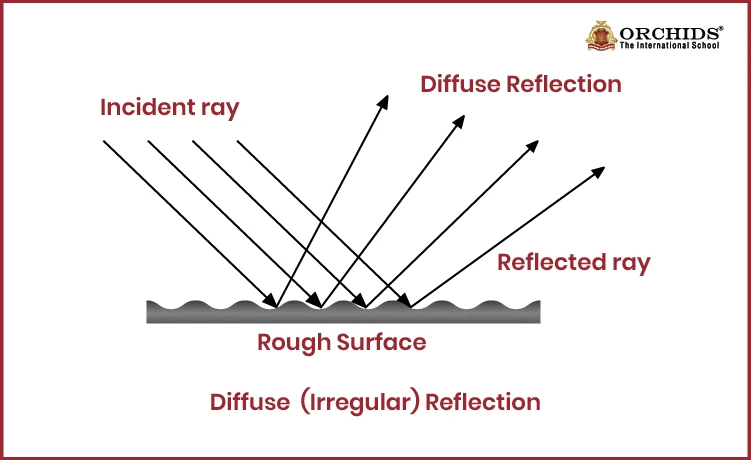
Diffuse (Irregular) Reflection of light
In this type of reflection, light rays scatter in every possible direction when they approach rough surfaces like a wall without getting a clear image.
Multiple Reflection
This type of reflection occurs when light bounces between more than one mirror, and it creates multiple images.

Laws of Reflection of Light
There are two main laws of reflection,
(i) The angle of incidence (i) is equal to the angle of reflection (r).
(ii) The incident ray, the normal to the mirror at the point of incidence, and the reflected ray all lie in the same plane.
These simple laws help us to understand how light will behave after striking a mirror, and that’s exactly what makes our reflections look so clear and accurate.
Now the question is, how are images formed in a Plane Mirror? Let's discuss,
How Images Are Formed in a Plane Mirror?
When you place an object in front of a plane mirror, the image appears behind the mirror at the same distance as the object is in front.
Let's try to understand this in a better way by using one example. Take one candle as an object and put it in front of the plane mirror as shown in the figure. Now, try to see the candle inside the mirror. It appears a similar candle is placed behind the mirror, interesting!
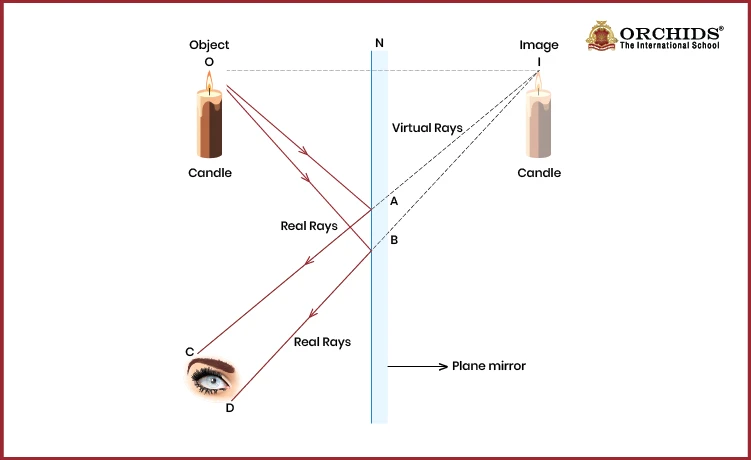
Here, we can clearly see how a virtual image is formed. The light rays from the candle flame travel in straight lines and strike the mirror.
From the above, it can be concluded that the angle of incidence = the angle of reflection, which means these reflected rays bounce back by following the laws of reflection strictly.
When these reflected rays reach our eyes, our brain traces them backward in a straight line, making it appear as though they come from behind the mirror.
To understand this even better, let’s look at the wavefront explanation.
Consider light rays 1, 2, and 3 coming from the object, as shown in the figure.
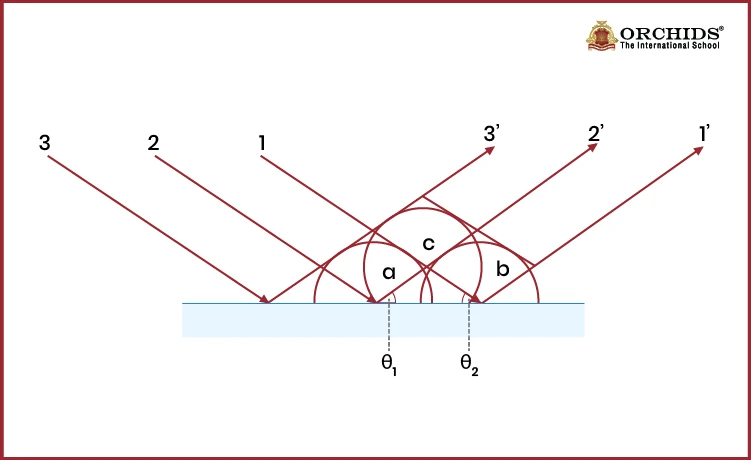
At a point, a wavefront is generated due to the secondary source on ray 2.
Similarly, at the same time, the other two wavefronts at points c and b are also generated. So here the distance, ac=ab,
So the triangle formed at this point is isosceles. And in an isosceles triangle, the angles at the base are equal, i.e, .
Where is the angle of incidence, and is the angle of reflection
therefore,
Angle of incidence = Angle of reflection
This principle helps us understand how images are formed in plane mirrors.
Now let's look at their characteristics.
Characteristics of the Image Formed by Plane Mirrors
The nature of the image formed by a plane mirror can be summarised as follows:
- The image is virtual and erect.
- The size of the image is equal to the size of the object.
- The image appears behind the mirror.
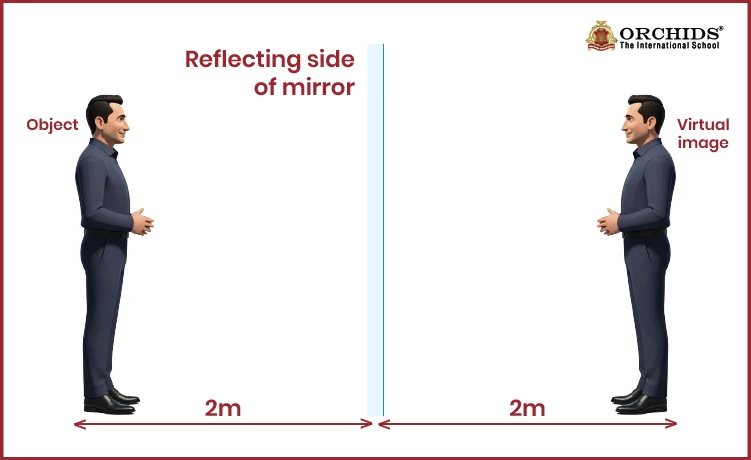
- The distance of the image from the mirror is equal to the distance of the object in front of it.
- The image is laterally inverted, meaning left appears as right.
Thus, the plane mirror doesn’t create a real image; it forms an illusion of reality, perfectly symmetrical and bright!
For example, if you stand 2 meters away from a mirror, your image will also appear 2 meters behind it, just like another you standing on the other side of the mirror!
Plane mirrors are commonly used at home for grooming and checking our appearance. In vehicles, they serve as rear-view and side-view mirrors to help drivers see behind them. They are also used in instruments like periscopes, kaleidoscopes, and solar cookers, where light needs to be reflected in a specific direction.
Till now, we have learned that reflection in a plane mirror is an important part of our daily life. From personal grooming to advanced technology like telescopes, periscopes, solar cookers, plane mirrors, they play a significant role in shaping our world in a better way.
Frequently Asked Questions on Reflection on a Plane Mirror
1. Is a plane mirror concave or convex?
A plane mirror is neither concave nor convex; it is a flat mirror with a planar surface.
2. What is a plane mirror, and how does it work?
A plane mirror is a flat, polished, and shiny surface. It works on the principle of reflection of light, forming a virtual, erect, and same-sized image behind the mirror.
3. Can the image formed by a plane mirror be captured on a screen?
No, the image formed by a plane mirror is virtual, meaning the reflected rays only appear to come from behind the mirror.
4. What are the laws of reflection for a Plane Mirror?
Laws of Reflection are-
- The angle of incidence is equal to the angle of reflection.
- The incident ray, the normal to the mirror at the point of incidence, and the reflected ray all lie in the same plane.
5. What is a real-world application of plane mirrors?
Plane mirrors are used in periscopes, Solar Cookers, kaleidoscopes, and are also used as personal grooming mirrors.
6. How does a plane mirror reflect an image?
The image formed by a plane mirror is a virtual and not a real image. The image is always upright, and of the same shape and size as the object it is reflecting.
Science isn't just a subject, it's the way of seeing the world. Curious how Orchids The International School teaches it that way? Talk to our admissions team.
Admissions Open for 2026-27
What type of concept pages would you prefer?
CBSE Schools In Popular Cities
- CBSE Schools in Bangalore
- CBSE Schools in Mumbai
- CBSE Schools in Pune
- CBSE Schools in Hyderabad
- CBSE Schools in Chennai
- CBSE Schools in Gurgaon
- CBSE Schools in Kolkata
- CBSE Schools in Indore
- CBSE Schools in Sonipat
- CBSE Schools in Delhi
- CBSE Schools in Rohtak
- CBSE Schools in Bhopal
- CBSE Schools in Aurangabad
- CBSE Schools in Jabalpur
- CBSE Schools in Jaipur
- CBSE Schools in Jodhpur
- CBSE Schools in Nagpur
- CBSE Schools in Ahmednagar
- CBSE School In Tumkur











Orchids The International School is one of India's leading chains of CBSE and ICSE schools, with 110+ schools across the country.