

Free Fall

The Free fall is a special type of motion where an object drops only under the influence of Earth’s gravity, without any other force acting on it. Every day, we see objects falling right! Sometimes we throw them down, and other times they slip from our hands and drop on their own. You might be amazed to know that in both situations, the same invisible force works, and it is gravity.
So, if an object is falling and only gravity is acting on it without any external force, then it is in free fall. This article provides complete insights into free fall, including the free fall formula in detail.
Table of Contents

What is Free Fall?
Free fall is a type of motion in which an object moves only under the influence of Earth’s gravity, with no other external forces, such as air resistance, wind, or friction, acting on it.
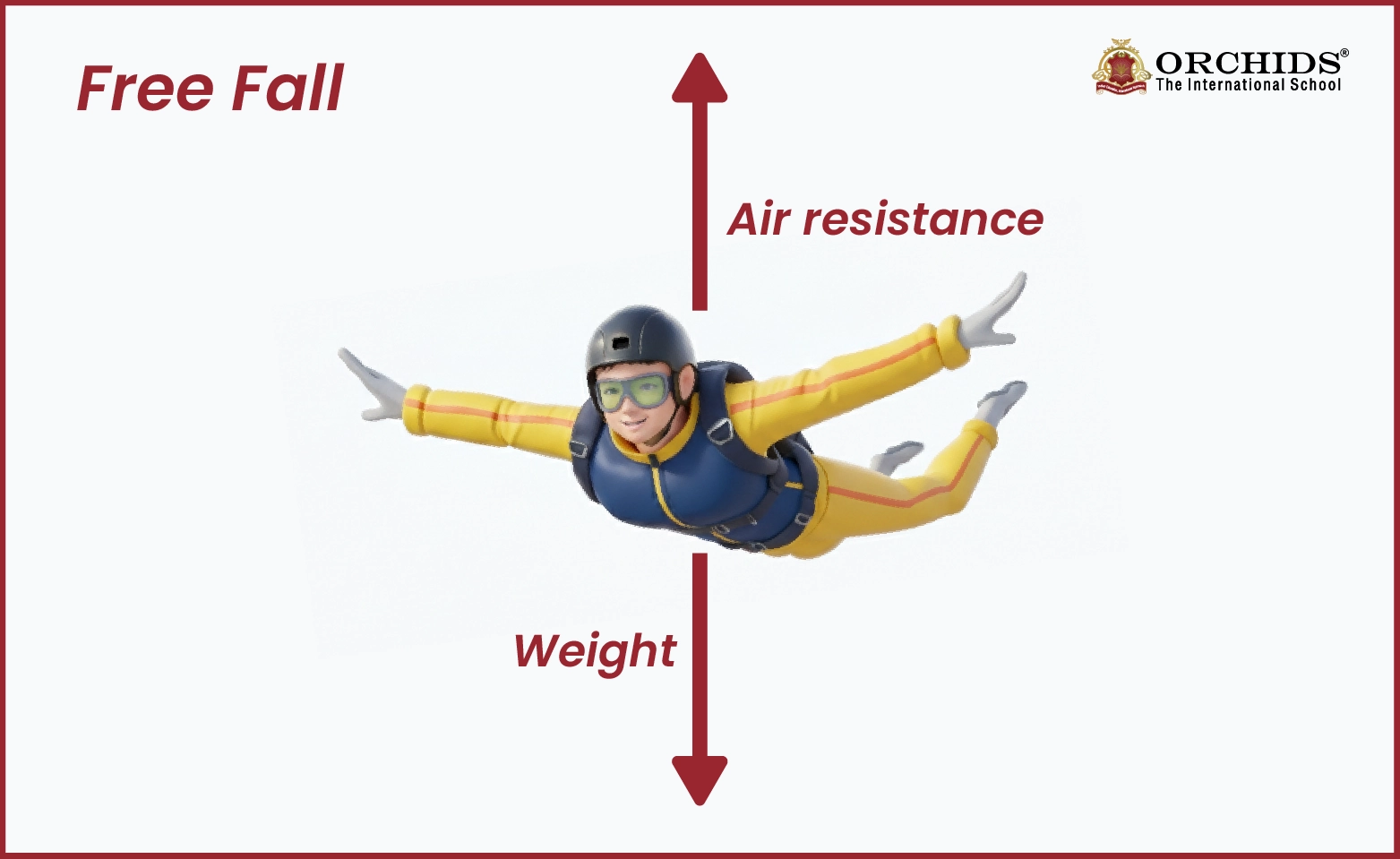
Since gravity pulls the object downward, it keeps speeding up as it falls. And do you know, this increase in speed is known as the acceleration due to gravity.
Imagine you are dropping an object from your hand. Here you will observe that only gravity affects its motion, and that movement is called free fall.
.webp "Dropping Ball from your hand Example of Free Fall")
So, in simple language, it can be defined as,
|
The Free Fall is the motion of an object when gravity is the only force acting on it, causing it to accelerate towards Earth. |
We already know that Sir Isaac Newton discovered this gravity, which pulls everything toward the Earth. When an object falls freely, gravity makes it speed up continuously. This increasing speed is known as the acceleration due to gravity.
But what is the acceleration of Gravity, and how can it be calculated during free fall? Let's discuss,
Acceleration Due to Gravity During Free Fall
Acceleration due to gravity is the acceleration that is offered by the centre of the Earth. The value of Acceleration due to gravity is .
To calculate the acceleration due to gravity during free fall, we assume that the height from which the object is dropped is very small compared to the Earth’s radius. This allows us to treat the distance as constant during the fall.
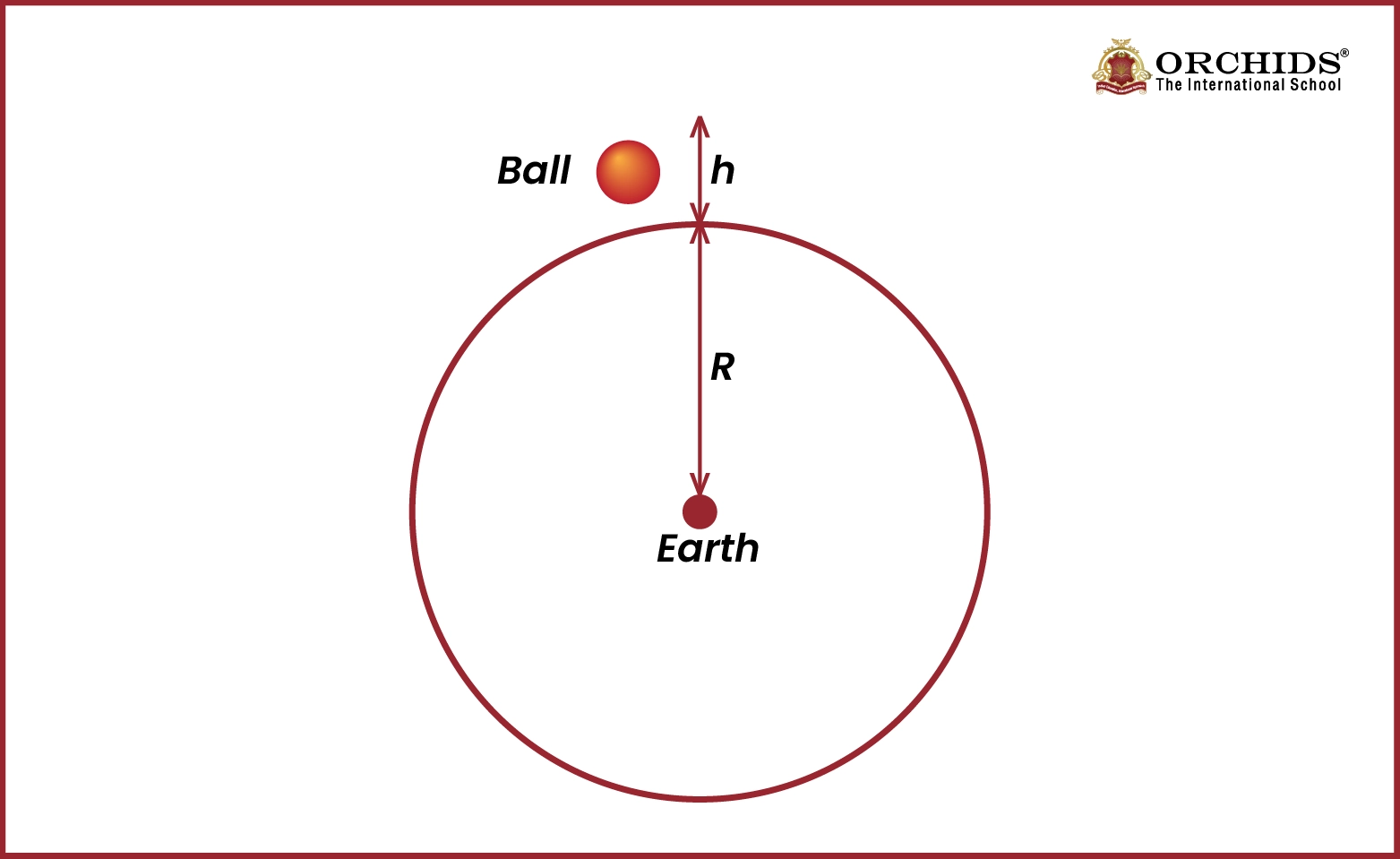
When an object is in free fall, the only force acting on it is the gravitational force between the Earth and the object.
According to Newton’s Law of Gravitation,
We know, h<< R
Hence, the Height at which the object is dropped can be neglected.
We already know, according to the definition of Force, F = ma
Here, a = g (acceleration due to gravity).
F = mg =
mg =
g =
Where,
G is Gravitational Constant
M is the mass of the object
R is the Radius of the Earth (6378 km)
We’ve already discussed ‘G’, the Universal Gravitational Constant, which has a fixed value across the entire Universe.
However, gravity (g) does not behave the same way. If we look at the equation below,
We can clearly see that g depends on the dimensions of the celestial body, meaning its mass (M) and radius (R). So, g is not constant; it changes from place to place. For example, g on the Moon or Mars is different from g on Earth.
Also, here is the important thing to keep in mind: during free fall motion, the acceleration remains constant and is equal to g. Therefore, we can apply the usual equations of motion by simply replacing acceleration a with g. For example,
By substituting condition for free fall, that is for initial velocity, for distance travelled, and for acceleration, we get,
Final velocity,
Distance,
Velocity-height relation,
These are the free-fall formula
Now, let’s discuss how the concept of free fall applies in real life.
Real Life example of Free Fall
Free fall is not just a classroom concept; it happens all around us every day! Here are some common and real life examples,
-
When you drop a stone from a tower or window, it accelerates toward the ground due to gravity.
-
While raining, before air resistance significantly affects them, raindrops initially fall freely under gravity.
-
For a short duration, Skydivers, before the parachute opens, experience free-fall motion.
-
Gravity pulls ripe fruits down to the ground.
-
Even a pencil, pen or any kind of object that accidentally slips from our hand experiences free fall.
These examples help us see that free fall is all around us, and the same force, which is gravity, is responsible for all of them.
Till now, we have learned that free fall describes the motion of an object that moves only under the influence of gravity, without any other forces acting on it, not even air resistance. When an object is in free fall, it accelerates downward because of Earth’s gravitational pull. This acceleration remains nearly constant at 9.8 m/s², and it is represented by the symbol ‘g’.
Frequently Asked Questions on Free Fall
1. What does the concept of free fall mean?
Free fall is the motion of an object when only gravity acts on it. In this motion, the object accelerates continuously toward the Earth.
2. What is called free fall?
Any object that moves downward under the influence of gravity alone, without other forces like air resistance, is said to be in free fall.
3. Why is free fall important in physics?
Understanding free fall helps us study motion and gravity. It also forms the basis for calculating speed, distance, and acceleration of falling objects.
4. What is the acceleration of free fall?
The acceleration of free fall is the rate at which an object speeds up while falling. On Earth, it is about 9.8 m/s², represented by g.
5. Does air resistance affect free fall?
No, in true free fall, air resistance is ignored. The object accelerates only due to gravity without any slowing force.
6. Can free fall happen in space?
Yes, Free fall can happen in space near a planet or star where gravity is the only force acting on the object.
7. Can heavy and light objects fall at the same rate?
Yes, in free fall, all objects accelerate equally regardless of their mass if air resistance is ignored.
8. Where is the value of g different from 9.8 m/s²?
The acceleration due to free fall changes on other celestial bodies, like the Moon or Mars, depending on their mass and radius.
Science isn't just a subject, it's the way of seeing the world. Curious how Orchids The International School teaches it that way? Talk to our admissions team.
Admissions Open for 2026-27
What type of concept pages would you prefer?
CBSE Schools In Popular Cities
- CBSE Schools in Bangalore
- CBSE Schools in Mumbai
- CBSE Schools in Pune
- CBSE Schools in Hyderabad
- CBSE Schools in Chennai
- CBSE Schools in Gurgaon
- CBSE Schools in Kolkata
- CBSE Schools in Indore
- CBSE Schools in Sonipat
- CBSE Schools in Delhi
- CBSE Schools in Rohtak
- CBSE Schools in Bhopal
- CBSE Schools in Aurangabad
- CBSE Schools in Jabalpur
- CBSE Schools in Jaipur
- CBSE Schools in Jodhpur
- CBSE Schools in Nagpur
- CBSE Schools in Ahmednagar
- CBSE School In Tumkur











Orchids The International School is one of India's leading chains of CBSE and ICSE schools, with 110+ schools across the country.