

Gravitational Constant
The gravitational constant is a physical constant that is used for calculating gravitational attraction between two different objects or bodies.
Have you ever wondered why, when you jump, you always come back down? Or why don’t the planets just float away into space? The answer lies in gravity, the invisible force that keeps our universe connected. Interesting!
This article provides complete insights into what the Gravitational constant is. Newton's law of universal gravitation, and how it is measured.
Table of Contents
- What is the Gravitational Constant
- Discovery of Gravity
- Newton’s Law Of Universal Gravitation
- How Is the Value of the Gravitational Constant Measured?
- Frequently Asked Questions on Gravitational Constant

What is the Gravitational Constant?
We already know, gravity is everywhere, all around us. An interesting fact about gravity is, it binds planets, stars, and galaxies, holding them together in a cosmic dance. Interestingly, gravity also keeps planets in orbit around stars, stars within galaxies, and is responsible for the formation of celestial bodies by pulling gas and dust particles together.
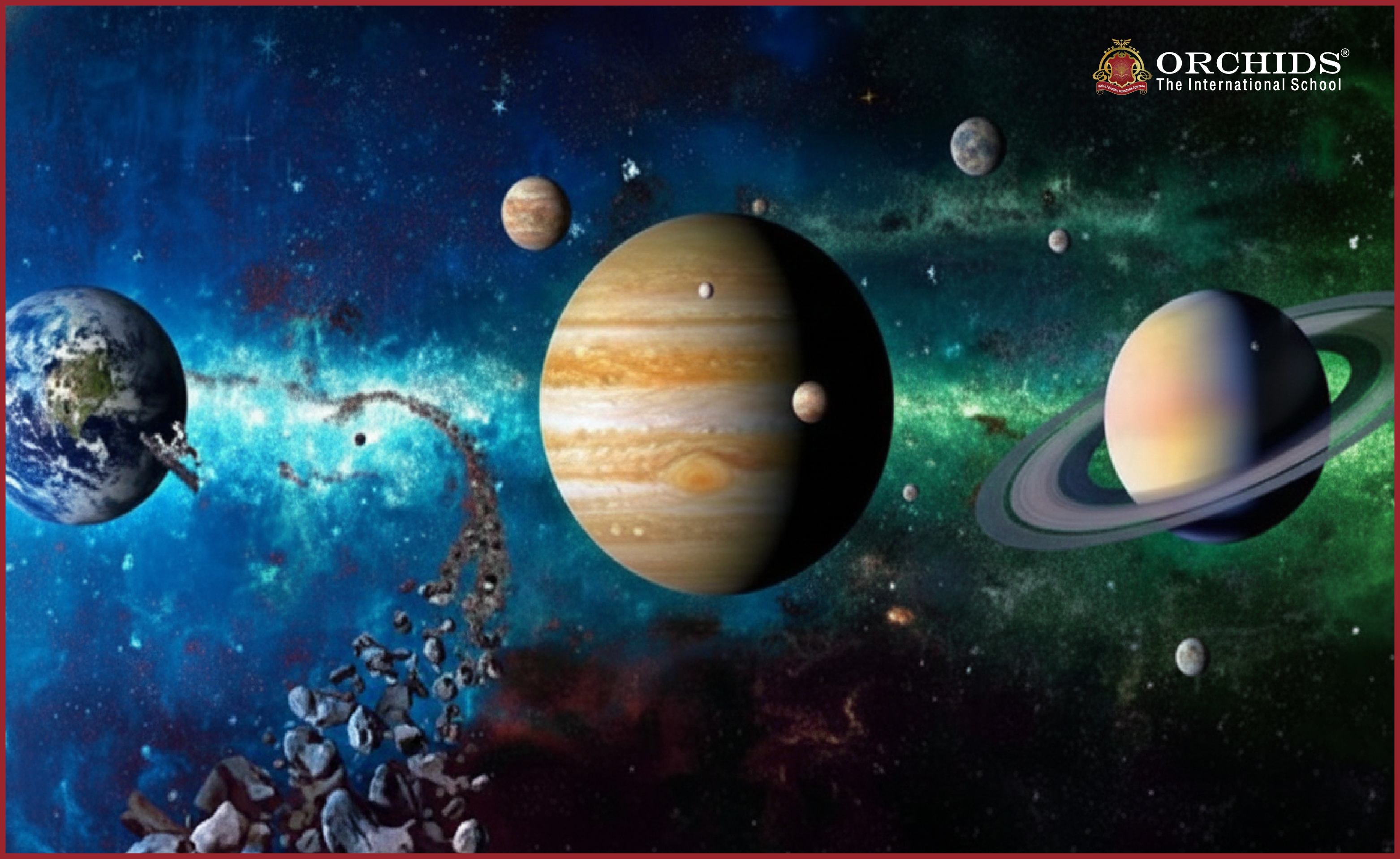
But here you might ask, who invented gravity first? lets discuss
Discovery of Gravity
The story of gravity begins with a curious mind, Sir Isaac Newton. In 1687, Newton explained the motion of planets, moons, and falling objects with a simple yet profound insight: every object with mass attracts every other object.
After Newton, Henry Cavendish helped quantify this attraction by defining the gravitational constant, which gave scientists a precise way to measure gravity
You may wonder after knowing that gravity also affects light, which grows redder as it moves through a strong gravitational field. Interesting, isn't it?
The gravitational constant (G) is a fixed numerical value that determines the strength of the gravitational force between two objects.
In other words, the value of gravitational consist helps us calculate how much two masses attract each other, and it is an essential part of Newton’s law of universal gravitation.
Newton’s Law Of Universal Gravitation
Newton’s Law of Universal Gravitation tells us:
|
"Every particle attracts every other particle in the universe with a force directly proportional to the product of their masses and inversely proportional to the square of the distance between them." |
Mathematically, this law is expressed as:
Where,
F = gravitational force between two objects
& = masses of the objects
r = distance between their centres
G = universal gravitational constant
You will be amazed after knowing the gravitational constant has many names, such as universal gravitational constant, Cavendish constant, or Newtonian constant of gravitation, and it is commonly denoted by G, and its SI unit is .
Here is an important point to remember: in classical physics, G can be derived from Planck’s length, mass, and time, while in other formulations, it’s linked to the electric force. Its value is:
Here, one important question arises: how exactly is the gravitational constant calculated? Let's discuss,
How Is the Value of the Gravitational Constant Measured?
Let’s discuss how scientists actually calculate the value of the gravitational constant, G.
We already know that gravity is extremely weak compared to other forces. So, measuring G is one of the most challenging tasks in physics. But, over the years, scientists have developed several clever methods to detect and measure this tiny gravitational pull.
Here are a few commonly used ones:
-
Using a laboratory balance to measure Earth’s gravitational pull on a test mass.
-
Comparing the pull of a large natural mass, such as a mountain, with Earth’s gravity.
-
Directly measuring the force between two known masses in controlled experiments is a method famously used in Cavendish’s torsion balance experiment.
These techniques help scientists calculate a highly accurate value of G, contributing to our deeper understanding of gravitational interactions in the universe.
So far, we have learned that gravity is more than just a force; it’s the invisible thing that shapes our universe. From keeping our feet on the ground to guiding planets around stars, it shapes everything we see in the cosmos. Here, all credit goes to Sir Issac Newton and Cavendish. Because of them, we can not only understand this mysterious force but also calculate it with the gravitational constant, G.
Frequently Asked Questions on Gravitational Constant
1. What is the value of the gravitational constant G?
The value of the gravitational constant is approximately . It determines the strength of gravity between two bodies.
2. What is the universal gravitational constant?
The universal gravitational constant is a fundamental constant in physics, denoted by G, which is the gravitational attraction between any two objects in the universe.
3. What is the SI unit of the gravitational constant?
The SI unit of gravitational constant is .
4. What is the dimension of the gravitational constant?
The dimension of the gravitational constant is
This shows how it relates to mass, length, and time in physics equations.
5. How is the value of the gravitational constant determined experimentally?
The value of the gravitational constant is determined experimentally using Cavendish type experiments that measure the tiny attraction between known masses.
6. Why is the universal gravitational constant important?
The universal gravitational constant is important because it allows us to calculate the gravitational force between any two objects, from apples to planets.
7. How is the dimensional formula of the gravitational constant derived?
The dimensional formula of the gravitational constant is derived from Newton’s law of gravitation, relating force, mass, and distance between objects.
Science isn't just a subject, it's the way of seeing the world. Curious how Orchids The International School teaches it that way? Talk to our admissions team.
Admissions Open for 2026-27
What type of concept pages would you prefer?
CBSE Schools In Popular Cities
- CBSE Schools in Bangalore
- CBSE Schools in Mumbai
- CBSE Schools in Pune
- CBSE Schools in Hyderabad
- CBSE Schools in Chennai
- CBSE Schools in Gurgaon
- CBSE Schools in Kolkata
- CBSE Schools in Indore
- CBSE Schools in Sonipat
- CBSE Schools in Delhi
- CBSE Schools in Rohtak
- CBSE Schools in Bhopal
- CBSE Schools in Aurangabad
- CBSE Schools in Jabalpur
- CBSE Schools in Jaipur
- CBSE Schools in Jodhpur
- CBSE Schools in Nagpur
- CBSE Schools in Ahmednagar
- CBSE School In Tumkur











Orchids The International School is one of India's leading chains of CBSE and ICSE schools, with 110+ schools across the country.