

Uses of a Concave Lens
Uses of a concave lens can be seen in many everyday tools because this lens has a unique way of bending light. AConcave Lensis an optical device that refracts light in different directions by diverging it. Do you know, the term Concave means curved inward or hollowed in, so a concave lens is thinner at the centre and thicker at the edges. It is also called a diverging lens or a negative lens. And because of this, it spreads out light rays as they pass through it.
This article explains what concave lenses are and why they are used in so many everyday tools, all in simple language.
Table of Contents

What Is a Concave Lens?
Have you ever noticed how some lenses make things look smaller instead of bigger?
It is because of a concave lens! Concave means curved inward or hollowed inside, and it is designed so that it is thinner in the middle and thicker at the edges. When light passes through it, the rays spread out or diverge, instead of coming together. So, that's why a concave lens is also known as a diverging lens or a negative lens.

Do you know? Because of this unique behaviour, concave lenses are used in many devices, such as glasses to correct short-sighted vision, telescopes, cameras, lasers and binoculars.
Read More: Concave Lens
Uses of a Concave Lens
Have you ever wondered how some devices make things look smaller or help spread out light evenly?
That’s where a Concave Lens comes into the picture. It has a surface that curves inward, and when light passes through it, the rays spread apart. Because of this, the image formed is virtual, upright, and smaller than the actual object.
Next, concave lenses are used in many tools and technologies. Let’s understand these uses of a concave lens one by one:
- The Concave Lens Used in Eyeglasses for people with (nearsightedness). A person with myopia, i.e, nearsightedness, can see nearby objects clearly, but distant objects look blurry. The reason behind this is that the image forms in front of the retina instead of on it.
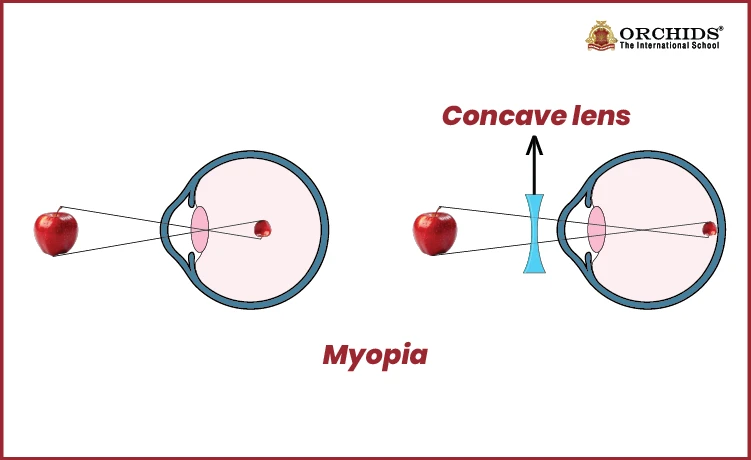
A concave lens spreads out the light rays before they enter the eye, so the image forms directly on the retina. This correction allows people a clear vision for distant objects.
- Concave lenses play an important role in Laser Systems by helping shape and control the laser beam. But how exactly do they control? Let's discuss,
As we know, Laser beams are highly focused and need to be diverged or spread out for different applications. For that, small concave lenses are used to widen or adjust the beam precisely. They are used in scanners, laser cutting machines, and medical devices.
- Concave lenses improve image quality and clarity in Cameras. A convex lens alone can create distortions or colour fringes, which are also known as chromatic aberrations. So, how is this corrected?
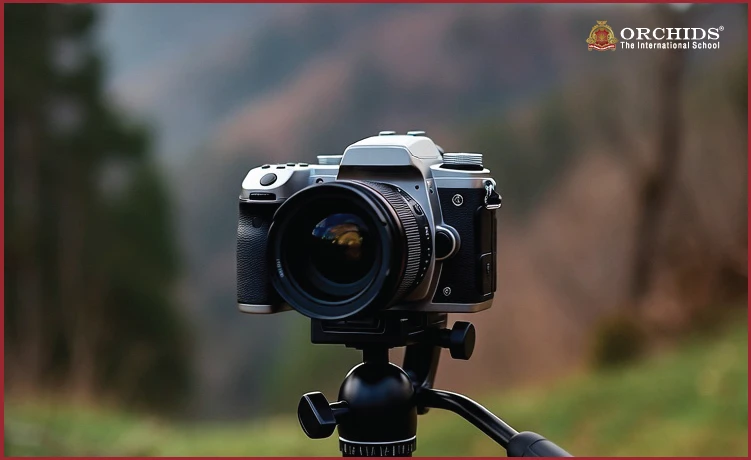
To correct this, camera manufacturers combine concave and convex lenses. The concave lens helps counteract distortion and produces sharper, more natural images.
- Concave lenses are also used in Flashlights to control and expand the light beam. Let's see how a concave lens controls the light beam in flashlights.

The light source inside a flashlight shines on the concave lens. The lens diverges the light rays, spreading them over a wider area. This increases the beam radius and provides broader illumination.
- Concave lenses are very important in Peepholes or Door Viewers, which are security devices that allow a person to see outside without opening the door.

The concave lens minimises and spreads the image, providing a wide-angle view. This helps users see a panoramic image of what is outside, even through a small opening. Interesting!
- Concave lenses are used in various optical instruments such as Binoculars, Microscopes, and Telescopes. They help control and refine light paths in these systems.
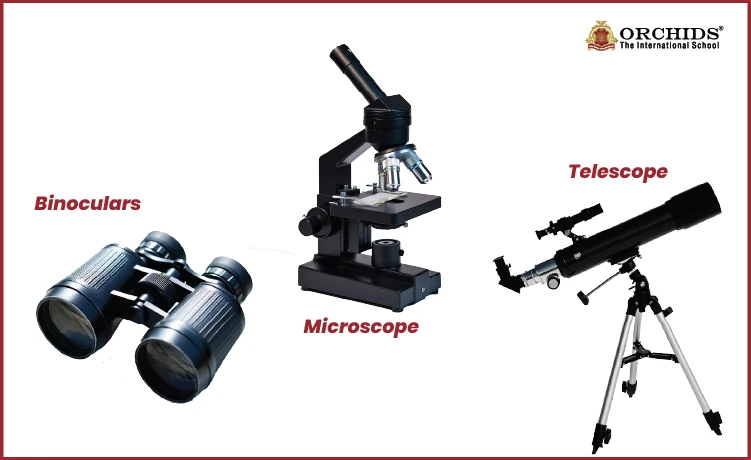
As we know, Concave lenses reduce aberrations, adjust focus, and improve image precision. In telescopes, they work with convex lenses to form clear images of distant celestial objects.
- A Concave Lens is highly used in physics experiments. In educational and research laboratories, concave lenses are widely used for studying the optical behaviour of light. They clearly show how light refracts and diverges. Students use them in experiments on refraction, dispersion, and image formation.
And it’s interesting to note, Concave lenses also help to verify optical laws and create experimental setups for studying the behaviour of light.
In this article, so far, you have learnt that concave lenses may look simple, but they play a major role in devices we use every day. Their ability to spread out light rays makes them valuable in optics, from projectors to spectacles. Understanding their applications helps us appreciate how important lenses are in creating clear images and enhancing the visual experience.
Frequently Asked Questions on Uses of a Concave Lens
1. What is the main purpose of a concave lens?
A concave lens spreads out light rays that pass through it, forming smaller, upright, and virtual images.
2. How does a concave lens help people who are nearsighted (myopic)?
It diverges light before it enters the eye, helping focus distant images properly on the retina for clearer vision.
3. In what everyday optical devices might you find a concave lens?
They’re used in eyeglasses, peepholes, cameras, and flashlights to control and spread light effectively.
4. Can a concave lens produce a real image?
No, it always forms a virtual and upright image that appears on the same side as the object.
5. How are concave lenses used in science and technology?
They’re used in lasers, telescopes, and binoculars to expand light beams and correct optical distortions.
6. Why is a concave lens thinner in the centre and thicker at the edges?
Its shape causes light rays to bend outward or diverge. This is what gives the concave lens its unique ability to spread light.
7. What are 5 uses of a concave lens?
Concave lenses are used in eyeglasses to correct myopia, in flashlights to spread light, in lasers to control beams, in door viewers for wide views, and in optical instruments like telescopes and binoculars.
8. What type of image is made by a concave lens?
A concave lens always forms a virtual, erect, and diminished image.
Science isn't just a subject, it's the way of seeing the world. Curious how Orchids The International School teaches it that way? Talk to our admissions team.
Admissions Open for 2026-27
What type of concept pages would you prefer?
CBSE Schools In Popular Cities
- CBSE Schools in Bangalore
- CBSE Schools in Mumbai
- CBSE Schools in Pune
- CBSE Schools in Hyderabad
- CBSE Schools in Chennai
- CBSE Schools in Gurgaon
- CBSE Schools in Kolkata
- CBSE Schools in Indore
- CBSE Schools in Sonipat
- CBSE Schools in Delhi
- CBSE Schools in Rohtak
- CBSE Schools in Bhopal
- CBSE Schools in Aurangabad
- CBSE Schools in Jabalpur
- CBSE Schools in Jaipur
- CBSE Schools in Jodhpur
- CBSE Schools in Nagpur
- CBSE Schools in Ahmednagar
- CBSE School In Tumkur











Orchids The International School is one of India's leading chains of CBSE and ICSE schools, with 110+ schools across the country.