

periscope
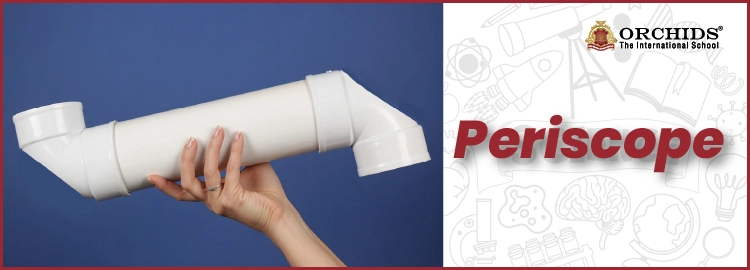
Periscope is one of the most important optical instruments that is used by scientists and sailors. Optical instruments are tools that use and manipulate light to help us see objects more clearly. Whether it is a simple magnifying glass or a more complex device like a telescope or periscope, these instruments make distant or hidden objects easier to observe by enhancing the image that reaches our eyes. A periscope is technically a reflecting optical telescope. This article completely focuses on Periscope, understanding its working, and how we can make it at home.
Table of Contents
- What is Periscope?
- How is Periscope used in Real Life?
- Periscope Science Project
- Real-life uses of Periscope
- Frequently Asked Questions on periscope

What is Periscope?
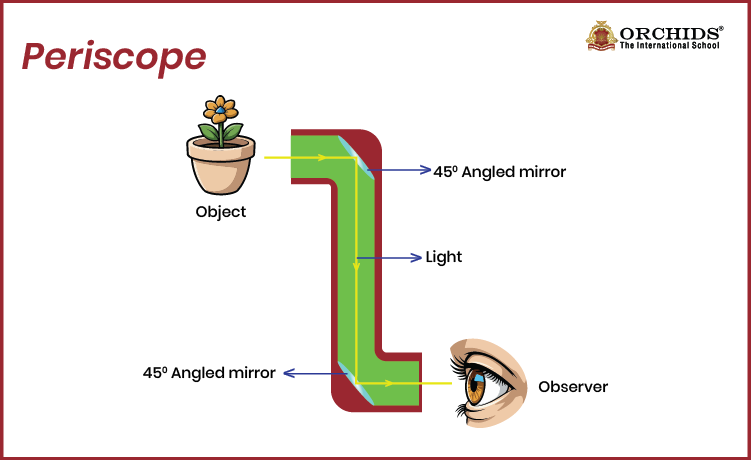
A periscope is an optical instrument that helps you see things that are normally hidden from your direct view. A periscope is a long outer case with two mirrors set at 45° near each end, allowing someone to see over or around an obstacle.
Did you know who invented the periscope? It was invented by Jules Carpentier, a French engineer and inventor. His design became important, especially during World War II, when periscopes were widely used in submarines, tanks, and armored vehicles for safe observation. Have you ever wondered how someone inside a submarine can see what’s happening above the water without coming out? 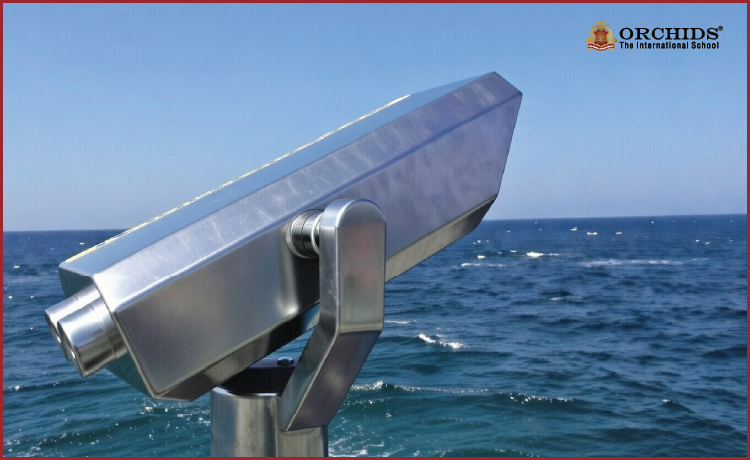
That’s exactly where a periscope comes into the picture. It is technically a reflecting optical telescope, meaning it uses mirrors to redirect light so you can look over, under, or around obstacles such as walls, buildings, or even a crowd of people. The name periscope comes from the Greek:
- peri: meaning around
- skopos: meaning to look
So a periscope literally means “to look around.” Interesting, right?
How is Periscope used in Real Life?
Have you ever wondered how a periscope lets you see over walls or obstacles? It all comes down to the principle of the laws of reflection of light. When light from an object hits the periscope, it bounces off the mirrors inside, making the object visible to the person looking through it.
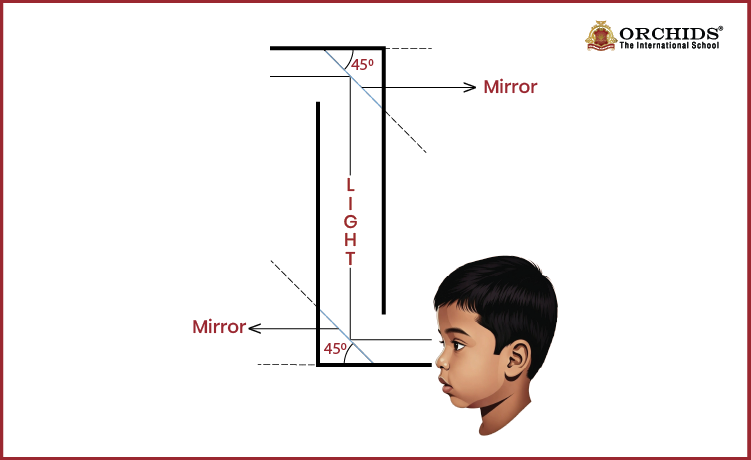
In a simple periscope:
- Two mirrors are placed at 45° angles at the top and bottom of the tube.
- Light from the object hits the top mirror, reflects down to the bottom mirror, and then travels to your eyes.
Do you know that some advanced periscopes use prisms instead of mirrors, which improves clarity and reduces image distortion? It is very important to note that a periscope does not magnify objects; it simply redirects light to let you see things that are otherwise hidden. Also, traditional periscopes do not provide crosshairs or targeting lines; they are purely observational tools.
Periscope Science Project
Before we start this simple project, it is very important to know what we are trying to learn from it. This project will help students understand how mirrors and light work together to let us see things that are not directly in front of us.
Objective:
The main goal of this experiment is to learn how to make a simple periscope and understand how it can be used to see over obstacles, around corners, or even across a pool.
Required Materials:
- 2 circular mirrors
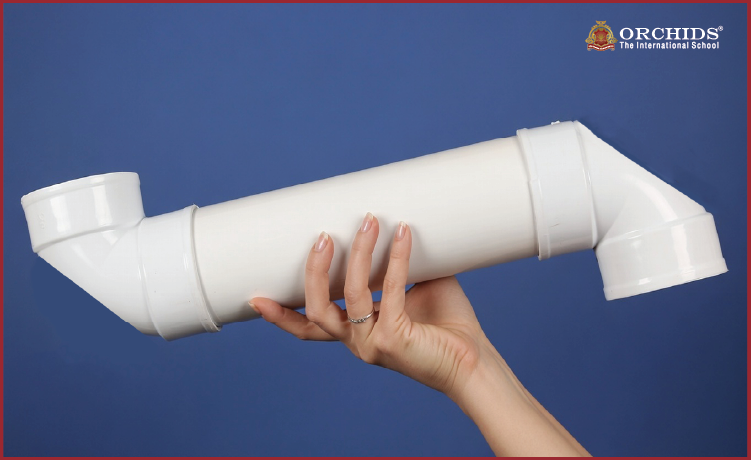
- 2 PVC pipes, 12 inches long, with one slightly wider than the other so they can slide together easily
- 2 PVC elbow joints: one for the smaller pipe and one for the larger pipe
- Putty
Diagram:
Procedure:
- By using putty on the back side of the mirror inside each PVC pipe at a 45° angle.
Here, you may wonder, why 45°?
Because this angle allows light to reflect perfectly from one mirror to the other and then into your eyes.
But what if the angle were slightly bigger or smaller?
The light would no longer follow the correct path, and the image might become distorted, or you might not see anything at all.
- Next, connect the inner surfaces with the mirrors to the corresponding pipes.
- Then slide the larger pipe over the smaller pipe so that they can move smoothly up and down.
- Now, attach the PVC elbow joint to the smaller pipe to create the eyepiece.
- Paint or add patterns to your periscope to help camouflage it while using it.
- Look through the eyepiece and observe objects over walls, around corners, or across water. You can also slide the larger pipe to adjust the length of the periscope for better visibility.
Observation:
And there you have it, your own working periscope! Now you can see hidden objects safely, just like in submarines and observation posts.
Real-Life Uses of Periscope
A periscope does much more than simply help you look over an obstacle. Let’s discuss in detail where and how it is used.
- Periscopes are essential tools in submarines. They help sailors see above the water, estimate the distance of targets, and decide the right moment to launch torpedoes.
- In atomic reactors, periscopes allow scientists to observe chemical and nuclear reactions safely without being exposed to radiation.
- War tanks and armed vehicles rely on periscopes to inspect their surroundings, spot threats, and navigate safely during missions.
- Soldiers often use periscopes to monitor enemy movements while staying hidden.
- Some delicate medical instruments are based on the periscope principle. They allow doctors to see inside the body with minimal invasion, making certain procedures safer and easier.
- Periscopes are also useful for exploring areas without revealing your presence, which is why they are widely used during military operations and surveillance activities.
In this article, we discussed that a periscope is a simple yet powerful optical device that lets us see beyond our normal line of sight using the principle of reflection. From submarines and tanks to scientific and medical applications, its uses are wide-ranging and valuable. By making your own periscope, you can clearly understand how light travels and how this clever instrument helps us view hidden objects with ease.
Frequently Asked Questions on periscope
1. What is used to make a periscope?
A simple periscope is made using two plane mirrors, a long tube, and angled holders to fix the mirrors at 45°. These basic materials help redirect light so you can see over or around obstacles.
2. Who invented the periscope?
The modern submarine periscope was invented by Jules Carpentier, a French engineer whose design became crucial during naval operations in World War II.
3. Which mirror is used in a periscope?
A periscope uses plane mirrors, placed at 45° angles inside the tube. These mirrors reflect light from one end to the other, allowing the viewer to see hidden objects.
4. What are the uses of a periscope?
The uses of periscope include observing from submarines, tanks, and bunkers, studying reactions in nuclear labs, and exploring places without revealing one’s presence. It helps users see beyond their direct line of sight.
5. What is Periscope?
A periscope is an optical instrument designed to help you see over, under, or around obstacles by reflecting light through mirrors or prisms. It is commonly used in submarines and military observation posts.
6. How does light travel in a periscope?
Light enters the periscope, hits the first mirror at 45°, reflects to the second mirror, and finally reaches your eyes. This zig-zag path allows you to see objects that are normally hidden.
7. What is the periscope meaning in simple words?
Periscope meaning: it is a device that lets you “look around” using mirrors to bend light. In simple terms, it helps you see things without being directly in front of them.
8. What is a periscope diagram used for?
A periscope diagram is used to show the placement of mirrors at 45° and the path of light inside the tube. It visually explains how the periscope works using the law of reflection.
Science isn't just a subject, it's the way of seeing the world. Curious how Orchids The International School teaches it that way? Talk to our admissions team.
Admissions Open for 2026-27
What type of concept pages would you prefer?
CBSE Schools In Popular Cities
- CBSE Schools in Bangalore
- CBSE Schools in Mumbai
- CBSE Schools in Pune
- CBSE Schools in Hyderabad
- CBSE Schools in Chennai
- CBSE Schools in Gurgaon
- CBSE Schools in Kolkata
- CBSE Schools in Indore
- CBSE Schools in Sonipat
- CBSE Schools in Delhi
- CBSE Schools in Rohtak
- CBSE Schools in Bhopal
- CBSE Schools in Aurangabad
- CBSE Schools in Jabalpur
- CBSE Schools in Jaipur
- CBSE Schools in Jodhpur
- CBSE Schools in Nagpur
- CBSE Schools in Ahmednagar
- CBSE School In Tumkur











Orchids The International School is one of India's leading chains of CBSE and ICSE schools, with 110+ schools across the country.