

Cloud Formation
Cloud formation begins when warm, moist air rises, cools, and condenses into tiny water droplets or ice crystals, eventually creating the clouds we see in the sky. Have you ever looked up at the sky and wondered how those fluffy white shapes or dark rain clouds appear out of nowhere? Clouds may look light and magical, but there is real science behind them.
This article is a perfect guide for a cloud formation experiment, which also helps in understanding the cloud formation process, and even anyone can try a fun experiment to create a cloud at home.
Table of Contents
- What are Clouds and How Do They Form?
- Cloud Formation Experiment
- Frequently Asked Questions on Cloud Formation

What are Clouds and How Do They Form?
Clouds are collections of tiny water droplets or ice crystals that float high in our atmosphere. They form when warm air rises, cools down, and the water vapour it carries turns into minuscule droplets by clinging to particles such as dust, pollen, or salt.
Simply, we can say,
|
“A cloud is a large group of tiny water drops or ice crystals that float in the air high in the atmosphere.” |

An interesting fact about clouds is that each droplet is incredibly light, but when millions of them gather together, they create the fluffy, white or grey shapes we recognise as clouds.
But have you ever thought about how clouds are formed?
The cloud formation process starts when tiny drops of water or ice crystals come together in the sky. The air around us always has some invisible water vapour in it.
Interestingly! When the air cools down, this water vapour changes into small water droplets.
And the fact is, when the air becomes full, or saturated, these droplets start to collect around dust or smoke particles. Interestingly, as more and more droplets gather, they form the clouds we see in the sky.
Now that we understand how clouds form naturally in the sky, right?
But do know, we can try creating a cloud ourselves with the help of a simple experiment at home. Interesting! Let's see,
Cloud Formation Experiment
Before we start the experiment, it is important to know what we are trying to learn from it. This Experiment will help students to see how clouds form in nature by recreating the same conditions on a small scale.
Objective
The main goal of the cloud formation experiment is to show how clouds form by demonstrating condensation, air pressure, and temperature changes. Using simple household materials, we can demonstrate the basic conditions that create clouds in the atmosphere.
Required Materials
- Droppers or pipettes
- Blue food colouring
- A clear jar with a lid
- Shaving cream
- A container of water
Diagram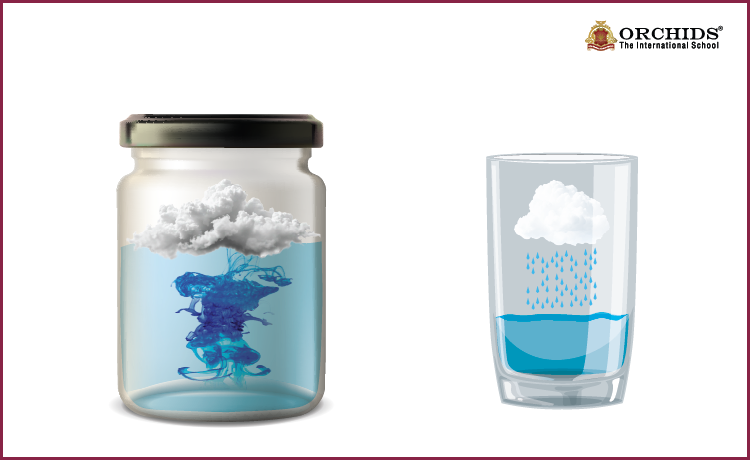
Procedure
- Fill a small jar or cup about three-fourths full with water.
- Add a layer of shaving cream on top of the water and let it settle completely.
- In a separate glass, mix a few drops of blue food colouring with some water.
- Now, use a dropper to carefully add the coloured water on top of the shaving cream.
- Now observe the transformation.
- Watch as the “cloud” becomes heavy with water and eventually lets the colour “rain” through the shaving cream layer into the water below.
Observation
If you observe it, you will see the formation of a cloud in the jar clearly. When the cloud becomes full of water, it begins to “rain,” just like real clouds in the sky. Interesting!
Let’s break down the physics behind this experiment to understand how everything is working behind the picture.
You will be amazed after knowing that clouds are made of condensed water vapour and show visible signs of atmospheric processes. They help regulate the energy balance of Earth by absorbing infrared radiation and reflecting sunlight.
And clouds also move excess energy from the equator toward the poles and return water to oceans and land, playing a crucial role in the planet’s water cycle.
So far, we have learned that cloud formation is a natural process that plays a crucial role in our weather and the water cycle. By trying the cloud formation experiment, students can clearly observe how water vapour turns into droplets and creates a mini “cloud” right at home.
Frequently Asked Questions on Cloud Formation
1. What is Cloud Formation?
Cloud formation is the process in which warm, moist air rises, cools, and the water vapour condenses into tiny droplets. These droplets come together to form clouds in the sky.
2. How can we explain the formation of clouds in simple words?
To explain the formation of clouds easily, think of warm air rising and cooling until water vapour turns into small drops. When these drops gather around dust or smoke, a cloud forms.
3. What is the cloud formation process?
The cloud formation process begins when water vapour cools down and changes into tiny droplets. These droplets then group and form visible clouds.
4. What is the formation of clouds in the atmosphere?
The formation of clouds happens when moist air becomes saturated, and water vapour condenses into droplets. These droplets cling to small particles and float as clouds.
5. What does a cloud formation diagram show?
A cloud formation diagram shows how warm air rises, cools, and forms droplets that create clouds. It visually explains each step involved in making a cloud.
6. What is the lifespan of a cloud?
A cloud’s lifespan can range from a few minutes to several hours, depending on weather conditions. Some large clouds may even last for days.
7. Is it cold inside a cloud?
Yes, it is usually cold inside a cloud because clouds form high in the sky where temperatures are lower. That’s why the droplets or ice crystals stay suspended.
8. Do clouds absorb sunlight?
Clouds can absorb some sunlight but mostly reflect it into space. This is why cloudy days often feel cooler.
9. Why are clouds important in the cloud formation process?
Clouds help regulate temperature of Earth by reflecting sunlight and trapping heat. They also return water to the surface as rain, completing the water cycle.
10. How does the formation of clouds help the water cycle?
The formation of clouds is a key step in the water cycle because clouds store condensed water. When they become heavy, they release this water as rain.
Science isn't just a subject, it's the way of seeing the world. Curious how Orchids The International School teaches it that way? Talk to our admissions team.
Admissions Open for 2026-27
What type of concept pages would you prefer?
CBSE Schools In Popular Cities
- CBSE Schools in Bangalore
- CBSE Schools in Mumbai
- CBSE Schools in Pune
- CBSE Schools in Hyderabad
- CBSE Schools in Chennai
- CBSE Schools in Gurgaon
- CBSE Schools in Kolkata
- CBSE Schools in Indore
- CBSE Schools in Sonipat
- CBSE Schools in Delhi
- CBSE Schools in Rohtak
- CBSE Schools in Bhopal
- CBSE Schools in Aurangabad
- CBSE Schools in Jabalpur
- CBSE Schools in Jaipur
- CBSE Schools in Jodhpur
- CBSE Schools in Nagpur
- CBSE Schools in Ahmednagar
- CBSE School In Tumkur











Orchids The International School is one of India's leading chains of CBSE and ICSE schools, with 110+ schools across the country.